Here’s what I tell people when they confess that they are intimidated by boiling water bath canning. If you can make pasta, you can handle a boiling water bath canner. And truly, it’s no harder or more complicated that than! Read through this post for a step-by-step introduction to processing high acid preserves in a water bath.

So, a little disclaimer to start out with. I’m going to detail my particular canning workflow. This might not be exactly how you do it in your kitchen and that’s okay. We all find ways to make it work with the tools, equipment and space that we have. In the end, the most important things are that you get your jars hot, that you fill them with a freshly made, hot product to the proper headspace, you use new lids, and that you process them for the amount of time prescribed by your recipe. There’s a good deal of flexibility in the rest of the details.
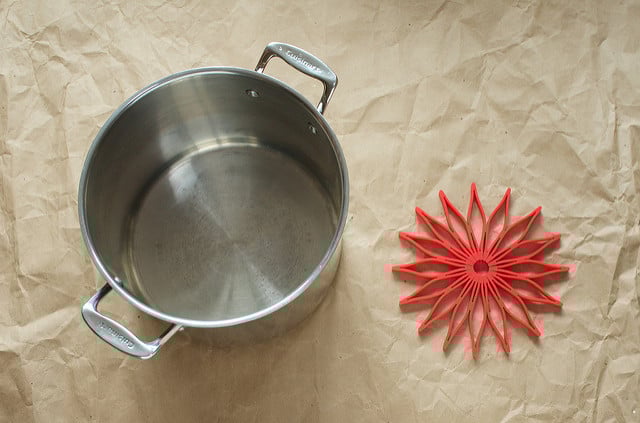
As I mentioned in the first post in this series, any pot can be your canning pot as long as it’s tall enough to hold a rack and your jars, and that it allows the jars to be fully submerged in the water. I like this one (thought it’s best for pints and smaller, it’s a little too short for quarts) but the best pot to use is the one already in your kitchen. If you don’t already have a pot that’s large enough to serve as a canner, I recommend opting for a durable stainless steel pot rather than a traditional enamel canner, as it will be more durable and versatile.
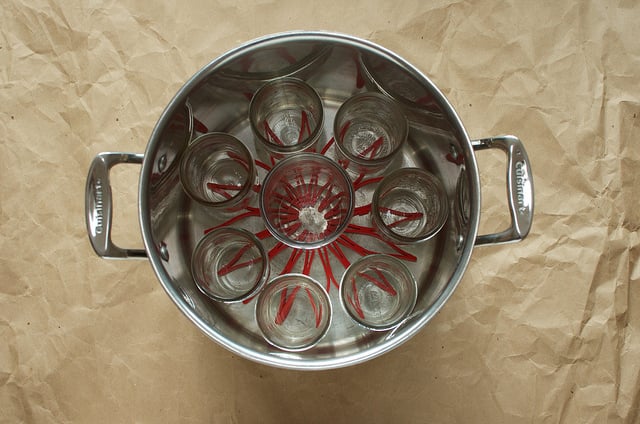
Once you’ve picked out your pot, position a rack in the bottom. I have a silicone trivet pictured here, but any round rack, or collection of old canning jar rings. Once you have a rack in your pot, place the jars you’re using on top.
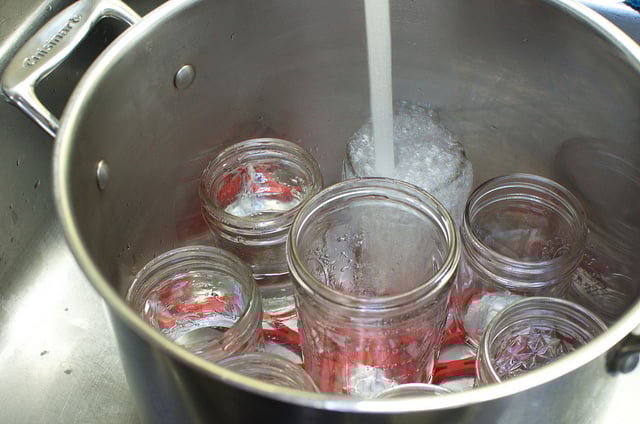
Then, fill up the jars and pot with water. I like to use the hottest tap water available, as it speeds up the boiling process a bit to start.

It’s a little hard to see in this picture, but at this point, I only fill the pot enough to just barely cover the tallest jar I’m using. This should be more than enough water for the processing stage, because the jars are currently empty.
Once you remove the hot jars, fill them with your product, close them, and lower those filled jars in the pot, they will displace enough water that they will be sufficiently covered. Sometimes, you’ll even need to remove a little water from the pot to prevent overflow. If this becomes necessary, use something heatproof, like a Pyrex measuring cup so that you don’t burn yourself.

It is always a good idea to pour a generous glug of white vinegar into your canning pot before you start heating it. This will prevent any minerals present in your water from depositing on your canning pot or jars. I don’t live in a place with particularly hard water, but I still do this because it keeps my pot in good shape and makes it easier to clean. If you’re someone who likes more precise measurements, use between 1/4 and 1/2 cup.
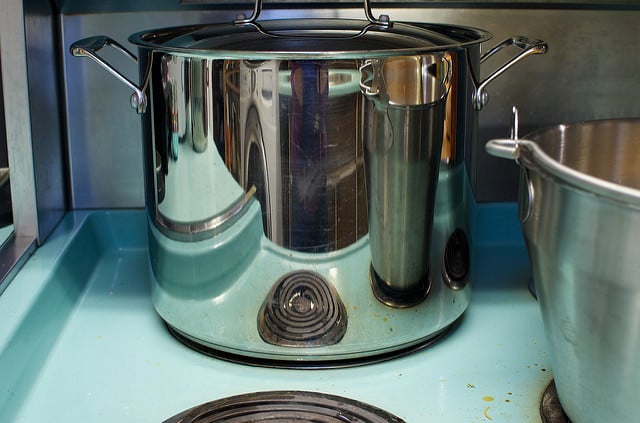
Now the pot is ready to go on the stove an come to a boil. I do all of this before I ever apply heat to my preserves. That way, the canning pot has a head start on my product and the jars will be nice and hot when I’m ready to use them.
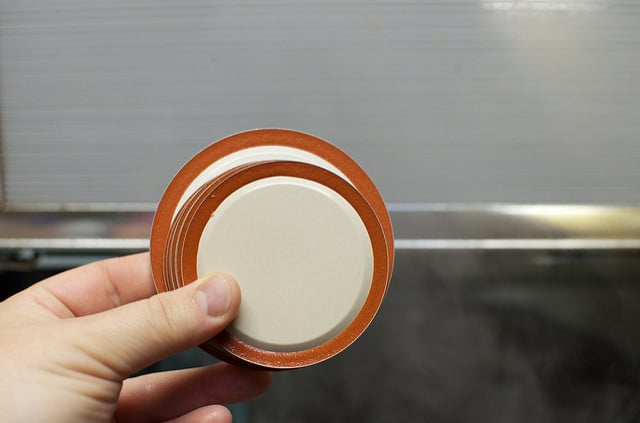
A note about lids
It used to be that you’d need an additional small pot running next to your canner, in which to warm your new lids before using. Back in 2014, Ball Canning announced that it’s no longer necessary to simmer lids prior to canning, as the plastisol sealant doesn’t require softening. Instead, they just need to be washed in warm, soapy water before applying them to filled jars. This change applies to all Ball, Kerr, Golden Harvest, and Bernardin lids. More information about this can be found here.
If you are using lids from a different manufacturer, make sure to read through the package instructions to determine whether or not they need to be warmed before use.

When the product is ready to go into the jars, I slide the canning pot off the heat and pull out the jars with a handy jar lifter. Just a note: These jars are hot, but not sterilized, because I turn the heat down to a simmer as soon as the pot boils. Jars do not need to be sterilized prior to filling if your processing step is ten minutes or longer.
However, if your recipe calls for a processing time that is shorter than ten minutes (very few modern recipes use this shorter processing time), you need to actively boil your jars for at least ten minutes before filled, to ensure you have sterilized jars.

Now you fill up your jars, leaving the amount of headspace required by your recipe. If the recipe doesn’t tell you how much headspace to leave, use 1/2 inch.

Before applying the lids and rings, wipe the rims with a damp paper towel or clean kitchen cloth. I use the hot water from the canning pot as my dampening water, as the heat helps remove any stubborn sticky spots. If your product is super sticky, a little white vinegar on the cleaning cloth will help.
Then, center a lid on each jar and secure it with a ring. Tighten the ring just until it meets resistance. The term for this level of tightening is called “finger tip tight” meaning that you only tighten as much as you can with the tips of your fingers. This allows the oxygen to vent, which is what produces the airtight seal once the jars cool.
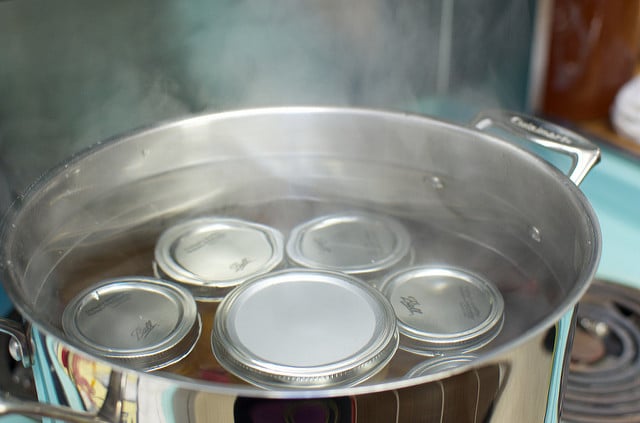
Once all the jars have lids and rings, lower them into your canning pot. Make sure the jars are fully submerged and are covered with about an inch of water (you need that much to ensure that they won’t become exposed during boiling). Turn the burner to high. When the pot returns to a boil, set a a timer to the prescribed amount of processing time.
You do want to maintain an active boil throughout the processing of the jars, but make sure you control your boil. If the pot is madly rolling, the chances that you will burn yourself increase. Turn it down a little, to minimize splashing and injury. I like to use one of these spill stopper lids on my canning pot rather than the original lid, as it also helps manage the mess of the boil.
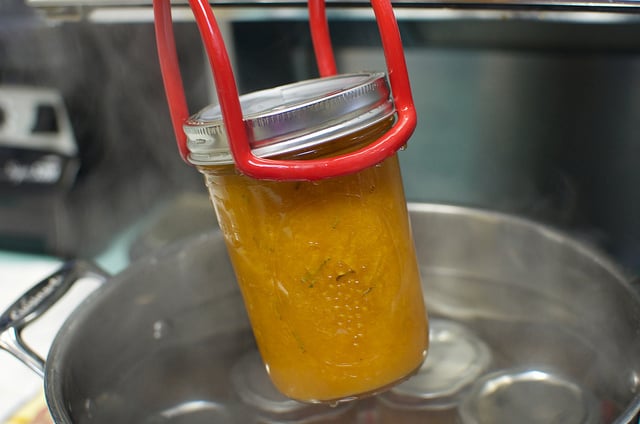
When time is up, turn off the heat. Remove the lid and let the jars stand in the water for five minutes. This allows them to cool more gradually and prevents the product loss that sometimes occurs if you take the jars out too quickly. It can also improve the quality of the seal.
Once that rest period is over, lift your jars out of the pot and place them on a folded kitchen towel or wooden cutting board to cool. You don’t want to set them onto surfaces made from stone, metal or tile, as their cooler temperatures can cause the jars to break.

Once the jars are out of the canner, leave them alone and let them cool. Best practice is to leave them alone for a full 24 hours, but if you can’t manage that, try to wait until they are completely cool to the touch. As the jars cool, you should hear the lids making a series of popping and pinging sounds.
These noises are indications that the jars are sealing as they should. However, don’t freak out if you don’t hear those noises. Jars sometimes seal slowly and quietly. Once the jars are completely cool, remove the rings and test the seals by holding onto the edges of the lids and lifting up an inch or two. If the lids hold fast, the seals are good.
Sealed jars should be stored in a cool, dark place without the rings. If the jars are at all sticky after processing, make sure to wash them before you put them away. Any sticky residue can attracts ants and other pests, so make sure your jars are squeaky clean.

If a jar doesn’t seal within an hour of processing, can I try to boil again and see if it seals? Would that be safe?
You’d need to remove the lid, wipe the rim, apply a new lid (in case the issue lies with the sealing compound), start the jar in cool water, bring everything slowly up to a boil, and then start the processing time once you return to a rolling boil. It works best with jams and sauces. Pickles don’t reprocess well.
I’m canning tomato sauce which I made from my garden tomatoes. I noticed at the end of your instructions that you don’t need to have rings around the jars to store them. So, no rings at all, ever? What will happen if I screw
The lids on?
It’s recommended that you store the jars without rings because they can mask a bad seal if something goes wrong. You can always put the rings back on for travel or gifting.
my bottles were just barely covered with boiling water but i boiled them for over 45 minutes and they sealed will they be ok? it was tomato sauce and i added 2 table spoons of lemon juice in the bottom of each litre jar
As long as they were barely covered for the duration of the canning process. If they boiled to the point of exposure during the canning process, there is a higher chance of spoilage. However, they will probably be okay.
Is a canning rack a must? I read you mentioned that a collection of old canning jar rings would work too.
What’s the purpose of a canning rack? Thanks!
A canning rack is definitely a must because it allows the water to circulate around the jars and offers optimum heat penetration into the product, which in turn makes for the best outcome. However, you can DIY it with jar rings. I have also used a round cake cooling rack to good effect. You just want something under the jars so that you can elevate them off the bottom of the pot.
Not sure about seal on my raspberry jam jars. Out of 5 jars, only had heard 2 soft pops. After they cooled, I unscrewed the rings and held each jar by the lid with 2 fingers, about an inch off the cupboard. None of the lids came off or unsealed. Is my jam OK, or do I have to reprocess?
Your jam is fine. You don’t need to hear the jars pop to get a good seal.
Hi, my name is Judy, I just got done making the pickle relish three out of seven of my jars sealed, but the others didn’t do. I need to open all the jars that didn’t seal reheat the contents and do a boil bath on them again thanks.
That is very frustrating! Here’s a post on the topic of jar seal failure! https://foodinjars.com/blog/my-jars-didnt-seal-what-happened/
Is this canning jars recipe good for pickled beans
Here’s my recipe for pickled beans. https://foodinjars.com/recipe/dilly-beans/
Never use hot water from the tap for anything you’re going to eat! It’s seriously dangerous. https://www.epa.gov/lead/why-cant-i-use-hot-water-tap-drinking-cooking-or-making-baby-formula
It’s not just lead you have to worry about, all sort of metals and minerals from pipes and hot water heaters can end up dissolved in your water.
You don’t eat the canning pot water. So it’s not an issue here.
I just found your site. Thank you!! Okay, I just canned for the first time today. I’m a little worried. I only washed my jars and my lids in hot soapy water. Is this okay? Then I prepped my food to put in jars. I added my seasonings first and the veggies. I boiled vinegar and water and poured that into my jars. Then I ran out of vinegar and I had white rice vinegar and did equal parts of water to it, but I put it in the rest of the jars cold. Is this okay? After doing all of that I did the hot bath method. All the jars sealed. Do you think I’m okay this time around? Or should I throw it all out? Thank you! I love your site.
It should be okay. Jars don’t need to be piping hot when you pack them with pickles. You do ideally want the pickle brine to be hot when you pour it over the jars, though.
Hi, I am new to canning and just made some pickled garlic. I used ball 8 oz cans and added my pickling mixture to the garlic and sealed it and then boiled my garlic for 10 min. After the timer went off, I immediately took the can out and wasn’t thinking and tried to open the can right away but realized I messed up when the liquid started spurting out, I didn’t open the can all the way just turned the lid enough for liquid to bubble inside the canning jar and then spurt out.
Then I quickly tried to re-seal it and let it rest. After it cooled, I took the outer lid off and tested the top and it was sealed. I’ve been stressing about this and am worried I ruined the pickled garlic and might have to throw it out. It is currently stored in my pantry. Is it still ok to use?
Yikes. I’d probably keep that jar in the fridge.
Some of it is clear but some is not.are u supposed to take the tops after. Canning?need to tell me like a 5 year. First u boil empty jars and then boil after food is in jars. A little. Confusing. Scared they would blow up
What can u cawhat can u can . Thankusharon duke
After the jars are done in the boiling water bath process and are completely cooled, you do remove the rings that are holding the lids in place. This allows you to check the quality of your seal and give the jars a wash. You want to store the jars without the rings, as if the seal goes bad at any time, you’ll readily discover that fact.
Jars do not explode during the processing step because there is still a tiny bit of space through with the air that is trapped in the jars can escape. The don’t fully seal until they are out of the pot and are cooling down. As far as what can you can, I suggest you look through some of the recipes you see here on the site. Another good resource is the National Center for Home Food Preservation. Find them here: https://nchfp.uga.edu/
this is perfect! I wanted to start canning, but I thought it was this super labor-intensive fancy tools type of thing. BUT you made sound so doable, thank you for the instructions. I know this is an old post, but wanted you to know that it’s still a HUGE help, even in 2024!
So glad that this post found you and was helpful!
Hi Marisa, thanks so much for your very helpful site! I’m using the Quattro Stagioni jars with one piece lids to jar lime marmalade. In the past you advised me to tighten the lids a bit more before processing, which definitely helped with the sealing. (I find these lids don’t always seal well).
I just now noticed that the quattro stagioni instructions say that after processing the jars in boiling water for the required time, we should “let the jars cool in the same boiling water. Once the jars have cooled down take them out of the water by holding them from the jar body.” I usually take the jars out of the water immediately after the 10 minutes of processing, but would leaving them in the water help the sealing process at all? Thanks a lot!
do I need to throw out canned green bean s or squash that has been water bathed if the water level inside shrunk and a few of the product is now sitting above the water level, is it good still,, ?
You cannot safely can green beans or squash in a water bath unless they are pickled. If you processed them in a water bath without any kind of additional acid, discard them immediately. You are asking for botulism.
Only a few jars popped. They very tight so from your comments their safe
Tight lids are safe lids.
Just wondering If I need to dry the lids after washing them or heating them up in hot water? Thank you!
A couple drops of water are no big deal. I don’t typically dry my lids because I see that action as a way to potential introduce dirt or bacteria.
what if I boiled in the water bath too long? It is salsa and I overboiled by a half an hour. All jars did seal. Any danger?
There’s no danger, but the salsa may have an overly soft texture as a result. It’s not dangerous, just perhaps not as delicious.
I c where people do not stack there jars on top of each other in the pantry. How come?
There is a chance that stacking jars one on top of each other can put enough pressure on the lids that it can cause the seals to go bad.
Hello Marsia
I just made 22 qt pot of spaghetti sause for canning.
Now I did not remove the tomato skins or the skins of my peppers, yellow squash or my zucchini and carrots.
I think I saw somthing about were you should not use the skins of the tomatos. I immersion blender the skins and veggies all up till smooth. Should I have added more lemmon juice to each jar before I water bathed them.
I also added lots of mushrooms in my sause Is that a big no no?
? Did I do this all wrong. Im new to this canning and wished I had found you sooner.
This is not a safe product for water bath canning. All the vegetables you used are low in acid and so can potentially provide a good home for botulism to develop. This is a product that needs to either be frozen or canned in a pressure canner. Please discard all this sauce immediately.
After the jars have been processed and are sealed, do you have to wait a certain amount of time before you can open them and cook with them?
Someone told me this but they aren’t a canner and I haven’t been finding anything online about this.
Thanks for your time.
For things like pickles, it is good to give them some time in the jar so that the flavor of the vinegar and spices can be fully absorbed by the vegetables. But for things like jams, chutneys, and other condiments, they are good to use as soon as the cooking process is up.
Why do you store jars with out the rings or have I misunderstood?
The instructions for method are excellent just don’t quite understand the rings thing. Thanks
Here’s a post on that subject: https://foodinjars.com/blog/store-jars-without-rings/
I’m new to canning. I don’t own a pressure cooker, So I would like to water can everything. Can I water can lamb and if so what is the shelf life? Thank you💐
Unfortunately, only high acid foods can be safely preserved in a water bath canner. Those products are things like jams, pickles, jellies, relishes, etc. Lamb is low in acid and can only safely be preserved in a pressure canner. There is no way to do it in a water bath canner without creating a potentially deadly situation.
When lifting the jars out of the bath there is always water on top. I have read you need to lift the jars straight up and not tip them as this could interfere with the seal. But with that water sitting there I am worried some may siphon into the jars as they cool. I always seem to have a tiny bit of liquid on top of my jam after they set and am wondering if its from that water on top of the lid. My most recent recipe I used a paper towel and soaked up the water as I took them out without putting any pressure on the lid, just gently placed a corner of the paper towel on the lid to soak up most of it (but not all). Any other suggestions? and what is that small amount of fluid on top of the jam once it sets? Thanks a bunch for taking the time to answer all our questions 🙂
Great, reassuring article! Have you ever used a pasta pot with the ‘strainer’ insert used as the rack? Would that work or is there too much metal and maybe not transfer the heat to the jars correctly?
Thanks, NS
You can definitely use a pasta pot with the strainer insert. Just make sure that it is deep enough that the jars will be fully submerged in the water.
If I have more jars to seal that what my pot can handle, do I cool the water down before adding them. I’ve had so many jars crack and am trying to figure out the correct method.
The best thing to do is to only fill the number of jars that your canner can hold. Keep the rest of the product warm in the pot and then heat and fill another set of jars when the canning process for the first batch has finished. If you regularly make more than your canner an accommodate, consider getting an extra burner to run an additional canning pot.
Vented lid or not for the canning pot?
I always put a lid on my canning pot to help retain heat and keep the water at a boil.
Would this method be safe to can beans like pinto beans or black beans?
No. Beans need to be pressure canned. This can specifically deals with canning in Weck jars, but the theory is the same no matter what jar you use. https://foodinjars.com/recipe/pressure-can-dried-beans/
I’m just confused on a couple things. When you list your steps it says to remove hot jar then to fill with product, close, lower into the pot and then to place in the stove and boil. For the processing time are these the same steps or different?
The amount of time you process the filled and closed jar will depend on the recipe. Any well written canning recipe will tell you how long to process it.
Hi, I’m canning apple sauce in quarter pint and half pint jars for baby. How long do I hot water bath the quarter pints?
Same as for pints. Fifteen minutes at sea level, adjust for altitude if you live above 1,000 feet.
I did Green Tomato Relish and half of the jars did not seal. It was a recipe from my mother that was very vague. I am assuming I can put the sealed, filled jars and Submerged in water and bring to a boil. I am assuming they will seal after that, correct? So frustrating!
Did the recipe have a processing step? If not, know that modern lids are a bit thicker than they used to be and so it is hard to get a good seal without a boiling water bath process. At this point, you can put the unsealed jars in a pot of cold water and bring it all up to a boil slowly. Then process for 15 minutes.
Am I understanding this correctly I sterilize my jars in boiling water for 10 minutes then I take some out and put my pickles etc. into the jars and attach the seal and the tops then I submerge the jars into a large pot with water about an inch over top of my bottles and boil for another 10 minutes and then remove, etc.
That is correct.
Your articles are the best! I made a batch of jam and after the water bath I had them sitting in the water to “rest” for 5 minutes before removing. But I got distracted and came back in 7 minutes. I figure not a big deal, but when I pulled them out they all had sealed already. Is this common for the “button” on the lid to go down during the rest? And is that ok?
Thanks so much for all your well written articles.
Hi Marisa,
I wish I would have found you before I attempted my first canning. My main concern are the air pockets and air bubbles. When I first raw packed my mason jars with tomatoes (before the water bath) there was not an air pocket in sight or air bubbles. I packed them in tight and used the tool to get the air bubbles out and left the 1/2 inch head space. After they processed and cooled, I noticed the tomatoes rose to the top and there was liquid on bottom which I understand can be normal. When the tomatoes rose, it created some air pockets between some of the tomatoes. Is this safe? Also, there are small air bubbles in the jars. When I move my jars or shake them, the bubbles move. Is this considered active bubbles? My jars have all sealed. Thank you.
Your tomatoes sound entirely normal. Read through this post: https://foodinjars.com/blog/canning-101-tomato-float-sauce-separation-and-loss-of-liquid/
Hello Marisa,
Your site is such a lovely collection of information. Thank you for all the tips and tricks.
I have two questions.
We wash the jars with warm soapy water and boil them in a canner. We remove the jars from the water and fill them with up hot jam/jelly. The Jars would be wet from the inside right? Is this ok?
And I wanted to ask, is the process of sterilising the jars in the oven at 100 degrees C for 15 minutes also as effective?
Thank you for the kind words. It’s fine to fill the jars without drying them when you pull them out of the hot canner. Typically, they are so hot that any residual water inside the jars evaporates quickly once the jars are removed from the pot. As far as using the oven, it’s fine to put jars in the oven to keep them warm prior to filling (because you never want to put a hot product into a cold jar). But you don’t actually need to sterilize jars prior to filling if you are doing a water bath process, because that will do the job of sterilizing them.
If I’m trying to can for like 5 can I can like chicken do I fully cook it? What is the prices? I want to be able to count on that 10 stored food that I have. This is my first time and I really wanna get into it because I know we are coming into bedtime.
Canning chicken requires a pressure canner. Here’s more detail on canning chicken: https://nchfp.uga.edu/how/can_05/chicken_rabbit.html
Thank you! I’m an older sort of newbie canner who would like to can small amounts of food as I have a small family. Also, I don’t have as much oomph as I used to have either. I bought your book and plan to try the Apricot Rosemary Jam minus the rosemary as I’m looking for a simple apricot jam recipe to use. I love your book and your website.
I bought the Kuhn Rikon 4th burner pot you recommended and I can fit two 4 oz. jars in it. Could I process two 4 oz. jars and then the remaining jar (s) in a second batch? I look forward to trying your Preserving by the Pint recipes too. I’d like to try some of the Ball Canning recipes using smaller batches and your preserving method. Many thanks for your help.
Yes. Just keep the jars on or near the stove to retain as much heat as possible. And add a couple minutes to the processing time to make up for the inevitable cooling.
Hi there! Such a helpful article!! Thank you 🙏🏻
I have a question about the lids.
I’ve read a here and in other locations that you need new lids when you reprocess or when you can something else. My question is (and I hope don’t sound like a total air head!😆), do I need completely new never used lids OR new as in washed and no product on them lids?
You need new, never used lids. The sealing compound in the lids doesn’t have the ability to create a good seal more than once.
I made dill pickles but didn’t waterbath them. Can I go back now and water bath them. It’s been about 10 days since I pickled them. Will they be ok if I don’t water bath them? I boiled my vinegar, water and salt and poured in jars filled with cucumbers, jalapeños and garlic and dill
Did they form a seal? Or have them just been open on the counter all this time? You don’t want to water bath can them now because you’d need to remove the brine, reheat it and then pour it back over hot. Ideally, you’d find a place in the fridge for these jars.
I used these instructions when jarring homemade salsa this afternoon. They were very easy to follow – thank you! I look forward to going on the Ball website to find a recipe specifically for canning; I’m not sure my salsa will last long enough in this household – we love spicy food!
So glad these instructions were helpful!
I am confused, your instructions after boiling time is up is to remove lids ( I assume ring as well ) and let rest for five minutes. Not only is everything very hot but the jars are under water. How do you let them rest. Remove some of the hot water? I guess. Return the lids and ring before or after removing jars from water to cool. Do you keep rings hot before returning to jar? I guess I need gloves along with a tong!
Please let a greenhorn know.
Thanks for your understanding
JB
You’re not removing the lids of the jars. You’re removing the lid from the pot so that the jars can cool gradually. Removing the lids on the jars will undo everything you’ve done. I’m so sorry that my instructions confused you.