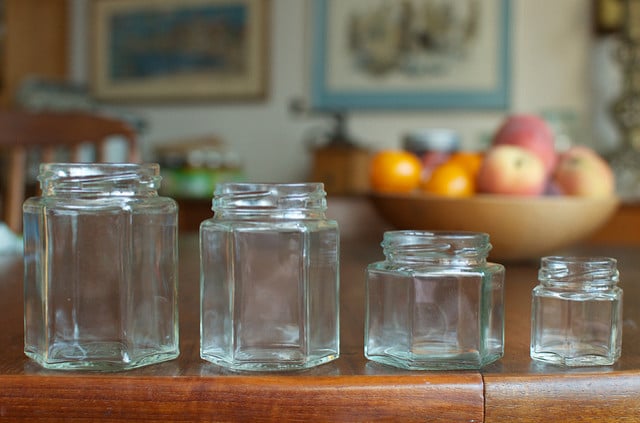
Today’s tutorial is a sponsored post from Fillmore Container. They are a jar and closure distributor based in Lancaster, PA and have long been a friend of Food in Jars. In addition to selling traditional mason jars and two-piece lids, they also offer an array of jars designed for commercial preserving, including four sizes of six-sided jars called hex jars. These are the jars we’re going to focus on today. While these jars aren’t approved by the USDA for home canning, they can be safely used in home kitchens for preserves if you know just a few things.

These are jars that should only be used with high acid preserves that need short spells in the boiling water bath canner (I try to keep the processing time to 10 minutes when using these jars). That means that I don’t use them for fruit butters or denser jams that need longer stints. They fill and process much like mason jars.
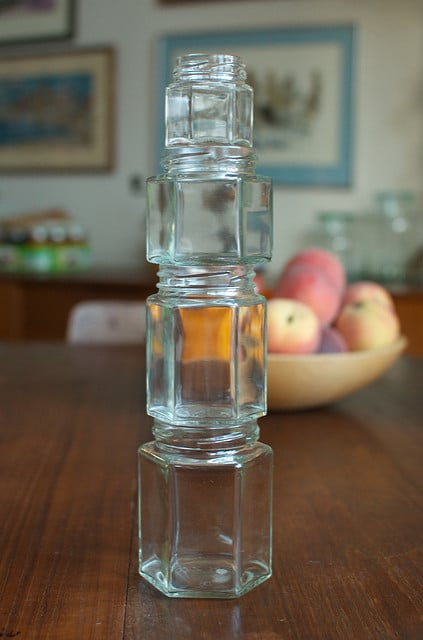
Fillmore Container sells four sizes of hex jars. There’s 1.5 ounce (perfect for samples and variety gift baskets), 4 ounces (which is the same size at the smallest quilted jelly jars that Ball makes), 6 ounces (a nice in-between size that you can’t get with a mason jar), and 9 ounces (think of it as a very generous half pint jar). Their faceted sides are smooth, which makes them perfect contenders for all sorts of label and stickers, which is a nice thing if you’re trying to create a more professional or uniform look.

Hex jars use lug lids that are lined with plastisol. The reason they’re best for shorter times in the canner is that the plastisol liner can’t take long periods of heat exposure or extreme heat. So while they’re perfectly safe for short periods of boiling water bath canning, but are a no-go for pressure canning. If you want to preserve low acid foods in jars like these, you use retort lids instead.

I prep these lug lids the same way I do regular canning jar lids, by warming them with a little simmering water for a few minutes before applying them to the jars. The most important thing to remember with these lids is that you don’t want to tighten them too tightly. A gentle quarter turn is plenty to keep them firmly in place and leaves enough space for the oxygen to escape during processing and cooling.

The mouth of these hex jars is a bit smaller than conventional mason jars which means that regular wide mouth funnels don’t work with them. The Kilner wide mouth funnel I featured last week has a slightly smaller opening and so does work with the larger of the hex jars. For the smaller ones, I ladle my product into a spouted measuring cup and use that to fill the jars. It’s not a perfect method, but it’s better than trying to spoon jam into tiny jars. Once your jars are filled, take care to bubble your jars, because those edges at the top like to trap air bubbles. A few gentle taps and a chop stick will do the job.
Once your product is in the jars and the lids are on, everything else about canning in these jars will be familiar to anyone who’s got a batch or two under their belt. The filled jars are lowered into the canning pot and processed for the amount of time called for by the recipe. When the time is up, you pull them out and let them cool on a folded kitchen towel. The lids have a button that goes concave as the jars seal, just like two-piece lids have. You know that your jars are sealed when the lids feel solid and don’t wiggle when pressed.
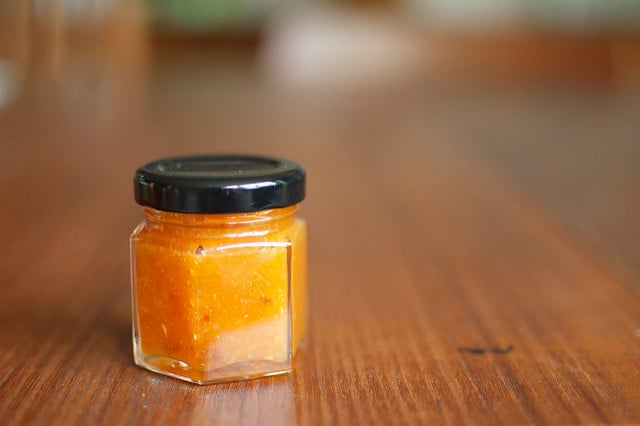
In conjunction with this tutorial, Fillmore Container is hosting a giveaway on their blog. The winner can choose from a 12 count case of hex jars or 12 sided jars and get to pick out lids to fit (they come in a bunch of colors and hues). Click here to enter their giveaway.
How would you use hex jars in your home canning?

I had issues with the lids popping off the 4oz jars like crazy. The jars are new. Do I have to tighten them most the way then? Should I invert them when I take them out? Do I tighten additionally while they’re still hot? Sorry for the questions, I am about to make some autumn olive jelly and really don’t want to wreck this stuff that’s worth it’s weight in gold lol
You do need to tighten them more than you would with mason jars. I haven’t needed to retighten them after the boiling water bath, but if you are having issues, I’d suggest reaching out to the manufacturer to see what they recommend.
Hi. I am new to the world of canning. I bought hexagon jars from Hobby Lobby because they were on sale.
Do you have to boil the water first before you add the jars to clean them and then fill them with your choice of fruits and add back to boiling water.
I suggest you read through this post. It’s got all the canning process information. https://foodinjars.com/blog/new-to-canning-start-here-boiling-water-bath-canning/
These smaller lids with 4 threads make a very firm connection when tightened by hand as far as they go. I’d use a rag and a household glove to tighten them hot. A brand new lid might need a bit more force. The lids can be reused. The plastic lining conforms to the rim, which doesn’t practically change from jar to jar. A new lid is about €0.20, which is a lot relative to the amount of food material. Boiling water will dull the paint, and probably get a microscopic amount of it in the food. I tried simmering them in a pot and got a line at the water level.
But most of these seem too small for practical use for a jam, a relatively diluted sugar. Maybe ok for spices. I’d say minimum is 250 ml (9 ounces). An ideal size is 350 ml, which bumps the lid diameter up, which is harder to seal, or you have tall jar that needs a long spoon.
I just wanted to clarify that you pull the jars out after the 10 minutes as opposed to with other jars that you leave in for five more minutes with the heat and lid off.
Leaving the jars in the water for an additional five minutes is a fairly new step in the canning process. When this post was initially written, it was not the norm. If you want to leave the jars in the pot for an additional five minutes, it won’t do any harm and might even help.
Would these be acceptable to can syrups in? I wanted to make some different syrups for cocktails and desserts, such as rose and lavender?
These would be great for syrups, provided that the syrups are properly acidified for water bath canning.
I apologize my daughter decided to type with me. What I meant to say is, can you dry can rice and pinto beans with these jars and lids? I’m having a hard time finding a solid answer regarding these jars. Thank you for your time.
I wouldn’t use these for dry canning. It can be a little harder to determine whether they’ve sealed, and since oven canning often produces a more discreet seal, these might leave you wondering whether you got a seal at all.
i am wondering how do you tell if a lug jar lid has been used and is it ok to use them again, as in sealing honey in jars. it does not require processing but a professional seal is ideal,
Typically there will be some staining or sealing compound imprintation if the lid has been used. If you want the honey to be sealed, you would still need to heat process. The lids do not produce a seal without processing.
Could I please get clarification on how tight to tighten the lid? When using regular round canning jars you tighten the lid then turn back a quarter turn. When I read the above directions I get the impression that you only tighten the lid enough that it just holds on to the ribs of the jar rather than tighten then loosen (like the round jars. Would you please clarify? Thank you!
I’m not sure where you’re getting your information that you loosen the rings a quarter turn with regular canning jars. The rule of thumb is that you tighten them with as much pressure as you can exert with the tips of your fingers.
With these lids, you want to turn them until they grasp the jar. Lug lids are very hard to overtighten, so give them a good, solid turn.
I made apple butter. I was using the hexagon jars with the lug nut tops. I left 1/4 space at the top. I put the tops on and used a wire rack and dropped them in the bath I processed them for 10 min. When I opened the cover to the pot the tops had popped off all but 4 . Why did this happen now I am afraid to use them. What could have gone wrong?
It sounds like you didn’t tighten the lids tightly enough. Lug lids require a tighter closure than two piece lids do.
Marisa my dilemma is , I boil my jams with lug lid jars in the water bath for 10 minutes .When I open the jars after couple of days, and compare the jams in the jar and some leftover jam that I didn’t put in water bath, I see that colour of my jams in the jar are much darker, not as bright and clear as the ones I didn’t water bath, They have lost their beautiful color. Have you had same problem I’m having? I wander if the jams in the jar are continue to cook in the water bathWhen they are boiling.
I always do my jams in a water bath, so I really can’t speak to a changing color. So sorry!
I’ve just started using these this year and your tips have helped. However, I’ve had an issue getting the small jars to seal. I don’t tighten the lids too much and process them like I normally do. The 8 ounce jars seal with no issues (maybe 1 out of 40 don’t seal with processing), but the 3.7 ounce jars I’m failing with. Any tips?
It could be that those smaller jars need some additional force to seal. Try inverting them once they come out of the water bath. It might help.
Can they be used for dry storage such as for rice and beans? The jars only are heated for sterilization [typically dry heat in the oven]
Yes.
Would it be safe to preserve lemon curd in these?
I find that lemon curd does better in the freezer than canned. But as long as you do the water bath process, the lemon curd has a shelf life of six months once canned.
Have you had trouble getting these jars to seal?
I haven’t, but I’ve heard from others who have. Try closing them a bit tighter before processing and inverting them for a short period of time after processing.
Would the 1.5 oz hexagon jars work well for vinegar-based BBQ sauces? We are thinking of giving out little favors of BBQ sauce (that will be provided from our wedding food vendor — they make their own sauces in-house) and putting them in those mini jars. I would imagine we will need to can/preserve them once in the jars — how long should it be boiled? Thanks!
They would work and they’d still need to be processed for 10 minutes. That is the minimum for sterilization.
One more question…you mention that plastisol lids don’t hold up in prolonged high heat—does this also mean that they are only good for one use?
All lids are only good for one time use.
Hiya. I’m brand new to canning! I made A LOT of pesto and bought little 1.5oz jars with plastisol lids from a different brand. These lids don’t have the buttons that will visually show me that I’ve sealed the jars properly. So, after I’ve removed my jars from the boiling bath and let them sit to cool, do I wait an hour or two before testing opening a few tops to see if I was successful? If I get a good “pop”, I’ve don’t it right? Is that correct?
Pesto is not safe for canning. So any pesto you’ve processed needs to be refrigerated promptly or discarded. However, for the future, the lids should be visibly concave, even without the buttons.
Thank you! Why is pesto not safe for canning?
Because it is low in acid. Botulism loves low acid environments. You seriously need to do some reading about safe canning practices.
Thank you so much for this quick tutorial. I recently bought a case of 1.5 oz jars with the lug lids, and needed to know how exactly to waterbath them. Glad to see there isn’t any difference between using them vs their 2-part canning lid counterparts.
The lug lids that i have don’t have a button. How do i know they worked if there is no pop?
They will still be concave and without any movement or wiggle.
O’K, Thank you.
How long would you water bath the 1.5 ounce jars? They’re so cute!
They spend the same amount of time in the canning pot as pints, half pints, and quarter pints.
Thanks so much for this post, Marisa! I just ordered a bunch of hex jars to make favors for my shower/wedding and then realized I hadn’t used the lug lids before. Very clear directions.