Here’s what I tell people when they confess that they are intimidated by boiling water bath canning. If you can make pasta, you can handle a boiling water bath canner. And truly, it’s no harder or more complicated that than! Read through this post for a step-by-step introduction to processing high acid preserves in a water bath.

So, a little disclaimer to start out with. I’m going to detail my particular canning workflow. This might not be exactly how you do it in your kitchen and that’s okay. We all find ways to make it work with the tools, equipment and space that we have. In the end, the most important things are that you get your jars hot, that you fill them with a freshly made, hot product to the proper headspace, you use new lids, and that you process them for the amount of time prescribed by your recipe. There’s a good deal of flexibility in the rest of the details.
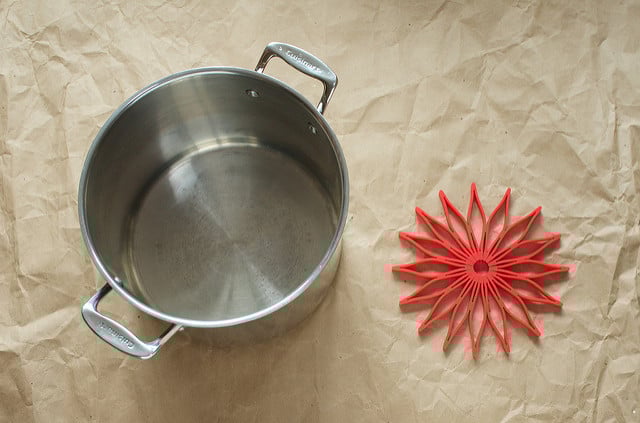
As I mentioned in the first post in this series, any pot can be your canning pot as long as it’s tall enough to hold a rack and your jars, and that it allows the jars to be fully submerged in the water. I like this one (thought it’s best for pints and smaller, it’s a little too short for quarts) but the best pot to use is the one already in your kitchen. If you don’t already have a pot that’s large enough to serve as a canner, I recommend opting for a durable stainless steel pot rather than a traditional enamel canner, as it will be more durable and versatile.
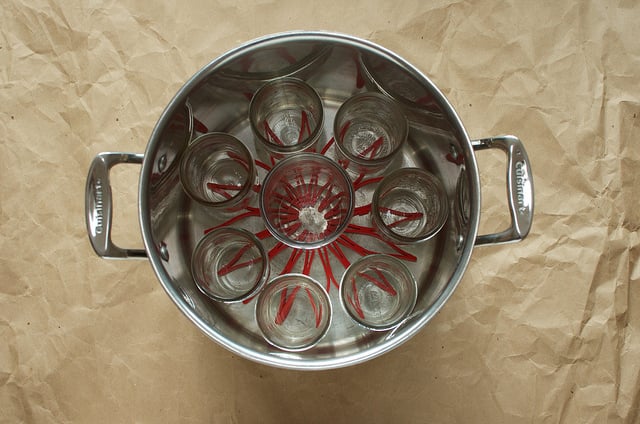
Once you’ve picked out your pot, position a rack in the bottom. I have a silicone trivet pictured here, but any round rack, or collection of old canning jar rings. Once you have a rack in your pot, place the jars you’re using on top.
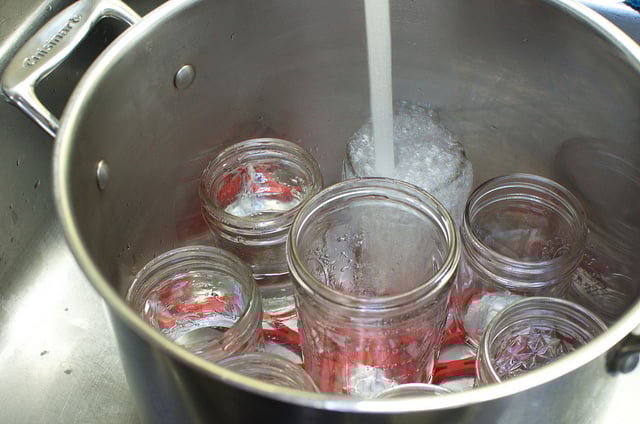
Then, fill up the jars and pot with water. I like to use the hottest tap water available, as it speeds up the boiling process a bit to start.

It’s a little hard to see in this picture, but at this point, I only fill the pot enough to just barely cover the tallest jar I’m using. This should be more than enough water for the processing stage, because the jars are currently empty.
Once you remove the hot jars, fill them with your product, close them, and lower those filled jars in the pot, they will displace enough water that they will be sufficiently covered. Sometimes, you’ll even need to remove a little water from the pot to prevent overflow. If this becomes necessary, use something heatproof, like a Pyrex measuring cup so that you don’t burn yourself.

It is always a good idea to pour a generous glug of white vinegar into your canning pot before you start heating it. This will prevent any minerals present in your water from depositing on your canning pot or jars. I don’t live in a place with particularly hard water, but I still do this because it keeps my pot in good shape and makes it easier to clean. If you’re someone who likes more precise measurements, use between 1/4 and 1/2 cup.
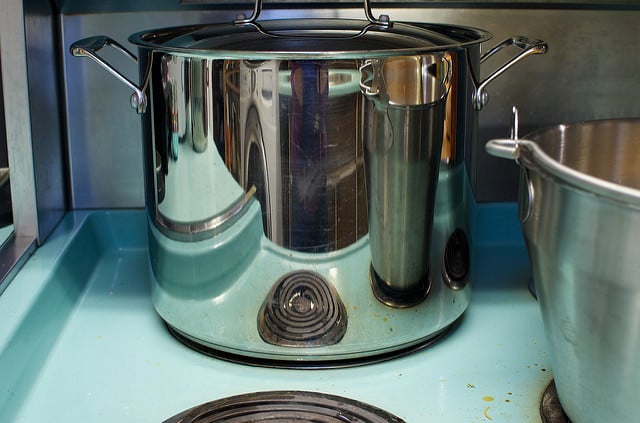
Now the pot is ready to go on the stove an come to a boil. I do all of this before I ever apply heat to my preserves. That way, the canning pot has a head start on my product and the jars will be nice and hot when I’m ready to use them.
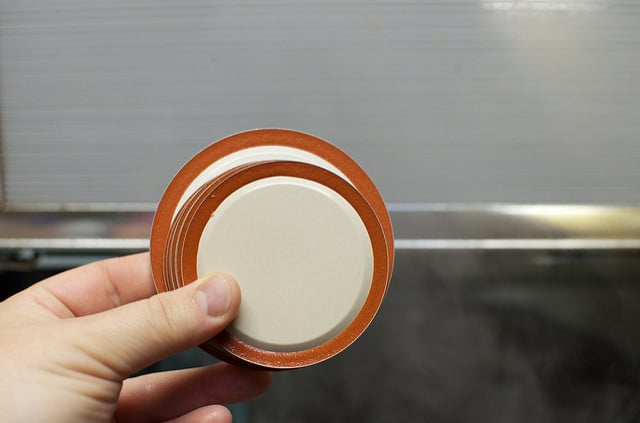
A note about lids
It used to be that you’d need an additional small pot running next to your canner, in which to warm your new lids before using. Back in 2014, Ball Canning announced that it’s no longer necessary to simmer lids prior to canning, as the plastisol sealant doesn’t require softening. Instead, they just need to be washed in warm, soapy water before applying them to filled jars. This change applies to all Ball, Kerr, Golden Harvest, and Bernardin lids. More information about this can be found here.
If you are using lids from a different manufacturer, make sure to read through the package instructions to determine whether or not they need to be warmed before use.

When the product is ready to go into the jars, I slide the canning pot off the heat and pull out the jars with a handy jar lifter. Just a note: These jars are hot, but not sterilized, because I turn the heat down to a simmer as soon as the pot boils. Jars do not need to be sterilized prior to filling if your processing step is ten minutes or longer.
However, if your recipe calls for a processing time that is shorter than ten minutes (very few modern recipes use this shorter processing time), you need to actively boil your jars for at least ten minutes before filled, to ensure you have sterilized jars.

Now you fill up your jars, leaving the amount of headspace required by your recipe. If the recipe doesn’t tell you how much headspace to leave, use 1/2 inch.

Before applying the lids and rings, wipe the rims with a damp paper towel or clean kitchen cloth. I use the hot water from the canning pot as my dampening water, as the heat helps remove any stubborn sticky spots. If your product is super sticky, a little white vinegar on the cleaning cloth will help.
Then, center a lid on each jar and secure it with a ring. Tighten the ring just until it meets resistance. The term for this level of tightening is called “finger tip tight” meaning that you only tighten as much as you can with the tips of your fingers. This allows the oxygen to vent, which is what produces the airtight seal once the jars cool.
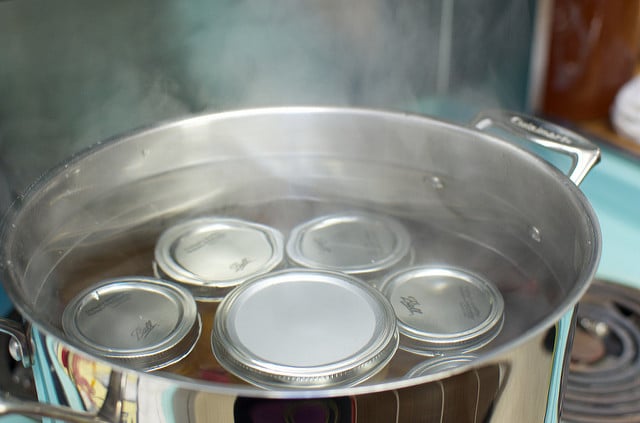
Once all the jars have lids and rings, lower them into your canning pot. Make sure the jars are fully submerged and are covered with about an inch of water (you need that much to ensure that they won’t become exposed during boiling). Turn the burner to high. When the pot returns to a boil, set a a timer to the prescribed amount of processing time.
You do want to maintain an active boil throughout the processing of the jars, but make sure you control your boil. If the pot is madly rolling, the chances that you will burn yourself increase. Turn it down a little, to minimize splashing and injury. I like to use one of these spill stopper lids on my canning pot rather than the original lid, as it also helps manage the mess of the boil.
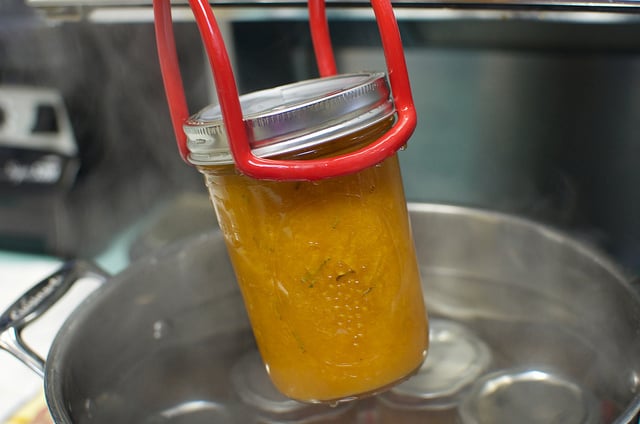
When time is up, turn off the heat. Remove the lid and let the jars stand in the water for five minutes. This allows them to cool more gradually and prevents the product loss that sometimes occurs if you take the jars out too quickly. It can also improve the quality of the seal.
Once that rest period is over, lift your jars out of the pot and place them on a folded kitchen towel or wooden cutting board to cool. You don’t want to set them onto surfaces made from stone, metal or tile, as their cooler temperatures can cause the jars to break.

Once the jars are out of the canner, leave them alone and let them cool. Best practice is to leave them alone for a full 24 hours, but if you can’t manage that, try to wait until they are completely cool to the touch. As the jars cool, you should hear the lids making a series of popping and pinging sounds.
These noises are indications that the jars are sealing as they should. However, don’t freak out if you don’t hear those noises. Jars sometimes seal slowly and quietly. Once the jars are completely cool, remove the rings and test the seals by holding onto the edges of the lids and lifting up an inch or two. If the lids hold fast, the seals are good.
Sealed jars should be stored in a cool, dark place without the rings. If the jars are at all sticky after processing, make sure to wash them before you put them away. Any sticky residue can attracts ants and other pests, so make sure your jars are squeaky clean.

Hi Marisa!
I have canned your tomato jam, one of the jars looks like there was some leakage. It was sticky around the rim. When I lift the jar by the lid, the seal is good. Is this safe to keep on the shelf?
As long as the seals are good, the jars are fine for pantry storage.
If you are not sure everything went properly can you take the peaches out of the jars and freeze them?
Is there anyway to “save ” the fruit form going bad. Guess I am just nervous that I did things proper. My jars are sealed and tight,and were processed in a water bath. Thks
If your did your water bath process properly and the jars are sealed, then they are fine.
This is a great article for us beginners!!! It all sounds so easy until you actually do it. I can’t wait to taste these fresh peaches in the middle of the winter. I live in Michigan….
Question ? I have done Hot water Bath in the past but do not remember why it is important to make sure the water in canner is 1 or 2 inches over the Jars ? We just canned 120 Qts of Tomatoes and all of them seal very nice. But I only fill the canner to the neck of the Jars with water to Boil. Mom says that they will be ok but don’t do that again, do I have any worries. ?
Because you need the heat of the water to penetrate fully and that is best done with fully submerged jars. There is a slightly higher risk of spoilage with unsubmerged jars.
Hi. I am new to making jam and wondered if I messed up. The lids were still wet on the inside when I put them on (I didn’t dry them). Sealed my jams, they jelled and look great. I removed the bands to be sure it was dry under there and you can see water drops on bottoms of lids inside jars. Will these be safe to store/eat? Thank you in advance.
They’re fine. It’s not a big deal if the lids are wet and having some condensation under the lids is entirely normal.
THANK YOU SO MUCH FOR THIS VERY PRECISE AND COMPLETELY UNDERSTANDABLE TUTORIAL!!! I can’t wait to get started! I just decided I wanted to begin canning my own preserves and such as I seem to spend a fortune on them at boutiques and craft bazaars – I looked up canning basics on pinterest and the pin for this one just jumped out at me and after reading it I need look no further! Thanks again!
Made pickles and didn’t have water covering. It was almost to the top. They did pop after coming out . Is that ok? What happens if you accidental push the top and it pops and stays?
Neither situation is ideal. The jars will probably be fine, but do have a slightly higher chance of spoilage.
I my boiling bath and boiled it for 35 minutes when I pulled thejars out of the water My Salsa had moved all the way to the top of the jar I had about an inch open space at the bottom what did I do wrong
Sometimes tomato products separate. https://foodinjars.com/2011/08/canning-101-tomato-float-sauce-separation-and-loss-of-liquid
Peaces initWhy does the water in my canner, after water bathing peaches, have the color of the peaches in it?
Because sometimes a little peach juice leaks out of the jars.
Canning is overwhelming!
If I wanted to try canning tomatoes (I’ve never canned anything in my life!), would I cook the tomatoes first so the skin comes off and then sanitize jars? And what about green beans?
Paula, it sounds like you need a recipe. This might be a good starting place for you. http://healthycanning.com/canning-crushed-tomatoes/
First time canning tomatoes today. And I’m just not quite sure I got it “right”. Should i have all my tomatoes ready to go and then start the sterilizing, etc? I ask because I was roasting my tomatoes in batches and ended up with some sterilized jars that had cooled by the time my tomatoes were ready to be put in the jar. Also, when I removed the filled jars from the water bath, some were boiling inside. Is that okay? Thank you in advance.
Both the jars and the tomatoes should be hot. Fill the hot jars with the hot tomatoes and put them into a hot (but not boiling) water bath.
As I’m reading all this great info I came across this. I just put my bottles in an already boiling water bath? Is that a big deal?
Ideally you don’t want the water at a full rolling boil, as it can lead to thermal shock and jar breakage.
I am new to canning and I was wondering a couple things. Firstly, how long do pickled beets need to be in the hot water bath (500mL jars if that matters)? Secondly, what do you do if the lids do no seal after the hot water bath?
There’s good info about canning pickled beets here: http://nchfp.uga.edu/how/can_06/pickled_beets.html
As far as seal failures go, it depends. If it’s just one jar, typically you just put that jar in the fridge and eat it up in a timely manner. If it’s a number of jars or all of them, you apply new seals and reprocess.
My jars of salsa pinged and sealed while still in the water bath, after I took the lid off and turned off the heat. Is this okay??
That’s fine. Though often that’s a sign that they’re not fully submerged in the water. And ideally they will be fully submerged.
My husband made jalapeno chili sauce while I was away, and did not put the jars through the water bath that I would normally have done. It has been about 10 days. Is it too late to now complete that step?
Thanks for any insight you can provide.
Once you ascertain that the sauce is still good, you’d need to open up the jars, reheat the sauce and can it like you normally would.
After you put the filled jars into the canner pot and bring it to a boil, do you put the lid on the pot or leave it off so you can see how it’s boiling?
You put a lid on it to keep the heat it and make it boil more efficiently.
I would like to can spaghetti sauce but I don’t have a canner.Can I use a large pot with a wet towel in the bottom or can you suggest something else.
Please go back and read this blog post. You’ll find that I expressly answer the question you’re asking within the body of the text.
I am new to water canning. I made blueberry jam, put in jars (sterilized, etc.) and put in water bath. I didn’t have anything to put at the bottom of the pot. I tried a towel but it kept floating up and tipping over the jars. So, I just took the towel out and boiled away. I added additional time for boiling and the jars “popped” and appear sealed. Why do you need a trivet or towel or something on the bottom of the pot? Is it to help keep the jars from breaking and I just got lucky? I just want to be sure that these will be safe to eat later. (I can buy a trivet for the future). Thank you.
The trivet is there to protect the jars from the direct heat of the stove, to allow water to better circulate around the jars, and to act as padding to help prevent breakage. Your jars are safe, but you got lucky.
I went by your steps. I was canning quart jars, This was my first time. I got towards the end the steps putting the completed jar in the canning pot & just with in a few seconds one of them just broke inside the canning pot, the bottom of the jar came completely off & also broke around the middle of jar, what do I do next time?
Sometimes jars just break. You might not have done anything wrong.
If you dont have a tray, towel, trivet or collection of old jars sitting on the bottom of your pot to keep your jars off the bottom or direct source of heat then your jars might break off at the bottom. Another reason could be your jar had an unseen crack or chip in it already or you used a jar not made for canning. Hope this helps.
One of my jars broke(the bottom fell out, as I was putting it into the hot water bath. I continued to process the other jars in that water which had the pickle juice in it. Will that affect the pickles in the other jars?
You might end up with finished jars that smell faintly of vinegar and spices, but beyond that, no harm is done.
We just canned pickles. all but one lid popped. What would cause this. did we make the lids to tight or could we have put to much liquid in the Jars?
You might have over tightened the jars. You might have overfilled them. There might have been something on the rim of the jar that prevented a good seal from forming. It is hard to diagnosis the reason a jar didn’t seal from far away. It happens to all of us. Just put that jar in the fridge and eat it within a month or so.
when canning pickles what is the fill line for the liquid? do you fill it completely or stop at the threading on the jar? i think we put in to much liquid because the lids popped up.
You leave about 1/2 inch of headspace, typically. And the lids will be popped up when you take the jars out of the water, but they should pop down again as the jars cool.
I am new to canning. I have started a little tomato crop in my back yard. I am wanting to can them but I am not sure how long they will need to be processed in the water bath. Any advice would be greatly appreciated. I have been told by some people that you don’t need to boil the jars, but I am not sure.
I canned salsa yesterday eve. Out of 12 pints 7 did not seal. I think it’s poss my water bath was not simmering high enough. I read to repeat the process so I put them back in a water bath this morning. Then I read further that you should unjar and start from scratch. What should I do?
Best to open up the jars, reheat the salsa, and reprocess with new lids.
Can I cook my prepared fruit and refrigerate then re-warm for canning later? Thanks!
That is not ideal. It’s better to prep the fruit, sugar it, and put it in the fridge at that point. Ideally you want to cook and can your jam on the same day for best set and consistency.
If a person wants to hwb peaches but doesn’t want the peaches really soft, would 10 minutes be long enough to hot water boil? My hubby and I do not like mushy canned peaches.
Peaches need to be canned for at least 20 minutes in a boiling water bath. All the times are listed here: http://nchfp.uga.edu/how/can_02/peach_sliced.html
I’m new to canning and I’m a little lost, after the jam is put in the jars and you place the lid and then finger tight the ring you boil the jars again, after they cooled you remove the ring and check the seal… you then say that the jars should be stored without the rings. Are you not suppose to screw the ring back on? I would like to ship my jam and I’m lost
Typically you leave the rings off for storage. If you’re shipping your jars, it’s fine to replace the rings.
Do you have to water bath jam the same day you make it or can you wait until the next day?
It is better to do it the same day as you made it because it needs to go into the jars hot. If you cool it and then heat it again for canning, you can ruin the set.
if you do cool it first because you forget to do the water bath, and you stick them in when you remember, (5 hours later) will they be ok? if they are runny after that, will they gel back again or are they ruined? thank you!
It depends, but it’s not ideal.
Please tell me how long should I can my ? jelly?
Most of the time, you process jams and jellies for 10 minutes at a full rolling boil. However, if you live above 1,000 feet in elevation, you do need to increase the amount of time that you process your jars. https://foodinjars.com/2012/02/canning-101-on-adjusting-for-altitude/
do you have to dry the jars inside and the lids before putting the jam in?
Nope. When you take them out of the water, they should be hot enough to dry pretty quicklyu.
hi, once you open the jar how much time do you have to consume it? i’m thinking of making hot chili sauce and canning it, but I don’t know how long will it hold up safely once I open a can. I imagine maybe a month if I keep it refrigerated? thank you
The open time of preserves varies depending on the recipe. But typically at least a month.
I made fig preserves for the first time last night. I added lemon juice and jalapeño. Tuwords the end of the cooking time I added more jalapeños cooked it on medium about another 10 minutes. I did not do a water bath. All the lids sealed. Should I still do a water bath and if so can I still do it or is it to late? Thank you for your help.
You should still do the water bath. You spent so much time on your fig jam it’s worth it to prevent spoilage
I am trying to send some dilly beans to my husband who is deployed in Rota Spain, will they be safe to eat after shipping?
As long as they’re processed in a water bath canner, they should be fine.
I have just this very minute put 3 quarts of pasta sauce in boiling water.
The recipe was for pints. I doubled the lemon juice. Now I’m wondering if the 25 min. hot water bath is sufficient. Any opinions?
You always add five minutes to the processing time if you increase the jar size.
Help!
My stovetop died just as I put the last jar of whole tomatoes in the hot water. Water was on the verge of boiling but didn’t get the chance to actually boil. I won’t have a way to process them until tomorrow (fingers crossed). It’s only been a few hours. Can I reprocess, do I make sauce and freeze or am I doomed to pitch 30 pounds of tomatoes?
You can make sauce and freeze!
I just made a batch of applesauce and left the recommended headspace. The jars all have a good seal but it looks like the applesauce touched the lids. As this is for our granddaughter, I need to be 100% sure the applesauce will be fine.
Has this happened to you? Any help is appreciated.
Applesauce expands sometimes. It’s still safe.
Can I reuse old jelly jars and their lids, which are all one piece lids again?
You can reuse old jars, provided that they are mason jars. Unfortunately, you cannot reuse the one-piece lids.
I’m interested in trying an instant pot for water bath canning. Have you used one before? What are your thoughts?
It’s not recommended.
just did my first canning project and downloaded my how to guide from pins , which was great , it all went well , but now im reading that i should have completely submerged my containers in boiling water to process them , i did not do this, i had the boiling water to half way up my jars . the jars seem to have sealed but are they safe ??
It’s not ideal, but the jars should be ok.
I canned some pickles and when I put them in the hot water bath after a few minutes they kind of buckled. The are sealed but the lid is not smooth .. How can I fix this ?
That buckling is an indication that you overtightened your rings and the air couldn’t escape naturally. There’s no way to fix it beyond removing the lids, applying new ones, and reprocessing. However, if the seals are good, you can just leave them as-is and use this as a lesson for next time. Only tighten the rings as tightly as is possible with the tips of your fingers.
Made pickles exactly like the recipe. It is equal parts water and vinegar, salt, sugar, dill. My question is when I did the water bath the water only came up to the neck of the jar, didn’t cover. It was in the water bath for 20 minutes but I’m wondering if they are safe since they were not completely submerged. My jars all sealed.
Thanks!
It’s not ideal, but they’ll be ok.
Any insight to canning bacon jam?
You need to use a pressure canner.
Thank you for all your helpful information. I too have a question. I live at 6,000 ft so there is quite an increase in processing time. That unfortunately is causing my fruit to turn very mushy. Any way to prevent that? Apples or plums without texture are not very appealing. Also, when can you safely start the processing timer? I have been calling the water boiling when I begin to see bubbles. If I have to wait until I see a vigorous boil, that’s even more processing time and worse mush.
In the past I experimented by adding lots of lemon juice to apples and only processing half the recommended time. Texture was great and the apples kept just fine. What am I risking with this method and how would I know if they are not safe to eat? Thanks for your help
we are new to canning. we just processed a batch of tomato salsa for 40 minutes, as per the recipe. When the time was up and the lid was lifted, we found that the water level had gone down just below the level of the jar tops, even though we had the water level about 2 inches above when we started.
Will the salsa be safe if the lids seal properly?
Yes.
We made peaches pears and applesauce and processed for the recommended time but didn’t have the jars fully immersed. The water was only about half way up. Will these products be safe to eat or is there a re-process we should be doing
It’s really not ideal. However, because these are all high acid products, if they do spoil, it will be obvious. I’d probably leave them as it and then follow proper procedures in the future.
This is my first time canning, and I am in the process of making pickles. i followed the recipe I was creating with soak times etc, filled my jars with the pickle mixture, and ran out of time to complete the processing via water bath. I put my jars, with lids finger tight, in the fridge. What steps do you recommend I take to finish processing/ sealing in a water bath?
Unfortunately, it’s not a great idea to process at this point. Jars need to be hot going into the canner.
Can I empty them reheat the jars and ingredients and refill them as I put in water bath?
Yes. But know that you’re going to lose some texture in the finished product.
Do you have to hot water bath your canned salsa if the kids sealed by themselves
Yes. You still need to do the processing step.
Is it to late after a couple of days before you hot bath them are they bad do I have to remove the lids and seal them in hot bath
I lent my canning supplies to a friend and didn’t check to see if everything was returned before starting a batch of salsa for canning. The jar lifters aren’t among the returned supplies and I’m not confident enough or daring enough to try to lift a processed jar out of hot water with anything else. A test run with empty jars verified that. So, until I can get the lifters back in a day or so, can I refrigerate the cooked salsa (for safety) and then reheat before canning? I’m thinking I’d need at least 5 minutes of a full boil before filling the jars and/or verifying with a digital thermometer the reheated salsa reaches the same temperature?
Whenever you heat, cool, and again heat tomatoes, you break up their emulsion and end up with a product that separates. As long as you’re okay with that, you can proceed as you’ve described.
Hi! Great article 🙂 I’m going to try canning for the first time and I’m confused by this:
“Once the jars are cool enough to handle, remove the rings and test the seals by holding onto the edges of the lids and lifting up an inch or two. If the lids hold fast, the seals are good.”
If I’m lifting up the lids and inch or two, how are they holding fast? Wouldn’t that be removing the lids? I know I’m missing something here… I just don’t understand.
Thanks so much!
If you’ve done your processing step well, the lid should be so firmly sealed to the jar that when you hold on to the lid, the jar comes with it. You’re testing to ensure that the seal holds fast.
While doing choke cherries in a hot water bath, the lids start to pop before the processing even begins. I go ahead and process them anyway. Will this impact the jelly?
Nope. You did the right thing.
Hi, please be so kind as to let me know if it is alright to recycle jam jars for crab apple butter.
The lids do not have rings and I am not sure how that will impact.
Thank you so much.
What kind of jars are you asking about? I’m not really sure what your question is.
I interpreted her question to mean – can she reuse commercial jam jars and lids to process and store her homemade crab apple butter?
my grandmother canned every thing using the water bath method. pressure canners didnt exist for consumers. we never got sick eating her canned vegetables. so why cant i do the same?
Because we know more about the science of food preservation than we did in your grandmother’s era. People got sick and died far more often in the past from contaminated food than they do now. Botulism is something you really don’t want to mess around with.
Hello I am new to canning. I used a tamale pot for by water bath. My jars are sealing wonderfully but there is a white film on the jars and lids. I’m thinking it has to do with my water. Was thinking of wiping them off with a vinegar solution after they are cooled for 24hrs. Can I add anything to the boiling water bath the next time to avoid this film?
That while film is minerals from your water. Add some vinegar to the pot (I mention this in the post above) to help prevent that mineral depositing.