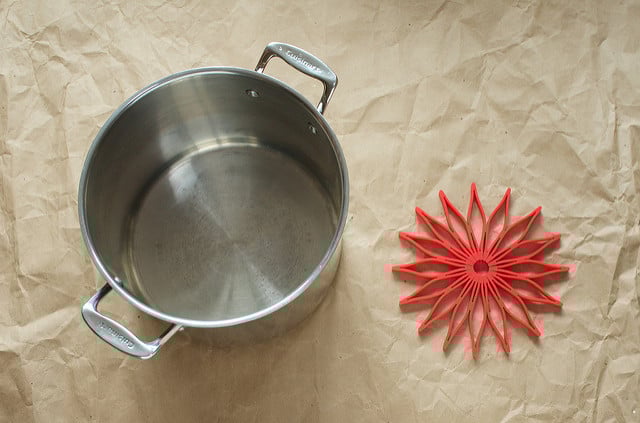
Here’s what I tell people when they confess that they are intimidated by boiling water bath canning. If you can make pasta, you can handle a boiling water bath canner. And truly, it’s no harder or more complicated that than! Read through this post for a step-by-step introduction to processing high acid preserves in a water bath.

So, a little disclaimer to start out with. I’m going to detail my particular canning workflow. This might not be exactly how you do it in your kitchen and that’s okay. We all find ways to make it work with the tools, equipment and space that we have. In the end, the most important things are that you get your jars hot, that you fill them with a freshly made, hot product to the proper headspace, you use new lids, and that you process them for the amount of time prescribed by your recipe. There’s a good deal of flexibility in the rest of the details.
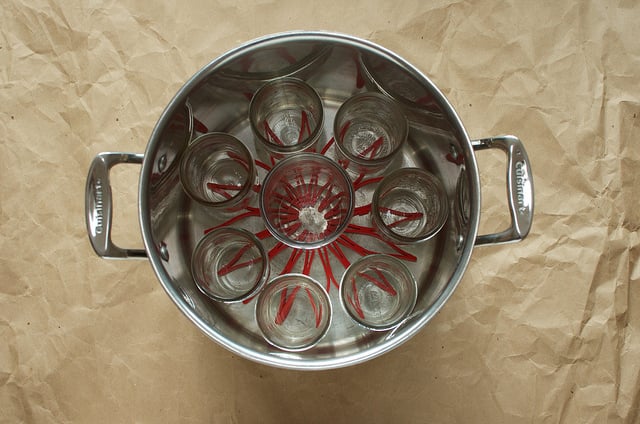
As I mentioned in the first post in this series, any pot can be your canning pot as long as it’s tall enough to hold a rack and your jars, and that it allows the jars to be fully submerged in the water. I like this one (thought it’s best for pints and smaller, it’s a little too short for quarts) but the best pot to use is the one already in your kitchen. If you don’t already have a pot that’s large enough to serve as a canner, I recommend opting for a durable stainless steel pot rather than a traditional enamel canner, as it will be more durable and versatile.
Once you’ve picked out your pot, position a rack in the bottom. I have a silicone trivet pictured here, but any round rack, or collection of old canning jar rings. Once you have a rack in your pot, place the jars you’re using on top.
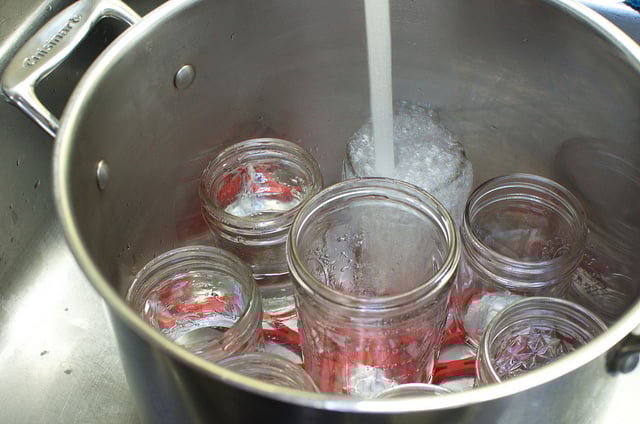
Then, fill up the jars and pot with water. I like to use the hottest tap water available, as it speeds up the boiling process a bit to start.

It’s a little hard to see in this picture, but at this point, I only fill the pot enough to just barely cover the tallest jar I’m using. This should be more than enough water for the processing stage, because the jars are currently empty.
Once you remove the hot jars, fill them with your product, close them, and lower those filled jars in the pot, they will displace enough water that they will be sufficiently covered. Sometimes, you’ll even need to remove a little water from the pot to prevent overflow. If this becomes necessary, use something heatproof, like a Pyrex measuring cup so that you don’t burn yourself.

It is always a good idea to pour a generous glug of white vinegar into your canning pot before you start heating it. This will prevent any minerals present in your water from depositing on your canning pot or jars. I don’t live in a place with particularly hard water, but I still do this because it keeps my pot in good shape and makes it easier to clean. If you’re someone who likes more precise measurements, use between 1/4 and 1/2 cup.
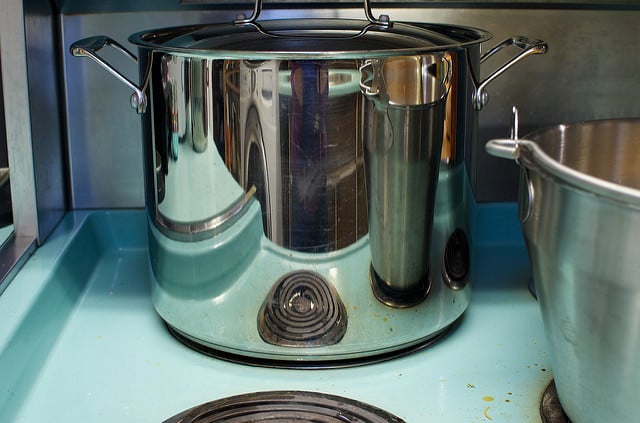
Now the pot is ready to go on the stove an come to a boil. I do all of this before I ever apply heat to my preserves. That way, the canning pot has a head start on my product and the jars will be nice and hot when I’m ready to use them.
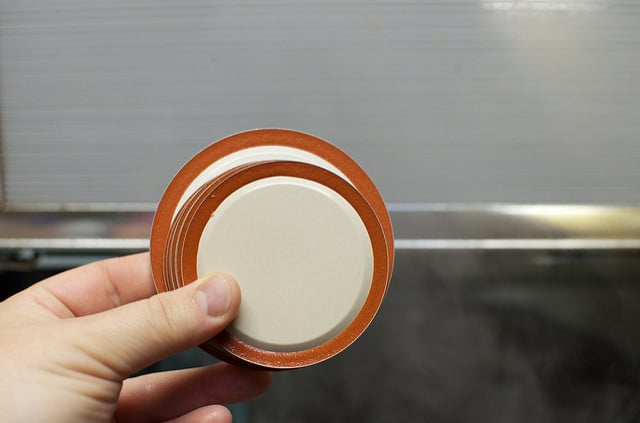
A note about lids
It used to be that you’d need an additional small pot running next to your canner, in which to warm your new lids before using. Back in 2014, Ball Canning announced that it’s no longer necessary to simmer lids prior to canning, as the plastisol sealant doesn’t require softening. Instead, they just need to be washed in warm, soapy water before applying them to filled jars. This change applies to all Ball, Kerr, Golden Harvest, and Bernardin lids. More information about this can be found here.
If you are using lids from a different manufacturer, make sure to read through the package instructions to determine whether or not they need to be warmed before use.

When the product is ready to go into the jars, I slide the canning pot off the heat and pull out the jars with a handy jar lifter. Just a note: These jars are hot, but not sterilized, because I turn the heat down to a simmer as soon as the pot boils. Jars do not need to be sterilized prior to filling if your processing step is ten minutes or longer.
However, if your recipe calls for a processing time that is shorter than ten minutes (very few modern recipes use this shorter processing time), you need to actively boil your jars for at least ten minutes before filled, to ensure you have sterilized jars.

Now you fill up your jars, leaving the amount of headspace required by your recipe. If the recipe doesn’t tell you how much headspace to leave, use 1/2 inch.

Before applying the lids and rings, wipe the rims with a damp paper towel or clean kitchen cloth. I use the hot water from the canning pot as my dampening water, as the heat helps remove any stubborn sticky spots. If your product is super sticky, a little white vinegar on the cleaning cloth will help.
Then, center a lid on each jar and secure it with a ring. Tighten the ring just until it meets resistance. The term for this level of tightening is called “finger tip tight” meaning that you only tighten as much as you can with the tips of your fingers. This allows the oxygen to vent, which is what produces the airtight seal once the jars cool.
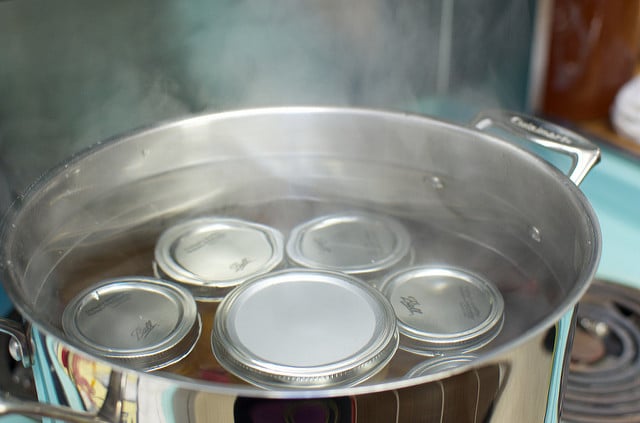
Once all the jars have lids and rings, lower them into your canning pot. Make sure the jars are fully submerged and are covered with about an inch of water (you need that much to ensure that they won’t become exposed during boiling). Turn the burner to high. When the pot returns to a boil, set a a timer to the prescribed amount of processing time.
You do want to maintain an active boil throughout the processing of the jars, but make sure you control your boil. If the pot is madly rolling, the chances that you will burn yourself increase. Turn it down a little, to minimize splashing and injury. I like to use one of these spill stopper lids on my canning pot rather than the original lid, as it also helps manage the mess of the boil.
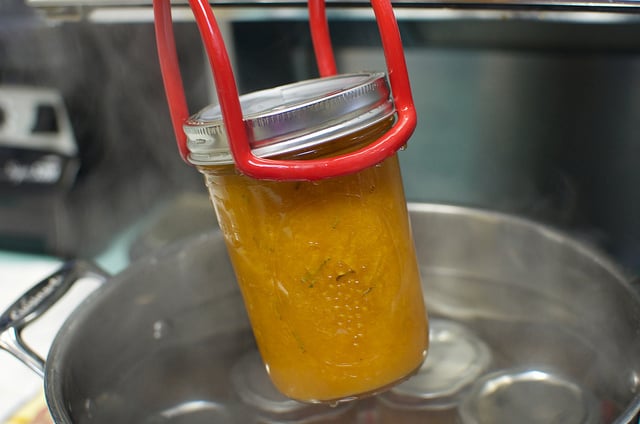
When time is up, turn off the heat. Remove the lid and let the jars stand in the water for five minutes. This allows them to cool more gradually and prevents the product loss that sometimes occurs if you take the jars out too quickly. It can also improve the quality of the seal.
Once that rest period is over, lift your jars out of the pot and place them on a folded kitchen towel or wooden cutting board to cool. You don’t want to set them onto surfaces made from stone, metal or tile, as their cooler temperatures can cause the jars to break.

Once the jars are out of the canner, leave them alone and let them cool. Best practice is to leave them alone for a full 24 hours, but if you can’t manage that, try to wait until they are completely cool to the touch. As the jars cool, you should hear the lids making a series of popping and pinging sounds.
These noises are indications that the jars are sealing as they should. However, don’t freak out if you don’t hear those noises. Jars sometimes seal slowly and quietly. Once the jars are completely cool, remove the rings and test the seals by holding onto the edges of the lids and lifting up an inch or two. If the lids hold fast, the seals are good.
Sealed jars should be stored in a cool, dark place without the rings. If the jars are at all sticky after processing, make sure to wash them before you put them away. Any sticky residue can attracts ants and other pests, so make sure your jars are squeaky clean.

Hello,
I’ve been making a lot of cucumber pickles lately. When I process the jars, I haven’t been fully covering the jars in boiling water — the water typically only goes about halfway up the jars. The idea is to maintain a crisper pickle. The jars have fully sealed, based on the state of the lid. Is this still safe, or is there a reason to cover the jars fully?
The reason to cover the jars fully is that water transmits heat better than air. So by only submerging your jars halfway, you’re not getting a full heat penetration to the center of the jar and your chances of later spoilage increases. I’d suggest you look into low temperature pasteurization for your pickles. It’s an alternative method of processing that helps maintain crispness.
Thank you!
Also, how can I ensure a good seal. About 25 percent of my jars have play in the lid when cooled. And my last question, actually 2. I remember instructions to turn the jars upside down for about 10 minutes, then right them to finish cooling, but I don’t see that anymore as part of the instructions. I also remember to finger tighten the rings and then fully tighten at some point, but I also don’t see those instructions anymore. Is this all necessary?
You don’t need to invert the jars or tighten the rings. As far as the seal failures go, do this. Once the processing time is up, turn off the heat and remove the lid from the canner. Let the jars sit in the canner for an additional ten minutes. The extra heat will help encourage a better seal.
I made some jelly and proabbly boiled it too long as it was setting soon after adding to the hot jars, and now that they are cool, it is VERY firm. Is there anyway to reprocess theses, maybe adding water, boiling and then recanning or is that it for that batch?
Unfortunately, that is not recommended.
You can warm it in the microwave to soften it when you need to use it. I had a batch that did this also….
I just don’t understand. I have been making homemade jam for 50 years, the way my Mother made it while I was growing up. The jams were never water bathed, and we have never had a problem. She did water bath her syrup packed fruits however.
All of a sudden several years ago, the recommendation to water bath jams came out. I don’t understand why it worked for so long without the bath and now it’s almost mandatory to water bath.
What has changed?
The recommendation to water bath jams is more than 30 years old. Studies found that it better prevented the occurrence of mold and fermentation. What’s more, modern recipes are lower in sugar. Any reduction in sugar raises the chances of spoilage. A boiling water bath canning process helps prevent that.
I made some chopped tomatoes yesterday and was unfortunately using the same pot for cooking the tomatoes down AND processing afterwards (I won’t be doing this again next time). I realized after reading some previous comments that the jars/product still being hot when they go into the water bath is important because otherwise they may not be processed long enough. I had some pints that were sitting out for maybe 60-90 minutes as I canned in batches. Fortunately, it’s been unbelievably hot outside and I didn’t notice them cooling down much. Are these still ok? Will it shorten the shelf life? I processed for the recommended 35 minutes and always wait until the water’s really boiling to start the timer. Now I know for next time!
Why do you need to cover the jars with water? If you used only an inch or two of water, wouldn’t the steam of the boiling water be able do get the job done?
This is how boiling water bath canning is done. Most regular canning pots don’t have the capacity to trap the steam sufficiently to build up enough heat to fully penetrate to the center of the jars. There is such a thing as a steam canner and it was recently approved for use by the National Center for Home Food Preservation. More information about using steam canners can be found here: http://fyi.uwex.edu/safepreserving/2015/06/24/safe-preserving-using-an-atmospheric-steam-canner/
I made jams from your “Preserving by the Pint” book yesterday (which is amazing BTW! LOVE 2 jar recipes ♡). I realized as I was falling asleep that I forgot to bubble the jams though. I’ve done them all in 125 ml jars and they all have good seals with proper heads pace, but there are definitely small bubbles throughout the jars. Wondering how concerned I should be…thoughts?
No need to be at all concerned. We bubble jars more to help prevent siphoning during the canning process. As long as the seals are good and you did the canning process for the proper amount of time, all is well.
I made some pickles today with the canning process that my grandmother uses. She packs the sliced cucumbers in the jar, then adds the boiling brine, making sure there are no air bubbles. The jars were sterilized in the dishwasher, and the lids and rings were in a pot of boiling, then simmering water. The lids and rings were put on immediately after wiping down the top of the jar, one at a time. They have all sealed. She said that she has never used a water bath with this process, and as long as they are sealed they are okay. Can I go back and do a water bath if they are already sealed, if it’s within 24 hours of canning them? Are they not considered safe to eat with the process I described?
Once they have sealed, you cannot go back and process the jars. The technique you used is not the recommended one, but as pickles are high in acid, if they go bad, the worst that will happen is that they will get moldy or funky. You won’t have any truly dangerous spoilage.
is it ok to give water bath after the jars are beginning to seal?
You really want to get them into the canner before they start to seal.
I made 24 jars of blackberry jam yesterday without processing them in a water bath. All jars have sealed, but I am concerned that I did not process in the water bath. Do I have to empty all jars, wash and heat the jars, reheat the jam/contents back to boiling and then but the jam back in the hot jars with new lids? Or, can I just put the sealed jars of jam in a water bath for 10 minutes?
If you want to do it the right way, you need to do it the long way.
I made peach jam in pint size jars. They didn’t completely set. The jam is thick but there’s still movement in the jars. Is this okay or should i do another water bath. How long do you need for a water bath using pint size jars?
Set doesn’t typically have anything to do with the boiling water bath process. Typically, jams packed in pints are processed for 10 minutes. If you live more than 1,000 feet in elevation, you need to increase your processing time.
What would happen if I left the water boiling in the canner for more than the recommended 10 minutes? Or if I left the jars in the water more than 5 minutes after removing the cover?
It’s going to be the end of the world. However, longer times in the canner can impact the texture of pickles.
Hi! Looking forward to canning fresh cukes this summer into garlic pickles. Thanks for all the info. Question: you mention a dish towel can be used for the rack in the processing pan. Would a white cotton wash cloth be acceptable to use as the rack? Thanks so much!
As long as it covers the bottom of the pot, it should be fine.
I made a large batch of clam chowder and used a water bath canning method to can the leftovers. Is this going to be safe to eat? If not, can I freeze clam chowder?
Nope. It’s never safe to use a water bath to preserve low acid foods like chowder. There’s no amount of time during which this could be a safe way to preserve that chowder. I would recommend that you throw it away.
Can you not do a pressure canning method?
No. Chowder contains dairy which is never okay for canning. Doesn’t matter if you use a boiling water bath or a pressure canner. it’s still a no-go.
Are the rings of the small jars slightly tough the outside of the pot to help them stay balanced? I have some trouble with jars tipping over. Or is that my rack or too strong of a boil?
It could be that the holes in your rack are too big. Typically when I do a boiling water bath process, I choose a pot small enough so that jars just fit, so that they’ll easily stay upright. It’s okay if the jars touch one another. You can also always use a couple empty jars to fill the space if you don’t have enough full jars.
So.. I’ve always had this question about the boiling water bath. I like to make hot sauce and many recipes call for boiling the ingredients for a minimum of 20 minutes. Is it safe to skip that step and go straight from blender to canning if I leave the jars in the boiling water bath for 20 minutes?
Nope. The sauce needs to be at a sustained boil before going into the jars and canning pot.
Used your recipe and steps for my first tomatoes salsa canning adventure. It worked like a charm and was so much fun. Question: after sealed jars cool, is it OK that the rings are loose?
As long as the jars seal, the state of the ring is inconsequential. In fact, once the jars are sealed, you should actually remove the rings and store the jars without them. https://foodinjars.com/2013/10/store-jars-without-rings/
I have been giving my sealed jars a hot bath to sterilize after filling them with marmalade. However in many of them water has seeped in. Is this normal? How do I totally prevent this?
The water isn’t seeping it. It’s a little bit of water that has separated out from the marmalade. It should integrate back into the product within a few days.
I just did my first canning project, and it was so much fun. The recipe I made filled more jars than I could process at once, and this is where I have a question. Last time, I boiled the jars, pulled them out, filled them with the hot jelly, put lids on, rings on, and put them back in the pot. Once it came to a boil, I let it go for 10 minutes, turned it off and let it sit for 5, and then took the jars out. Then, I put more jars into boil, then reheated the rest of the jelly to a boil, then completed the rest of the jars.
I want to make more, but here’s my question, can I fill more jars than I can process at once, and let some sit for 15-20 minutes while the first batch boils? Or do I need to put them in to process immediately after I fill them, and fill them in two stages the way I did the first time?
Filling them in stages like you did is better. Though ideally, you’d have a canning pot big enough for the whole batch to process at once.
Or use more pots?
That would also work.
Do really need a rack for canning or can you just put the jars straight into the pot?
I wouldn’t include it in this post if you didn’t need it.
No, you can use a towel in the bottom of the pot. I have been doing this since I started canning and it works fine for me and many other canners.
I use extra jar rings since I dont currently have a rack, and they work great.
Wow Kristy what a great idea!! =)
I didn’t know about this step, totally new to canning. 3 of my jars, the tops I can push up and down, the rest of them I can’t. I’m assuming those are the ones that are sealed? Can I do this water bath after the fact, like 3 days later? It’s fruit preserves. Or should I open them, put the preserves in a pan and heat it up to boiling again and do it the right way?
If the tops of the jars wiggle, it means that they did not seal. If you want them to be shelf stable, you need to open up the jars, reheat the contents, warm the jars, and process them correctly.
What a coincidence I’m new to canning! ?(Lol) but I have a few questions on what would not be safe to can. I’m mailing a package from US to the UK. It would take about 2 weeks for them to receive my package. I have been reading and noticed that there are a bit of nay to “Cake in the Jar recip” although I want to put brownie squares in the jars and seal it, would it still be safe?
Also would it be safe to put homemade rice crispies (the cereal and marshmallows), and chocolates?
Sorry for the long comment! Thanks!
You don’t want to seal baked goods in jars. It’s just not safe. I’d opt for a plastic container or a tin.
Have you tried canning in an 8 qt pot? how many jars do you think it could handle?
If you have a tall, skinny 8 quart pot, you can typically get 3-4 jars in it.
“Sealed jars should be stored in a cool, dark place without the rings”
Sorry, without the rings? How come?
https://foodinjars.com/2013/10/store-jars-without-rings/
Hi there. When canning with 125 ml jars, am I able to stack the jars in my canning pot for processing?
Yes. The easiest way to do it is to perch a flat, round rack on top of the first layer of jars. However, if you don’t have one, you can carefully set the jars on top of the first layer. Just make sure that all the jars are fully submerged.
If my jars sealed themselves before the water bath process do I still need to water bathe them or refrigerate them? Or is the seal fine and it can be stored? ( all food inside is fully cooked) .
Thanks
Even if the jars sealed while they were waiting to go into the boiling water bath, you should have still processed them. If you didn’t do it while the jars were still hot, it’s best to refrigerate them.
Hi Marisa! It’s so nice of you to give time in answering everyone’s concern in canning. I would be grateful if you could help me out. I’ve transferred raw, wild honey in 250ml glass jars and I was wondering if it should be sealed using water bath or not since I have heard others say that honey need not be sealed too tight as it requires a bit of air to breath. I didn’t understand what they meant. Hope to get a response from you. Thanks !
Frances, unfortunately I’m not an expert in honey storage. However, in my experience, honey doesn’t typically require anything beyond clean jars and a tight-fitting lid.
Hi Marisa,
First time canner tonight – my roommate and I made two jars of pickled onion. We prepped everything before we discovered that our pot was just barely tall enough. Instead of the recommended one inch we had perhaps 1 cm of water over the lids. The jars were able to sealed, but do you think the height of the water compromised the safety of the onions? Thanks in advance.
As long as they were covered, it should be fine.
Is it safe to reuse jars? I have been hoarding classico jars, my whole family laughs because they just sit in my cupboard. So i thought why not use them for canning?
If a traditional mason jar lid and ring fit the jar, it should be safe to use it for canning.
Thank you for the informative website. Short and sweet answers! My only question is, a month ago, in a hurry. did not do all i should for the pear preserves..They look kinda runny. Can i take them out of jars, add the surejell and reprocess the whole thing as if canning new preserves?
Is my salsa ok if I didn’t completely cover the iars in water for the boiling water bath? The water was almost to the top of the jars. All my jars sealed.
Thank you!
It’s not ideal, but it should be okay.
That’s almost exactly how my grandmother did it! Thanks for the review. I think I can do this now.
I just canned my first batch of tomatoes. While they were processing I was washing up the kitchen and never checked on my water level in the pot. There was 1″-2″ of water covering the jars when I started it but when the timer went off (40 min) the water was boiling just below the top of the lids. I added enough water to cover the jars another inch and put the timer on for 10 more minutes to make myself feel better about it all but I’m still nervous about it being safe. Ever experienced this before? Suggestions? Are my tomatoes safe to put on the shelf and eat later?
I just made a batch of ginger pear preserves, the recipe said I should end up with 7 jars of finished product.. I only ends up with three. And the texture seems like caramel, not jammy. I reviewed my recipe and realized I boiled my ingredients on high instead of medium, could that have caused this reduction in volume? And texture change?
Yep. When you overcook your jam, your yield is less and it turns to caramel.
Marisa, I just wanted to thank you for this post. I am new to canning and though I did can tomatoes once before with help, I was very nervous about doing it again – this time alone! When I began my research I found this site, and answers to every question that I had – all in one place. You are very patient to answer everyone’s questions very simply and to the point. And thanks to this, it gave me so much more confidence on my big day! Thank you SO VERY MUCH!!!
So glad to be able to help!
Hi, your site makes for very interesting reading. I have just steamed grapes from my garden and have approx. 8 litres of juice. I would like to can some of this but my pressure canner does not mention any time at all for canning juice. Any advice would be appreciated. Also what would be the shelf life. Thanks in advance
Here’s how to can grape juice: http://nchfp.uga.edu/how/can_02/grape_juice.html
I was wondering if when preparing applesauce or other food like jelly. If you get jars ready for boiling bath and they end up sealing before your process in boiling water should you still process the required time?
Yes, you still need the processing time.
Hi, I have a question that I have not been able to find the answer to. If I am making a batch of pint and half pint jelly and I have 20 jars total in one batch. What would be the process for the water bath? What I mean is can the jars that won’t fit in the first water bath sit on the counter ready until the first batch is complete, or would that have the jars getting too cool? I am trying to determine if successive batches can be done. Thank you.
You can do successive batches. Do your best to keep the waiting jars warm and then increase the processing time by five minutes to ensure that you get sufficient heat to kill any present micro-organisms.
I sterilize jars in dishwasher and fill them then keep second batch back in hot dishwasher to stay hot.
Hi! This article was super helpful, and it looks like you’re great about actually answering people’s questions, so I’m hoping you can help me. I made fig jam yesterday, and a thin layer of water leaked INTO a few of the jars. I noticed someone else asked about this back in April, and you said they probably didn’t tighten the lids enough (good to know for future!), but my question is about whether this actually ruins the jam.
As of this morning, all jars are fully sealed, seals hold when shaken upside down, and the leaked water actually looks like it’s been absorbed into the jam so it isn’t visible any more. Since the jars were all processed at 10-12 minutes at a full boil, I’m hoping the water that entered the jars is sterile, and the jam is still safe to eat (albeit slightly thinner). What do you think? I also tasted the one fridge-destined jar that didn’t seal properly and also got some water leaked in, and the water didn’t seem to affect the taste (I hadn’t read your article before, so there was no vinegar in the water). I’m really hoping they’re ok, because I have 30 jars and can’t tell which ones leaked now that they’ve absorbed the water!
Thanks so much!
Dani, chances are good that water didn’t actually leak into your jars. It was probably a bit of water condensing out of the jam. However, even if it was water, it was sterile water so the jam is entirely safe.
That’s a relief–thank you so much!!
I have a question. I made three jars of apple butter two days ago I didn’t know until I read here that the water had to be at a rolling boil before starting the timer but it come to a rolling boil for at least 8 mins an as it was my first canning I left them in longer than required they didn’t ping at any time but they do seem to be sealed should I trash them since it didn’t do a rolling boil for correct amount of time.
They are probably okay. Because they didn’t get the full amount of recommended heat exposure, they may not last as long as other jars. If they do go bad, they’ll either start to mold or ferment, and you’ll see that on the surface of the jar when you open it. If that happens, just don’t eat it.
Thank you SO much for this tutorial. You took out all the scary what-ifs! You made it look so easy! I finally canned something today (homemade mustard) and was relieved to hear the lids popping as it cooled. Can’t wait to can some jam!
Thank you!
I am going to try to can applesauce tomorrow, I have never canned in my life so I was just wondering when we take jars out of water and drain them we don’t dry them down before we fill them?
Typically the jars are hot enough when they come out of the water that they dry almost immediately. No need to dry them.
Great article! I just water bathed for the first time today and didn’t know how to tell if they jars are actually sealed or not. Love that you said you’d hear them ping, etc. That’s helped alot. They are on the counter and I’ll listen!!! Thanks!
I have used this method for 2 years..when I started canning. I always have success, in fact, I just put my jars in the water bath! I just make sure I keep the jars covered with boiling water. I love hearing those pings.
Forgot to hot water bath tomatoe sauce. I did put in lemon juice. Can I water bath now after a day?
You’ll need to open the jars, reheat the sauce, refill jars, and then process.
Good Day Marisa
I have made jams in the past and not done the hot water baths after making the jam and I have heard that pop sound of the lids sealing. What is the difference in doing the hot water baths or not?
Also I have found some small jam jars that have the lids as one piece. Are they as effective as the ones with the 2 piece lids? I am thinking that they should be as long as they seal like the others?
The boiling water bath helps create a stronger seal than you get without it, and it provides a sterilization step that enables the jam to last longer.
One: there was one jar I didn’t prepare the canning method that just sealed itself; all I did was poor hot tomato sauce in it because I was gonna use that immediately. What happened?
Two I took the lid off to because I the seal would pop up and down; after I sealed the fastening lid back on, the seal flattened(it didn’t pop anymore).
Three: I didn’t use citric acid with plum tomatoes. Is that bad???
Four:how do you reprocess if you didn’t achieve a seal the first time?
I am doing tomato sauces.
thanks
1. Jars can seal whether or not you do the processing step. However, the processing step sterilizes the jars and the contents, and so without it, the contents may not last long.
2. I don’t totally understand the problem.
3. Yes. You need to use citric acid or lemon juice.
4. You’ll need to open up the jars, reheat the sauce, refill the jars, and process again using new lids.
What happens if you forget about the cans you put in the boiling water. Are the contents still ok. In my case I put my pickles in at just under a boil and forgot about them for about 40 minutes.
Your pickles are probably going to be a little bit soggy after all that time in the canner. They won’t be unsafe, but they might not taste great.
I lost track of time and over-boiled my tomatoes…..will this cause problems?
It just gives them a softer finished texture.
Hello! This information on your site is very helpful but I do have a question that I cannot seem to find an answer to anywhere on the Internet and am hoping you can help!!
I have been canning for a couple years now and never have any problems. Today one of my jar of tomato sauce broke while in the water bath. Of course I freaked out and got all the jars out, emptied the water and replaced with new water. Now my questions is.. The jars were only in for about 5-8 minutes and they seem to have sealed while I was waiting for the water to come up to temp. Do I reprocess the good jars since they were not in the water bath for the required time or do I let them be since they did seal? I don’t want to break anymore jars or ruin anymore sauce.
Thanks!!
So sorry to hear that your jar broke. It just happens sometimes. They other jars still need the full amount of time in the boiling water bath. The processing time isn’t just about getting a good seal, but also about ensuring that you’ve killed off any bacteria present.
What happenes if the jar breaks (crushed tomatoes) but you did not notice it until the timer went off…. are the other jars OK or do you need to toss them? I think they should be OK, as I think that stuff may siphon out of jars at times, but I am not sure stuff gets sucked in… I hope you say it is OK as they were lovely heirlooms from my garden…
The other jars are just fine. Nothing sucks into the jars during processing.
Hi, I just started canning jam this summer and your post has been very helpful!! However today when I was removing a jar it slipped a couple times (I have been using tongs because I am at a remote cabin for the summer and cannot get to a shop). When I finally pulled it out of the water and put in on the towel, it made a sputtering sound like air or water was escaping from under the rim. There was some jam around the rim of the jar that wasn’t there before placing it in the bath. I was heating up a second jar ready to transfer the jam and try again when I heard it pop! Do you know if it has been safely sealed? Or should I put this jar in the fridge?
That sputtering sound is entirely normal for a jar freshly removed from the canner. As long as it sealed, it is fine.