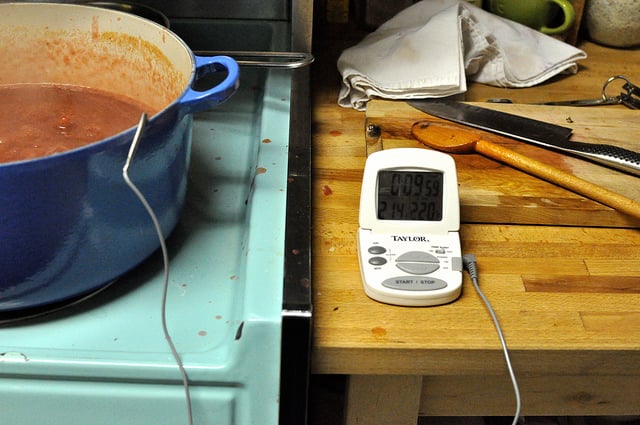
One of the trickiest things about making jam is achieving the set sweet spot. Cook it too long and you worry about the integrity of your cutlery as you reach in for a spoonful. Cut the stove time short and when it comes time to eat, the jam threatens to run off your toast in sticky rivulets (do know that jam this consistency is still amazing on pancakes or in yogurt. Call it a rustic syrup or old fashioned preserves and your friends will still be wowed).
First off, know that even the most experience jam maker has an off day here and there. The same recipe can yield a perfect set on Saturday and make an unfortunately sloshy batch on Sunday. Jam is influenced by the width of the pot you use to cook it, the ratio of sugar to water in the fruit, the amount of pectin in the fruit (as well as whether you add additional pectin), the elevation at which you’re cooking and even the amount of humidity in the air.
Here are a few things to keep in mind as you prepare to make a batch of jam…
- As I mentioned above, the width of your pot can influence the set of your jam. Always choose the widest pot you have at your disposal that also has enough height to let the jam boil vigorously. More surface area means faster evaporation and ample height means you can crank the heat and let it boil. Getting the water evaporated out of your cooking jam at a speedy clip is integral to having a nice, spreadably sticky jam.
- Take the jam’s temperature. Jam making is much like candy making in that you’re applying enough heat to the fruit and sugar to raise the temperature over the boiling point of 212 degrees and alter the structure of the sugar. The jam reaches its ideal set point at 220 degrees, so keep careful watch. Know that if you reduce the amount of sugar in your recipe too drastically, you may not be able to get your cooking jam up to the set point.
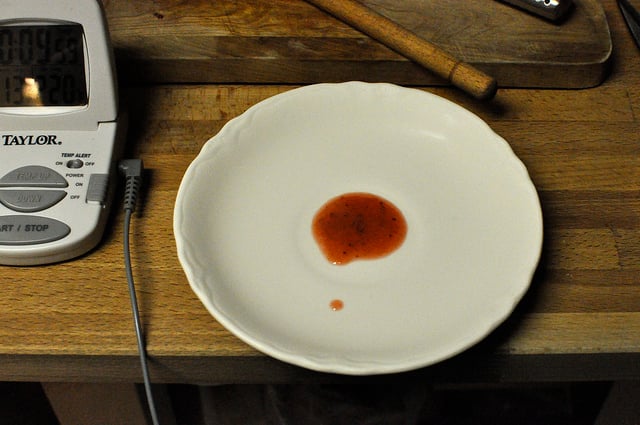
- Before you take the jam off the heat, try the plate test. At the beginning of cooking (or even before) stash a couple saucers or sandwich plates in your freezer. When you believe the jam is cooked, grab one of the plates and plop a small spoonful at the center. Let it sit for a minute or two and then gently prod the puddle of jam with your finger. If it’s formed a surface skin and seems to be developing a certain solidity, it is done. If it is runny and saucy, give it a few more minutes.
- Another test is the sheet test. Here, you stir a spoon through your jam and the remove it from the pot. Holding it over the cooking jam, watch as the remnants on the spoon drip back down. Do they fall back in runny drips, like rain on a window? If so, it’s not quite done. However, if they seem thick and run together in more of a sheet, your jam is finished.
- Cooking times are estimates. When the recipe gives an amount of time for you to let the jam cook, know that that is only an approximate time. The recipe writer doesn’t know how hot your stove cooks, whether you’re in arid New Mexico verses sticky Philadelphia or what size pot you’re cooking the jam in. Use your judgment.
- Additional pectin can help improve set, but it isn’t always a panacea. I’ve had jams that included additional pectin end up runny and then made others with no additional pectin that have firmed right up. Additionally, I’ve found recently that my beloved Certo liquid pectin isn’t working as well this year as it did in years past. I don’t know if they’ve changed the formula, but it’s thrown me off and made me remind myself of the basics of set all over again.
What are you tips for making sure your jam sets well?

I tried this and my chocolate cherry jam still hasn’t set. It’s been 24 hrs. I don’t know what to do
Without knowing what recipe you started with, it is hard for me to diagnose the problem. However, have you tried putting a jar into the fridge to see if it sets up when cool? That sometimes helps!
Thank you for you this thorough explanation. I’m new to jelly. Before I only made thick preserves with no pectin!
Today I Made prickly pear jelly. And a no set!
But I love the idea of using for syrup!!
Thank you for your time and energy to help others
I’m glad this post was helpful! Thanks for the kind words!
Hi I have a canning business, so make a LOT of jams.
Thank you so much for the info on settingup with pectin. So spot on!
I also have had issues with the Hoosier Farms pectin this year, having to add extra pectin, which 50 % of the time sets too firm with bubbles all through it…so many jars not salvagable! I’ve had to go back to small batches, rather than doubling or tripleing as I’ve done in the past.
Oh weird! I’m sorry you’re having that experience!
By accident I put half as much sugar than what recipe called for. Will that cause the jelly not to set?
It is possible!
Your last sentence about jam not working with Certo is such a relief to hear. I’ve used Certo for 30 years. Now the last 2 times the jam hasn’t set. So I’m going back to the basics.. Today actually. Yay it’s not just me. Thank you!
Glad to help! It’s so disheartening when the product doesn’t work the way it used to!
The recipe required 4 cups of prepared mangoes. I chopped up 4 cups of the mango and put it in my pot. I didn’t mash them until they were in my pot. My jam did set but it’s very sweet. 5 cups of sugar. I’m thinking the there is not enough fruit. Can I remake and adjust fruit?
If you’re very unhappy with the outcome, you could do that. However, I probably wouldn’t simply because chances are it won’t set up again.
If I am rebatching jam made with liquid pectin can I use powdered pectin in the remedy?
Yes. I actually always recommend powdered pectin for correction because it seems to set more reliably.
I too have found Certo and Sure Jell to be less effective. Thank you for your tutorial.
Glad to help!
I made peach mango chilli jam and it was more a sauce I tried boiling in home made marmalade pectin , and then I bought powdered pectin and that made it jammy but sucked the flavour out😥
Honestly, the flavor loss probably came more from the repeated rounds of cooking than the pectin.
I’m a happy plum jam maker, with a fruitful aging plum tree! This year by accident used old pectin and it turned out runny. Can I recook the batches with your recommendation of adding 1/4 sugar and 1 tablespoon fresh pectin to firm it up? OR should I just throw them away due to the expired pectin— is it unhealthy or taste bad? I frequently give them as gifts. Ugh I’m bummed!
You can absolutely recook the jam according to the instructions in this post. Old pectin doesn’t impart a funky flavor or cause any health issues, it simply doesn’t work as well. However, it’s never a bad idea to taste the jam before remaking it to ensure that you’re still happy with the flavor before putting the work in to remake it.
Can I use hot oil instead of jalapeno peppers to make the jelly hot?
No. That would not work.
I made tomato preserves for first time. no pectin required in recipe, but i did double the recipe, bad move.
i have several pints that none set. should I:
1. recook for a longer time and a smaller amount
2. add liquid pectin?
3 if I add pectin do I still need to add lemon juice again?
Recook until you have the desired consistency.
This was very helpful. At my experienced age of 70 something I’ve inherited a Meyer Lemon bush and have 40# of fruit to use. That’s great as neighbors and friends love my handmade gifts. I am not, however, experienced in the art of jam/jelly making with this low pectin fruit and was having trouble getting a decent “set”. I also have to travel almost an hour to the one place that sells your pectin so finding the website was perfect all around!
Thank you for such a great product and such valuable information.
So glad that I could help!
This article is a detailed instruction method. You have been thorough in your descriptions and I really appreciate that. Recipes are like written maps…you get directions… without signs and landmarks to look for along the journey…you talk like my mother would describe the process with tips like pot size and the saucer test….thankyou…now I am making JAMMIN’ JAM …it’s wonderful
I’m so glad that this post was helpful!
Is it OK to mix a new batch a pepper jelly with a batch that didn’t set up right? I used pint jars and only filled them half of the way up, so could I just finish filling the jars with the new batch and slightly stir them together in the jar then give them another water bath to reseal the jars?
I was just thinking this might be a faster way but I’m not sure if anyone else has ever tried this or how safe it would be? I’m thing I could set the hars with the jelly b in the down into hot water to get the jars heated up before adding the new jelly.
It wouldn’t be a good idea of open half filled jars and add hot jelly. The only way I’d do this would be by emptying the original batch into the pan, reheating everything together and then recanning.
Can you use clear jel
No, you can’t use clear jel for jams. It is only designed for pie filling.
I too have found certo pectin isn’t working for me anymore. I now use bernardin pectin and it’s been reliable every time, and I make lots of jam every year when the fruit is in season. I just finished making blueberry, strawberry, yellow plum, red plum, blackberry and peach.
Thanks for your hints and tips. I’m a Long time jam maker and always appreciate hearing what works for others
It’s so frustrating that Certo doesn’t work anymore. Why did they change the formula!?
Thank you for your advice. It kept me from overcooking yet another batch of jam. I just had to walk away!
So glad I was able to help!
I made. Tomato jelly. First time didn’t set. Reboiled it. Still didn’t set. Can I try. Again to rebooked it. Or just quite. Don’t know why it won’t set. First. Bach. Was ok. It set. Made same resipe. Next day & this is what happen
Thank you so much for Your note about Certo liquid pectin. After doing everything I knew and had learned through reading how to recook jam , I tried again with no luck., I threw in a second bag of liquid pectin to 41/2 cups of wild blackberries and still failed to make the jam set. I
Certo and SureJel liquid pectins are both pretty lousy these days. The only liquid pectin I have any success with these days is Ball. But I mostly use powdered in my canning at the moment.
It would appear i am in the right place – lots and lots of experts here i am pleased to discover! This is a great opportunity for me to tap your collective genius: Firstly, I am very green here, having practically no experience with jamming. I was in Hawaii earlier this year and discovered (fell in love with) passionfruit – it’s SO good. I purchased about 25 pieces of the fruit here at the farmers market in Los Angeles with the hope of making a jelly from it. I de-seeded all of the fruit by scooping out the pulp and juice and then heated it in a saucepan to soften it up for the purpose of straining and isolating the seeds from the usable friut juice. It yielded about 1/3 cup of intense passionfruit juice. In a 2nd pan i mixed just enough water to dissolve about 2 tablespoons of powdered pectin. I reduced this mixture (boiled it) until the pectin/water mixture was nearly as thick as pancake syrup, and twice as sticky. I added almost a 1/4 cup of sugar to the strained juice in the other vessel and stirred vigorously for about three minutes with a wisk until the sugar granules were completely dissolved in the juice. I then added the hot, thick pectin mixture to the juice/sugar mixture into a sterilized 8 oz jar, stirred it like crazy for a few minutes and put a lit on it. I let it sit over night before putting it in the fridge.
Its very delicious but its pretty runny. It works better on english muffins because the nooks and crannies do a better job of containing the viscous jelly than does toasted bread, which is much better at leaving my plate, tabletop or shirt with sticky spots of passionfruit.
I am wondering about one thing: Everybody here seems to talk about boiling the fruit and sugar mixture, or even the finished jelly itself. This is something I have not done. Instructions on the pectin box only spoke of boiling the pecting/water solution. So i am confused. If i put the liquidy finished product (which btw tastes amazing) in the saucepan now, and reduce it under heat, will that alone thicken up my runny jelly, or am i missing something? Thank you for reading and I appreciate all who contribute to my enlightenment.
What pectin are you using? I’ve never heard of a jelly recipe that includes instructions like the ones you have shared. Typically, the process is that you combine the juice, sugar, and pectin, and boil it for a prescribed amount of time.
Love this book… my question is , when a recipe calls 4 1 packet of pectin, how is that measures in teaspoons or tablespoons? I have seen recipes that call for package, of pectin, are package & packet the same. I purchased Mrs Wages powdered pectin not liquid and have yet to find measurement conversation in teaspoons or tablespoons. HELP Please
Here’s how to swap liquid pectin for powdered. https://foodinjars.com/blog/canning-101-how-to-substitute-pectin/
Greetings,
Every time I make jelly (wild grape or crabapple), I have to boil the dickens out of it to get it to 220 or good sheeting consistency. I try to use correct sugar:juice ratios. If one has to boil for a long time to get it up to temperature, is that a sign that more sugar is needed?
Increasing the sugar content will reduce the cooking time, because it is sugar concentration that allows the mixture to get up to 220F.
I’m a VERY beginner jam maker (yesterday was my second batch of jam ever, mostly made to empty our freezer for whatever our patch of strawberries puts out this summer), and this has opened my eyes to all kinds of things I didn’t know! The comments have been a great help, too. Thank you for the great resources!
I’m so glad that you found some useful information! Good luck with you future batches of jam!
I have messed up many batches.
Recently I read that this person added some lemon juice to all his batches to bind the molecules. Well….I tried it and it has worked every time . The article read not to use fresh lemons because each lemon has its own acid level, and to use bottle lemon juice instead for consistency. So, I follow a recipe. If it doesn’t set then I will add like a teaspoon or so and continue cooking for a few minutes. It works! There have been a few batches I have added it sooner and let it cook the whole time and that works too. Wow I feel like a pro now. I LOVE to make jam.
Hi, I did the plate test on both a small plate put in the freezer and another at room temp, plus the spoon sheet test. By all indications, I had a very thick jam, so I canned it. It’s been two days but it’s still runny in the jars although the lids have sealed… what have I missed? Recipe called for no powder pectin, just the juice of 1 lemon to 4lbs of plums with 3 1/2 lbs of sugar…
Try putting a jar in the fridge and see if that helps firm it up. Also, jams with no additional pectin will often be a bit softer than those that use commercial pectin.
Just made this fir the first time and instead of jam looks like I’ll have some delicious blood orange candy!
Did I cook it too long? Too much sugar? Both?
You cooked it too long.
I hope someone can answer Gene (Aug. 4, 2020) because that is exactly my problem.
Ruth, I’ve answered Gene’s question. Hopefully it helps you!
I have often had problems with jelly (or any fairly liquidy fruit puree for jam) using powdered pectin. The issue I am finding is that I follow the directions in adding the acid (i.e. lemon juice) and powdered pectin at the beginning, cook to a rolling boil before adding the sugar, then cooking at a hard boil for exactly 1 minute. Throughout the entire process, I constantly stir to ensure all the ingredients are evenly distributed. After I jar the final product, the residue in the pot and on the spoon I used to stir does immediately have that firm set. However after processing the jars to seal them, the resulting product in the jars more often doesn’t seem to set even after several days. The two I made this year didn’t set (rosehip jelly, watermelon jam). Anyone have any idea what I’m doing wrong? I only make one batch at a time (i.e. about 4 cups of liquid or fruit), use a 6 quart Dutch oven (which is fairly wide), and add the requested amount of sugar in the recipes (i.e. I know that sugar is required for the set). I already tried resetting the watermelon jam according to “how to fix jam that won’t set” and still didn’t work. Does the processing in the water bath have anything to do with the failure to set?
I often find that the one minute of boiling isn’t enough to get the firm set you need. Next time, try boiling a bit longer and test for set before stopping the cooking process. This blog post should help. https://foodinjars.com/blog/check-set-plate-test/
This saved my Pinot Noir Jam tonight. Thank you so much! It came out fantastic!
So glad to help.
Can you cut back on the amount of sugar called for, and still have the jam set? I saw a comment that no pectin was even required for blueberry jam. I used the ball recipe of: 4 cups of blueberries, 4 cups of sugar and 1 pkg of ball liquid pectin,; I made 3 batches yesterday and one batch did not set. I was afraid to cut back on the sugar, as I thought that would affect the outcome, but if I can cut back to 3 cups of sugar, I’d like to do that, since that batch didn’t set anyway!
This blog post should help clarify things: https://foodinjars.com/blog/canning-101-can-reduce-sugar/
I didn’t read all 7 years of replies 😉 But one thing to remember is that pectin comes from apples and a bad year of apples could mean they did have to alter their formula to accomodate the apple harvest. Just a thought. A tip given to me by my “farmer” honey.