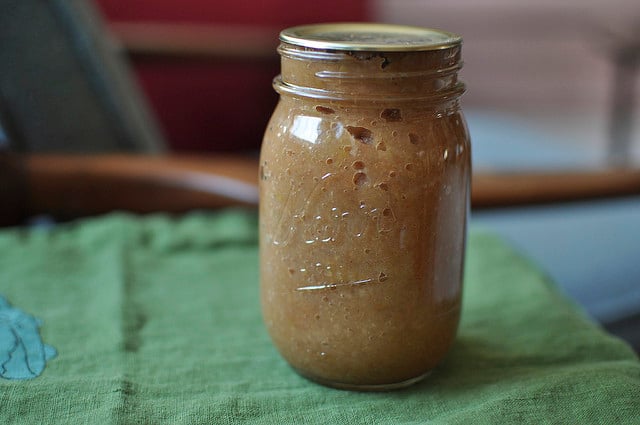
When it comes to my own canning, I like to make a mix of fun things and pantry staples. That means that while I make plenty of highly spiced jams and fancy pickles, I also make a point of putting up a goodly amount of tomato puree and applesauce each year. I stir applesauce into oatmeal, bake it into cakes, and eat it straight from the jar when lunchtime pickings are slim.
One would think that applesauce would be a fairly straightforward thing to preserve, but it can be surprisingly tricky, particularly for new canners. After getting a number of questions about applesauce recently, I thought I’d put together a list of commonly asked applesauce questions and my answers, in the hopes of putting many minds at ease.

What is the best kind of apple for sauce?
I don’t really think that there’s any one apple that makes the best sauce and truly, the best apples to use are the ones you have. I have cooked any number of apples into sauce and it has always been delicious. I would advise that you start with apples that taste good to you and that are relatively free from damage or rot (cutting around a bad spot or two is totally fine).
If you’re working with relatively sweet apples, you can always add a little lemon juice to balance the flavor. If the fruit is quite tart, a little sugar or honey will help adjust the sweetness.
What is the best way to make applesauce?
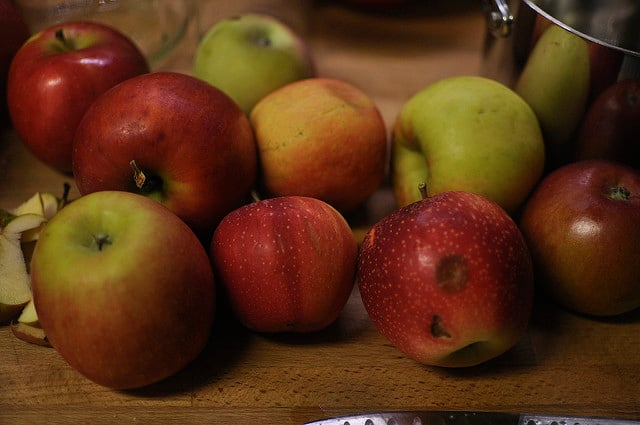
Your apple saucing approach depends on the gear you have in your kitchen. For basic batches, all you really need is a peeler, a paring knife, and a potato masher. Peel, quarter, and core the apples. Dump them into a big pot with a little water to prevent burning, and cook them on low until they are soft. Use the potato masher to smash them into a chunky sauce.
If you have a food mill or a tomato press with a saucing screen, you can skip the peeling process and put the cored and quartered apples right into your pot. Add a little water, over the pot, and simmer until the apples are tender. Then, work them through the food mill or tomato press. You’ll end up with a peel-free sauce with a uniform texture.
If you want to include the skins in your finished product, core and quarter the apples. Put them in a pot with a little water and cook until soft. Once they’re tender, work the apples through a blender in batches, pureeing until the apple skins are integrated. This works best with a high speed blender, like a Vitamix, Blendtec, or Ninja, but can be accomplished in regular blenders or with an immersion blender if you’re persistent.
I personally like a chunky applesauce, so often use an approach that blends the first and second techniques. I core and quarter my apples, but leave the peels on. I simmer the sauce until it’s tender. Once the fruit flesh has started to separate from the peels, I stand over the pot with a pair of tongs and pull the skins off the fruit. I work those peels through a food mill, to catch any bits of sauce, and then mash the remaining naked apples with a potato masher. You get the color and some of the vitamins from the peels and still retain the chunky consistency.

Do I have to add anything to my applesauce to make it safe for canning?
Nope. Because apples are naturally high in acid, you don’t have to add a thing to it to make it safe for boiling water bath canning. What’s more, apples also have a goodly amount of sugar, so they keep well once canned.
Can I add things to my applesauce?
Yes! You can add spices like cinnamon, nutmeg, ginger, allspice, citrus zest, citrus juice, sugar, honey, or maple syrup (though use maple syrup in conservative amounts. It is lower in acid than other sweeteners and if added in large quantities, can impact the finished acidity of the applesauce.
How long do I process applesauce in a boiling water bath canner?
If you live under 1,000 feet in elevation, you process pints for 15 minutes and quarts for 20 minutes. If you live above 1,000 feet, your processing time adjustments can be found here. Times and pressure amounts for processing a pressure canner can be found here, though it is not necessary for safety and can often lead to product loss.

I just took my jars of applesauce out of the canner and they are leaking! What did I do wrong?
First of all, know that applesauce almost always siphons like that. It’s hard to prevent it entirely, but you can do a couple of things to help minimize it.
The first is to minimize the amount of air you work into the apples during the saucing process. Apples pushed through a food mill or tomato press can take on more air than those mashed with a potato masher. The air isn’t the end of the world, but it will expand during the processing, which will then force some sauce out of the jar.
The second thing to do is to let the jars cool gradually once the processing time is up. The worst siphoning typically happens in the moments just after you pull the jars out of the canner, when they’re still really hot. Instead, let the jars sit in the canning pot for 10-15 minutes after the canning process is done. Once your timer goes off, you slide the pot off the burner and remove the lid. Let the jars cool slowly in the pot. After the 10-15 minutes are up, pull the jars out. They may start to siphon some, but it will (hopefully) be less than you’ve experienced in the past.
If my jars siphon, but the lids eventually seal, is my sauce still safe?
Yes! No matter how much they leak, if the seals are nice and tight, they are still safely shelf stable.
The surface of my applesauce has turned brown! Is it still safe?
It is! That is normal oxidation. You can either scrape off the brown layer or just stir it into the rest of he sauce.
If there is mold on the outside of my applesauce jars, is it still safe?
Yes! Sometimes you end up with a little bit of residual applesauce on the outside of the jars because of the siphoning I mentioned up above. It’s that applesauce residue that is molding. As long as the seal is still good and firm, the sauce inside the jar is perfectly safe.
There are some air bubbles in my finished, sealed jar of sauce. Is it still safe?
As long as those air bubbles aren’t moving around, they are fine. You can read more about air bubbles in finished products in this post.
If you have an applesauce question that you don’t see here, please make sure to leave a comment and I’ll update this post.

In the back of my pantry, I just discovered 4 half pint jars of my home canned applesauce from December 2012. The tops are still securely sealed. Is it still safe to eat?
If the color hasn’t changed dramatically, open up a jar. If there’s no funk growing on the surface and it smells generally like applesauce, I bet it’s fine.
As I was cooking my apple sauce, it tasted very good nice and sweet I added nothing just used Apple’s. I used a pressure cooker once it was done I tried a jar two days later and the applesauce for sour and did not taste good. in the pressure cooker I added 2 tablespoons of vinegar which was suggested. Could that of gotten into my applesauce if the lids were not tight enough?
I’m a little confused about what you did here. Are you saying that you pressure canned your applesauce? First, applesauce is a high acid food, so you don’t need to pressure can it. There’s really no way the vinegar in the water could have gotten into the sauce. I really don’t know why your sauce changed flavor so radically.
Should I heat the applesauce in the jars somehow before trying to can them?
The applesauce needs to be hot before it goes into the jars.
I filled my jars w my applesauce but then had an emergency and came back my applesauce had cooled in the jars and I haven’t put them in the canner yet. What should I do?
You need to empty them out, reheat the applesauce and refill the jars.
Do anyone have insight if following the canning process, whether Apple Butter and Pumpkin Apple Butter would work? Has anyone tried?
Apple butter will work. Any butter that includes pumpkin is potentially unsafe.
https://foodinjars.com/2010/10/canning-101-why-pumpkin-butter-cant-be-canned/
https://foodinjars.com/2015/12/maple-bourbon-apple-butter-oxo-on-illuminating-digital-immersion-blender/
Quick question, I have cooked all my apples but there are too many for me to can tonight, and now the next couple of days I’m busy. How long is the apple sauce good on the fridge for before I have to can them? is it ok to can them as couple days after I have cooked the sauce?
It’s not ideal to cook the sauce, cool it, reheat it, and then can it, because once in the jars, it is going to expand. You CAN can it after it’s been in the fridge for up to a week, but you’re going to have some product siphoning as a result.
Hi – how many lbs. of apples equate to how many pints/quarts of applesauce? I looked at one of your recipes that used 4 lbs. of apples but it didn’t say how many jars it made. Want to make sure I don’t over or under do it!
It’s going to depend on how much water content is in the apples and how long you cook them. Typically you’ll get about a pint per pound of fruit, but it’s an imperfect formula.
I am a first time canner. I peeled, cored & sliced my apples. I then boiled them till soft put them in my vitamix to process smooth, then added sugar & honey then reboiled again. At this time the applesauce was a nice yellow. After I pressure cooked it it turned dark pink. Is this normal especially when I peeled them first?
That happens with apples sometimes.
I am making apple sauce and I noticed a white foam is appearing mixed with my apple sauce when I put it through my mill. What is this white foam and how can I remove it?
I just got done water bath canning homemade applesauce this morning .My jars appear sealed but I did not hear a ping. I measured half inch headspace when filling my jars and now the product is up to the sealed lid .I picked it up by the sealed lid and it stayed tight.Is it okay even though I didn’t hear the ping? Also, any ideas why products swell so high when I started with the correct head space?
It doesn’t matter if you hear a ping or not, as long as the jars are sealed. Applesauce often expands during the canning process, which is why your headspace is gone.
My daughter in law and I made applesauce today. Just small green apples we had on a tree in the yard. Don’t know what kind. The applesauce is green. We pealed and cored the apples. Seasoned with sugar and cinnamon. It looks like Salsa Verde. Help!
It happens. It’s totally safe. Just label it as green applesauce, so that no one thinks that it has spoiled.
Free apples are even better no matter what variety they might be. I’ve driven around the older neighborhoods of my city and look for trees that appear to have ripe apples and are not being picked. I stop and meet the home residents and ask if they are not picking all the apples if I could pick a couple bushels.
Some say no, that they will be picking them, others say I can have a few and there are some who tell me they would be happy that someone would pick them so to keep the ground cleaner and not attract so many bees. I’ve even had one tell me to pick the tree clean.
Remember to thank them with a finished jar, pie or something else. The one who wanted all apples to go changed their minds after they saw how many nice apples were disappearing, but I did also tell them that I only used a small amount of the apples and the rest were donated to various food pantries in the city.
Does canned applesauce have to be kept in the fridge?
Also how long does it stay good for unopened?
Thanks! 🙂
Nothing that you’ve canned according to proper procedures needs to be kept in the fridge. That’s the whole point of canning, that you’re making food that doesn’t need to be refrigerated until you break the seal on the jar.
It keeps well on the shelf for at least a couple of years.
I have a question I never see-
I made apple sauce 5 days ago. It’s been in the fridge. Can I still can it now?
If you bring it back up to a boil, you can. Just know that it’s going to siphon a lot, because when you heat, cool, and then heat apple products, you break open the fiber in the fruit and it expands.
I canned applesauce last night by just putting hot apple sauce in hot jars with hot lids. They have sealed but now I’m worried about it spoiling. Can I still put them in a water bath now or is it too late?? I used crab apples and a little sugar, nothing else. Thanks
You’d need to open up the jars, reheat the applesauce, apply new lids, and process according to the directions. You can’t put the cold, imperfectly sealed jars in the canner and process them at this point.
Haven’t canned applesauce in three years. I knew you’d refresh my memory- thanks for spelling it out so clearly!
I made apple jelly from fresh apples a little while ago. I boiled the apples, strained the juice, even squeezed the pulp, and the apple jelly was freakin’ amazing… but then I had the remains of 6lbs of apples, sans juice. I decided to make an attempt at applesauce. I added plain water to the apples in the pot, a very small amount of sugar, some cinnamon, and boiled the bejeezus out of it, mashing it in the pot with a potato masher. I then poured the applesauce into prepared jars and processed them in a water bath for 20 minutes. Because of the air bubbles (I’ve read the link, now, so I’m more comfortable) I placed them in the refrigerator for storage because I’m a little paranoid. Now, the applesauce tastes great. The seals are solid. But, because the apple pulp was used after the apples had been drained of juice, do I need to be concerned with the acid level of the apples? Not sure how coherent that question is, but I hope you understand my inquiry!
The apple pulp also contains plenty of acid, so your sauce should be fine.
I made my first batch of applesauce over three weeks ago, placed into mason jars, and refrigerated. I plan to add some pretty twine and attach a couple cinnamon sticks and give them as Christmas gifts.
I have not yet sealed/canned the jars and I am wondering if it is still safe to do so? Not sure if it’s ok to cook, refrigerate, boil to seal the lid and then refrigerate again.
Also, assuming it is safe to can my jars after 3+ weeks, how should they be stored after canning? Back in the refrigerator or are they now safe for the cupboard?
Thanks so much!! ???
I would like to add that after I made the applesauce and immediately placed into mason jars, I did leave the filled jars out at room temperature without the lids until the applesauce cooled, and then put the lids on and refrigerated them.
You cannot can your applesauce at this point as it is. You could empty the jars out into a pot, reheat the sauce, refill the jars and process the sauce. You can’t just plunk the jars into a canning pot as they are. However, reheated applesauce has a tendency to expand in the jars, so canning it at this point is going to be a messy proposition.
If you do open up the jars, heat the sauce, refill the jars, and process, the sealed jars would then be safe for pantry storage. Any unsealed jars would need to be refrigerated.
I made applesauce last week and put the hot applesauce into the hot jars and then put on a hot lid and they all sealed. I did not process in a water bath. Are they ok?
It’s not the recommended way to seal your jars. Only time will tell if they are okay or not. They may spoil. However, apple sauce is high in acid, so if they do spoil, you’ll see it or smell it.
I made a few quarts of applesauce in my crock pot and then I’ve kept it in the fridge for a few weeks and now there is mold on the top when I am attempting to can it. Throw it out or scrape it off and still can? Thanks so much!
Throw it away. You can’t leave applesauce out of the fridge for that long and not have it go bad.
but Natalie wrote that she had it in the fridge as did i i have a tiny dot of mold on one of my jars, can i scoop that out and reboil the applesauce, they have been kept in the fridge the whole time
The process as I described for Natalie had nothing to do with how the applesauce was stored and everything to do with safe canning methods. If you want to scrape off the mold, reboil your sauce, and then can it, you can. I was just trying to communicate that she couldn’t take the jars and move them directly from the fridge to a canning pot.
I canned applesauce for the first time yesterday. I decided to pressure can it and did so for 8 minutes. I’m at 7000 ft so I used 15lbs pressure. What went into the canner were jars of lovely yellow applesauce, but what came out were jars of pink applesauce. It’s not a discoloration at the top, it’s throughout. I cooked my apples with the peels on, cores removed and then ran it through a strainer to remove the peels. The only ingredients going into the jars were apples and sugar. Any idea why it turned pink? All of the jars sealed.
I don’t exactly know why it happened, but I do know that it’s pretty normal for apples.
Hey Marisa!
I forgot to remove the large air bubbles and my quart jars of pressure canned applesauce have big bubbles, maybe 1/2 inch. Is this ok?
It’s not ideal, but as long as the jars sealed well, those air bubbles won’t cause any harm.
I made a mistake and processed my applesauce for 2 hours instead of 20 minutes!! (senior moment)
Will it still be good? Or, do I need to throw it all away?
It might have a softer texture than it would otherwise, but it should be fine.
thank you so much!
My applesauce had a small black patch on the top of the applesauce and jar . I don’t think it was mold. The jar was sealed and it smells fine.
It could have been some discoloration that was a reaction between the acid in the fruit and the material in the lid. If you feel comfortable eating it, then do it!
Why do I need to process my apple sauce. I have boiled it and put it into sterilized hot jars and they are sealing so why do I need to process? Thank you.
The moment you remove the jars from the canner and expose them to the conditions in your home, they aren’t sterile anymore. By putting the hot applesauce into hot jars and then putting them back in the canner, the interior of the jars are sterilized and remain so until you open the jars. Unprocessed applesauce goes bad at a much higher rate.
What causes mold on top of the applesauce? I canned some about two weeks ago and now some have mold on them.
Sounds like there was an issue in your processing.
Is there any nutritional value left in the applesauce after it has boiled in the canner for 15-20 minutes. I also noticed that my last batch which started out a beautiful pink (from the skins) was quite pale after the canning process.
Would very much appreciate your thoughts. Thanks..
I made so apple butter 4 months ago. I wanted to make sure they were okay for a few months. I pulled them out and over half of them have a light spot on the bottom. Is that mold?
Newbie question. This past fall I canned for the first time. I made quarts of apple sauce. I boiled the sauce after it was cooked and mashed, added it to boiled jars and then watter canned them. I also did dliced apples in a sugar sauce. I followed the directions. I don’t remember though if I boiled the jars for 10 or 15 minutes. Every jar sealed. The apple sauce moves freely in the jar.
Are they safe to eat? Or should I toss them and the several hours I put in, out? I’ve been to scared to open any of them for months. They all look fine, but botulism scares me.
Thanks
Apples are high in acid. Botulism can’t grow in high acid environments. As long as the seals on the jars look good, the jars are safe.
I just made my third batch of applesauce a few days ago. Everything sealed and looks great, but I cooked the apples with skins, seeds, etc., and used a food mill to grind the sauce and now there are some little apple pieces mixed in with the sauce (like skin and maybe some blossom parts). I don’t care for the way this looks – can the sauce be restrained and recanned? Thanks!
Yes. You just open the jars, strain out the bits, and can it up again like you did the first time (make sure to use brand new lids).
I saved the cooking water from the sauce a few years ago, added the cores back in, cooked a little longer, and made apple jelly from that. But I found that we never wanted to use apple jelly as a spread. So this time, I think I will just preserve it as a juice and use it to cook pork and onions in the crockpot. Anyway, this was great because I haven’t done it in a few years, and I am about to buy 4 bushels of fuji’s to sauce.
So, it’s OK to leave the jars in the water for a while after it’s done and turned off?
It’s okay to leave them in the water for a little while.
I just pulled out my Ball Complete Book of Home Preserving and it says lemon juice is not optional to assure the acidity is at a safe level. They recommend 4 tbsp for 12 lbs of apples. I’m just wondering why your recommendation is different?
According to the National Center for Home Food Preservation, lemon juice is not required. They are the highest canning authority in the land and the one from whom I take all my safety recommendations. http://nchfp.uga.edu/how/can_02/applesauce.html
Yeah, that does seem to be a reliable source. I wonder why the Ball jar people think differently.
Can I ask another question? I cooked my applesauce with some cinnamon sticks and I got them all jarred up and in the canner before I realized I only fished one cinnamon stick out, so the other one is in one of the jars. I can’t find any information anywhere about canning whole cinnamon sticks, so I was wondering if this was something I needed to worry about, like will the cinnamon stick become a low acid pocket of danger? I’ve inspected all the jars and can’t tell which one it’s in, so I can’t just stick that one in the fridge, unfortunately. I did end up adding extra lemon juice to my sauce to balance the flavor anyway, so it should be pretty acidic overall, if that matters.
It should be fine with the cinnamon stick.
Cranberries are one of my favorite additions to applesauce. Yum!
So far I haven’t had siphon issues, but I did notice condensation on the inside of my cranberry applesauce jars after processing–do I need to worry? They all sealed properly.
No need to worry about the condensation!
I’ve never had a jar of applesauce siphon, but I too have had the watery separation issue. I think I read that it meant I cooked the apples too long or too hot?
Another add in that is lovely is a plum or two. It adds a rosey color & a can’t-quite-put-your-finger-on-it flavor that my kids loved.
I don’t see any headspace in the jar you photographed. How much did you start out with?. And how long did you process your jars in the water bath? Would more headspace cut back on the probability of siphoning?
Really, what a helpful and encouraging entry! I do applesauce about once a month. It’s not all that hard to make it fresh but I wouldn’t mind one bit canning some so I could open the occasional jar instead of starting fresh each time.
PS Coring is so easy with a melon baller and there’s lots less waste.
I take out the seeds & cases from each half (some apples will need a large melon baller and for others a small one will do) and make small notches at the stem and blossom ends.
I left 1/2 inch headspace (which is what the NCHFP calls for). I’ve tried leaving more headspace and the sauce still siphons some.
Sometimes the sauce siphons out if your temperature or pressure fluctuates.
I want to put in a good word for Stayman apples for making applesauce. I don’t think they are commonly mentioned, but I used them one year at the recommendation of the person at an orchard and they made great applesauce.
I like to make pearsauce also to change things up sometimes.
I do need to clarify something: I don’t core the apples at all but I do remove the stems and the cut away a small part of the blossom end. Those little bits will pass through the holes of the chinois.
I don’t core my apples and I haven’t noticed any seeds in my finished product. I don’t have a mill; I have a chinoise. I cut my unpeeled apples into 8ths so they fit better in my pressure canner. I fill it to the maximum line and add 1/4 cup water. I then put the 15 pound weight on and place it over high heat until the lock pops up. Turn off the flame and let it rest; usually about an hour. When I open the lid, the apples are soft to the breaking point and surrounded by fluid. It’s not hard to push them through the sieve. I really like this method: it’s easy, uses less gas than cooking them in a conventional pot and there is no danger of scorching. It does result in a darker product which I suppose could be off putting to some.
When I make applesauce, I leave the peels on, then leave the cooked apples in a chinois over a big bowl to drain for a while before mashing them through the chinois. I save the lovely juice that drains off and use it to make apple jelly (no pectin needed, due to the natural pectin in the apples and peels, and the color is deep and gorgeous). And because the apple sauce has drained, it has a nice, thick consistency, which is great if I want to cook it down to make apple butter.
Granny Smith Apples. Seriously. Yes, you have to add WAY more sugar than you would with sweeter apples, but that tart bite still comes through and they make BY FAR the best applesauce I’ve ever had.
Sometimes I will also add some peeled, diced up pear in cooking with my apples. ( I may use a variety of different apples for my sauce.)
For red applesauce just toss in a few of the red hot candies.
I make all my applesauce by using my crockpot. While that’s cooking in the crockpot I can be doing other things.
In some of my past batches, I’ve noticed a watery separation at the bottom of the jar. I assume I’ve boiled the apples in too much water that never cooked off? I use the tomato puree method, often making 5 batches of quarts at a time, so I’ve got an assembly line of applesauce-making in my kitchen. It usually means I’m not paying attention to how long each batch cooks, but rather I get the apples into the puree machine just as soon as it’s available, when I’m not too busy at the stove tending to the processing of the sauce.
Additional comment regarding the leaking and mold on the outside of the jars — I usually wash/wipe my jars off afterwards, and I’ve not had a mold problem. It’s an extra step, but necessary, as I store them in the damp cellar of a very old farmhouse.
Last comment, regarding crabapples — these can be mixed in with regular apples to make a fabulous sauce that doesn’t have too much kick. I also will return my applesauce “waste” from the puree-machine to a boiling water pot, added in with freshly-fallen crabapples and the apple cores from when quartering them prior to making the sauce… then boil these down, toss it all into a jelly bag, then let it hang overnight. The next day I make a crabapple/apple jelly that really tastes great!! No extra pectin needed, only some lemon juice and I add some apple pie spices — a great use of what otherwise would have been thrown in the compost pile or to the chickens 🙂
I’ve had that issue, too, and would be interested in advice about it.
I love apple season and usually stock my pantry with a variety of different apple offerings. This was the first year I did applesauce and I enjoyed it immensely. The smell during saucing just cannot be beat!
I know you are located around the Philadelphia area and I was wondering if you know of any preservation society’s or canning clubs in the PA/NJ area? I live on the NJ Shore and have always been inspired hearing about the preservation society’s in cities like Portland OR and such. Curious if there is anything like that in our neck of the woods?
just to be clear – the same applies to canning pearsauce too?
Yep. Pears work in much the same way as apples. It’s just not as common a sauce, so I didn’t specifically reference it in this post.
We make spiced chunky pear sauce every year! It is amazing!!
I use my slow-cooker to make applesauce. I peel, core and slice my apples into quarters or eighths, then pile them into my crock-pot. When it’s full I let it cook on high for 4 hours or so. One quick stir and it’s chunky applesauce – just the way I like it. I prefer this method because it doesn’t require a lot of work from me, and I get to enjoy the scent of apples cooking all day. Sometimes I add the spices at the end, and other times I sprinkle them on top at the beginning.
All very good to know.
I’m about to make my first attempt at apple butter. I’ll assume the same applies as applesauce.
I made applesauce for the first time last weekend. I wish I had sooner; I finally took the apples the neighbors’ tree was dropping into the alley and were left to rot, and did something useful with them.
Great job being so resourceful! Today was my first day, too! I’ve canned other things but not applesauce. It was super easy and turned out great. What took me so long? 🙂
Very timely. I’m am overdue to make apple sauce. My apples want me to do it. My kids want me to do it because all I have left is some apple-quince from last year that was really tart—good for cooking, but even my kids who are used to no sugar added sauce don’t like this one.
Also, good to know about the maple. I made a crab apple sauce with maple for a sweetener. I don’t use a ton, but hadn’t consider it as a low acid addition.
I have been making applesauce evert fall for over 40 years (Cortlands are our favorites). Shortly after the invention of the microwave I realized I no longer had to peel or cook apples on the stovetop. Core, cut into chunks, put in large pyrex type bowl, cover with pyrex pie plate and microwave till soft. I cook a large bowl about 17 minutes. My daughter in law has a convection type microwave and hers takes less time. Experiment to find right time. Then put through food mill or better yet a good juicer/grinder.