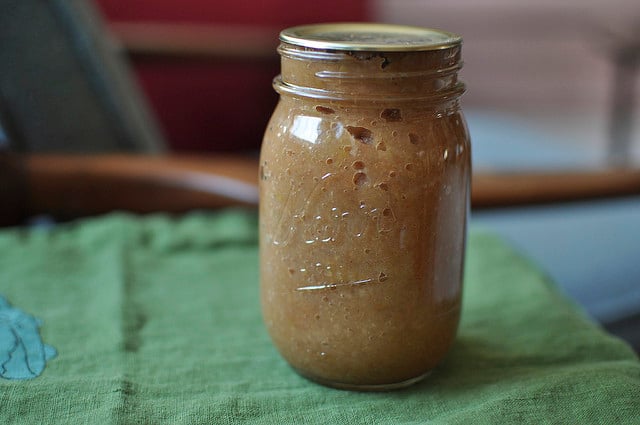
When it comes to my own canning, I like to make a mix of fun things and pantry staples. That means that while I make plenty of highly spiced jams and fancy pickles, I also make a point of putting up a goodly amount of tomato puree and applesauce each year. I stir applesauce into oatmeal, bake it into cakes, and eat it straight from the jar when lunchtime pickings are slim.
One would think that applesauce would be a fairly straightforward thing to preserve, but it can be surprisingly tricky, particularly for new canners. After getting a number of questions about applesauce recently, I thought I’d put together a list of commonly asked applesauce questions and my answers, in the hopes of putting many minds at ease.

What is the best kind of apple for sauce?
I don’t really think that there’s any one apple that makes the best sauce and truly, the best apples to use are the ones you have. I have cooked any number of apples into sauce and it has always been delicious. I would advise that you start with apples that taste good to you and that are relatively free from damage or rot (cutting around a bad spot or two is totally fine).
If you’re working with relatively sweet apples, you can always add a little lemon juice to balance the flavor. If the fruit is quite tart, a little sugar or honey will help adjust the sweetness.
What is the best way to make applesauce?
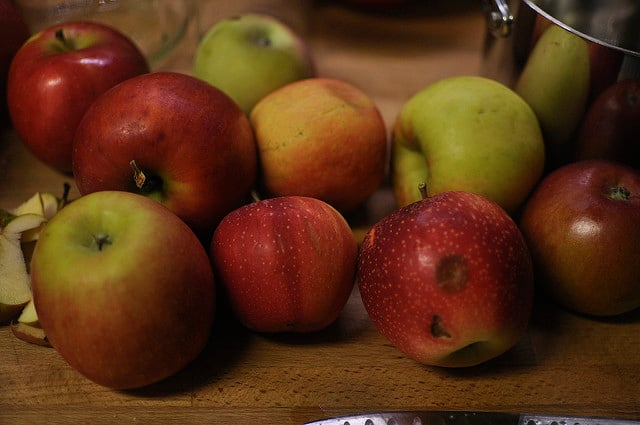
Your apple saucing approach depends on the gear you have in your kitchen. For basic batches, all you really need is a peeler, a paring knife, and a potato masher. Peel, quarter, and core the apples. Dump them into a big pot with a little water to prevent burning, and cook them on low until they are soft. Use the potato masher to smash them into a chunky sauce.
If you have a food mill or a tomato press with a saucing screen, you can skip the peeling process and put the cored and quartered apples right into your pot. Add a little water, over the pot, and simmer until the apples are tender. Then, work them through the food mill or tomato press. You’ll end up with a peel-free sauce with a uniform texture.
If you want to include the skins in your finished product, core and quarter the apples. Put them in a pot with a little water and cook until soft. Once they’re tender, work the apples through a blender in batches, pureeing until the apple skins are integrated. This works best with a high speed blender, like a Vitamix, Blendtec, or Ninja, but can be accomplished in regular blenders or with an immersion blender if you’re persistent.
I personally like a chunky applesauce, so often use an approach that blends the first and second techniques. I core and quarter my apples, but leave the peels on. I simmer the sauce until it’s tender. Once the fruit flesh has started to separate from the peels, I stand over the pot with a pair of tongs and pull the skins off the fruit. I work those peels through a food mill, to catch any bits of sauce, and then mash the remaining naked apples with a potato masher. You get the color and some of the vitamins from the peels and still retain the chunky consistency.

Do I have to add anything to my applesauce to make it safe for canning?
Nope. Because apples are naturally high in acid, you don’t have to add a thing to it to make it safe for boiling water bath canning. What’s more, apples also have a goodly amount of sugar, so they keep well once canned.
Can I add things to my applesauce?
Yes! You can add spices like cinnamon, nutmeg, ginger, allspice, citrus zest, citrus juice, sugar, honey, or maple syrup (though use maple syrup in conservative amounts. It is lower in acid than other sweeteners and if added in large quantities, can impact the finished acidity of the applesauce.
How long do I process applesauce in a boiling water bath canner?
If you live under 1,000 feet in elevation, you process pints for 15 minutes and quarts for 20 minutes. If you live above 1,000 feet, your processing time adjustments can be found here. Times and pressure amounts for processing a pressure canner can be found here, though it is not necessary for safety and can often lead to product loss.

I just took my jars of applesauce out of the canner and they are leaking! What did I do wrong?
First of all, know that applesauce almost always siphons like that. It’s hard to prevent it entirely, but you can do a couple of things to help minimize it.
The first is to minimize the amount of air you work into the apples during the saucing process. Apples pushed through a food mill or tomato press can take on more air than those mashed with a potato masher. The air isn’t the end of the world, but it will expand during the processing, which will then force some sauce out of the jar.
The second thing to do is to let the jars cool gradually once the processing time is up. The worst siphoning typically happens in the moments just after you pull the jars out of the canner, when they’re still really hot. Instead, let the jars sit in the canning pot for 10-15 minutes after the canning process is done. Once your timer goes off, you slide the pot off the burner and remove the lid. Let the jars cool slowly in the pot. After the 10-15 minutes are up, pull the jars out. They may start to siphon some, but it will (hopefully) be less than you’ve experienced in the past.
If my jars siphon, but the lids eventually seal, is my sauce still safe?
Yes! No matter how much they leak, if the seals are nice and tight, they are still safely shelf stable.
The surface of my applesauce has turned brown! Is it still safe?
It is! That is normal oxidation. You can either scrape off the brown layer or just stir it into the rest of he sauce.
If there is mold on the outside of my applesauce jars, is it still safe?
Yes! Sometimes you end up with a little bit of residual applesauce on the outside of the jars because of the siphoning I mentioned up above. It’s that applesauce residue that is molding. As long as the seal is still good and firm, the sauce inside the jar is perfectly safe.
There are some air bubbles in my finished, sealed jar of sauce. Is it still safe?
As long as those air bubbles aren’t moving around, they are fine. You can read more about air bubbles in finished products in this post.
If you have an applesauce question that you don’t see here, please make sure to leave a comment and I’ll update this post.

I only boiled my applesauce jars for ten minutes, not fifteen as recommended. They sealed but now I am concerned about the safety of my applesauce. Can I reboil them in the sealed jars?
They should be okay. Applesauce is a high acid preserve, so the very worst that can happen is that the jars will start to get moldy. I’d mark that batch and make sure to use it first.
I made applesauce and processed it in a water bath.the water came to a boil so I turned it down and it continued at a low boil , is this ok or should I open the Jars and redo it at the rolling boil. The jars sealed so would this be necessary?
As long as the water was moving, you should be okay.
I want to pressure can my applesauce. Can I raw pack the applesauce since it will cook during he canning process?
There is no reason to pressure can applesauce. It’s too much heat and pressure and will result in a poor finished product.
I froze my applesauce the day I made it then thawed it out 2 days later. Can it still be canned if I reboil it?
Yes. Reheat and proceed as you normally would.
I am leaving my cooked apple sauce on the counter for 2 days before water bath canning it.
(didn’t plan well)
If I reheat the sauce and simmer or boil for 5 min, before adding it to the cleaned jars to then water process will it be safe ?
As long as the applesauce doesn’t have any visible mold (which is a distinct possibility after 2 days), then you should probably be okay. However, letting it sit out that long is really not advised and this batch could spoil after that much time at room temperature.
Hi,
A friend of mine recently went to the Amish country and brought back a jar of applesauce for me. The mason jar lid is intact, but there is no ring. It came that way. Is it safe to eat the applesauce?
Totally safe. It’s common practice to remove rings once the jars are processed and sealed. More on that topic here: https://foodinjars.com/blog/store-jars-without-rings/
I opened a jar of applesauce and it smelled and taste like vinegar. Why is that?
It sounds like it probably fermented. Did you process it for the proper amount of time?
Does canned applesauce taste as good and fresh as frozen applesauce?
I think it tastes just as good, but admittedly, I don’t often freeze applesauce so my comparative faculties might not be perfect.
I was just wondering if applesauce can be canned using 8 oz jars (250ml). We do not go through a lot of applesauce.
If it can be done what would the headspace and cooking time be?
You can use half pint jars. Headspace and processing time remain the same.
Hello. I canned some applesauce back in September, and I just opened a jar (December) the jar was sealed perfectly but at the top of the apple sauce was a blob of something pink. Anyone know what it is? What caused it? And if it’s safe?
Does it look like it’s oxidized applesauce? Or did it look like mold? I’m unsure what would make applesauce pink if it didn’t turn that color during cooking.
Can I reclaim the applesauce on the bottom of my pressure canned that siphoned out of my jars. Will never use a pressure canner again for applesauce. What a mess.
You would not want to try and recapture that siphoned applesauce. And as a high acid food, there’s no reason to pressure can applesauce. The boiling water bath process is plenty.
thank you. going out now to check the tree for apples.
I would like to make bourbon vanilla applesauce. Do you have any info concerning how much bourbon and vanilla can be added safely per pound of apples ?
Here’s an apple butter recipe that includes bourbon. You can borrow the proportions from that. https://foodinjars.com/recipe/maple-bourbon-apple-butter-oxo-on-illuminating-digital-immersion-blender/
My applesauce has been sitting in the refrigerator for about 3 months. And now it has red specs on the top of the sauce.
Did you can it properly? That sounds like spoilage to me.
There are tiny white spots on the top of my bottled applesauce. The bottle was definitely sealed. Is the applesauce safe to eat?
That is not something I’ve ever run into before, so I’m uncertain how to advise you. The general rule of thumb is that if you are in doubt about the safety of your food, it’s best to throw it out.
I’d love to read your link on bubbles but the link isn’t working. Thank you!
Hi Wendy! Thanks for catching that error. Here’s the correct link. https://foodinjars.com/blog/canning-101-air-bubbles-in-finished-products/
I’ll make sure to fix the post.
I have canned applesauce several times now. I made the sauce yesterday, put it all into jars as soon as it was made while still hot. Started water bathing them today and I have a bunch that are fermented! My apple pie filling is fine, even the cider I made from the water I cooked the apples in is fine but the applesauce has about half of them fermented. What caused this?
You can’t make the sauce, put it in jars, and then can it the next day. You can need to water bath the jars as soon as they are filled with hot sauce. Of course your sauce fermented.
I realized I did not bring my applesauce back up to a boil before water bath canning, The sauce was warm, but not hot so I processed an additional 5 minutes. Is it safe to eat or should I toss them or possibly reopen and reprocess.
It should be fine.
Hi, I canned applesauce today for the first time. I live at altitude (5280 ft), but just realized I forgot to adjust my processing time (only did 15 minutes for point jars). Should I reprocess tomorrow or simply plan to use these jars in the next few months? Thanks!
I would eat those jars first rather than recan them (as it would negatively impact the finished quality). The worst that could happen with applesauce is that it could mold. You will see it immediately upon opening the jar. If you do, don’t eat that jar.
Is there anything I can do to make the applesauce stay yellow instead of brown when canning, it’s yellow when I cook it but turns brown after canning?
Applesauce always darkens a little. You could add extra lemon juice, but that will only help so much.
I’ve been canning for several years now and have used only tried and true techniques and recipes from several canning guru books. For some reason this year, the new jars with new seals and new seals for replenishing purposes, seem to not pop as heartily or at all, but slowly concave into the jars in the cooling down process after they’ve been either water bathed or pressure canned. This is happening across the board with different mouthed sized jars, different products being canned. I could have the exact same jars filled with the exact same amount of product, with the exact same headspace (I use a tape measure and measure each filled jar’s headspace prior to putting the seal on) and use the exact same company product seals and 1 jar may pop while the other slowly concaves into the jar. I could do 10 jars at one time and 50% will pop and the other 50% will slowly concave into the jar. I have always “warmed” the seals prior to putting them on the jar. I always ensure my jar rims are completely clean of any food prior to putting on the seal. So far I have canned over 150 jars of varying sizes and food products and there seems to be no rhyme or reason why this is happening with this year’s supply of seals. In prior years, the seals would have a visually definitive concaved appearance, giving one the assurance the product is sealed. These new seals don’t have that defined concave appearance, but show a subtle “dip” in the middle of the seal. I’m at the same altitude, I boil the recommended amount of time, I “rest” the jars in the water bath for 5-10 minutes prior to taking them out, etc. Any idea as to why this year’s seals are doing this? Kinda makes me feel whether they are properly sealing and concerned about the end product. Thanks for your patience. One of my canning friends (she’s been canning for more years than me), is saying the same thing. Perhaps a call to the 3 companies’ seal products I use should be done. Thanks for reading.
I believe that the folks at Ball increased the thickness of the lids ever so slightly, which could account for the difference. Know that Ball, Kerr, Golden Harvest, and Bernardin are all brands owned by the same company, so while they have different names, the lids are going to be identical (which is why you’re experiencing it across the board). Beyond the minor increase in thickness, I can’t explain why this is happening to you. Have you tried leaving the jars in the canner with the heat and lid off for 5-10 minutes after the processing time is up? That slow cooling period can help encourage a more immediate seal when the jars are removed from the canner. Good luck with it!
I made a batch of applesauce for the first time yesterday (looking forward to trying it) and there was some siphoning. I read that isn’t a problem.
But – the applesauce seems to have separated from the juice. There’s a layer of juice at the bottom. How can I prevent this in future batches?
That happens when you cook the apples, let it cool and then reheat it. It breaks down the pectin in the fruit. It’s not dangerous or unsafe. Just stir to combine before serving or using. In the future, once you start the applesauce making process, you have to go all the way to the canning process without letting the sauce cool.
Hi Marisa. I am curious about the separation question, because I just canned applesauce yesterday, going through the entire process without letting the sauce cool, and guess what? Separation at the bottom! Any other possibilities?
It could be that it cooled some. Beyond that, I don’t know what to tell you.
I just opened a pint jar of home canned applesauce that was given to me. It seemed to have sealed when it was canned. (I had to break the seal.) The top looks dried out except for one area about the size of a quarter. It looks like it is starting to have mold. Is it safe to eat?
If it looks like it is molding, you shouldn’t eat it.
I’m not sure if this was asked already but do i allow the jars to cool before the bath?
No. The jars need to be processed in a water bath immediately upon filling.
Hi, I added 1/4cup of southern comfort to my canned apple sauce just before canning &hot water bath. Did that hurt anything.
It shouldn’t have done any harm. I would make sure to label the jars so that you don’t accidentally feed that applesauce to any kids, though.
I canned applesauce in sept 2016, we moved and the jars froze while in storage and have now thawed, are they still safe?
I wouldn’t use them. The applesauce may have expanded as it froze, potentially compromising the seal.
I add various other fruits to my applesauce before canning in my water bath canner, how does that affect shelf life ? AND, if the seal does not take (I hear a thud when tapping with spoon instead of ping)
How long will product stay fresh UNOPENED in fridge as I like to bring to family to share. I understand week to 10 days AFTER opening but I am curious about refrigerator shelf life storage. I freeze as much as I can because I know that keeps longest. Thanks
The sound of the lid isn’t an accurate way to determine whether you have a good seal. The best thing to do is to remove the rings and test whether the lid is firmly adhered to the jar. It will probably keep for weeks unopened in the fridge.
Additionally, adding other varieties of fruits don’t impact the safety or shelf life of your applesauce. It remains the same. Good for about a year+.
My jars pinged (sealed) almost immediately after I removed from the pot. Are they still sealed correctly and safe to store on shelf?
Yep! That often happens!
If a pint jar of applesauce pops before it is put in a water bath, is it necessary to continue the water bath for the 15 or 20 minutes?
Yes. You still need the sterilization that the water bath provides.
I canned apple pie filling last yr. I used the boiling canning method. Just went into pantry’s to grab a jar and noticed that there is a separation in apples and I’m assuming it’s just the sauce…looks thick gravy in bottom of jar. The seal is good…Is it still safe to use?
That kind of separation is totally normal.
The Ball book says to cook the applesauce to 212 degrees (boiling) and keep it at that while I fill the jars but my applesauce is boiling at 175 degrees. I’m at an altitude of 4500 ft above sea level. Is that hot enough, as long as it boils?
Do I need to cook the applesauce first, before filling my jars with it and processing it? How long and to what temp.?
We just made applesauce and it seemed like a lot of food siphoned out. We were relieved to hear that if the seals popped, they are safe. However, there is a fair amount of space at the top of the jars. Is it still safe? They aren’t air bubbles but isn’t that air? (We canned in a pressure cooker).
As long as the jars were processed for the proper amount of time and the seals are good, they are safe. The trouble you experienced is probably due to the pressure canner. Applesauce doesn’t need to be pressure canned and the increased amount of heat and pressure that a pressure canner applies caused the siphoning.
I just made a big batch of applesauce a couple weeks ago. When I popped the top of the first jar, there was a bit of white mold. What went wrong? We used sanitized jars, heated to boiling before putting in jars and put them in the canner for 15 minutes.
I don’t know why your jars got moldy. It sounds like you did everything right.
Do you need to add lemon juice to applesauce made in the slowcooker (no sugar added) for freezing? How long should the applesauce keep in the freezer or refrigerator?
Applesauce needs nothing additional to be made safe. You can add lemon juice if you need to brighten the flavor or want to help prevent the sauce from discoloring, but it’s not necessary. And I find that applesauce keeps a couple weeks in the fridge and up to six months in the freezer.
Once canned, does the applesauce need to be refrigerated?
Once canned, nothing needs to be refrigerated until you open the jar. Canning creates things that are shelf stable.
I cooked several apples last week and used a colander to make the apples into applesauce. I then placed the applesauce in the refrigerator. Due to some expected issues, I haven’t been able to finish canning my applesauce until today, is the apple sauce still okay after a week in the refrigerator?
Yes. It’s fine.
I had same situation- in fridge 4 days, I let jars rest an hour then water bath canned. Are they safe to store in pantry now?
You put them in the fridge after you did your water bath? They should be fine, though they never needed to be put in the fridge at all!
I have been canning applesauce for three years. this year my applesauce congealed. it is like jello and wiggles. it still tastes fine. can you tell me why this happened? and is there a way to fix it?
I’ve never encountered that particular applesauce issue, so I have nothing helpful to add. So sorry!
New too canning … need some questions answered..
I canned applesauce for the first time this morning and when I opened
my water canner some had spewed out into the water. Has this ruined
all the jars that were in the water canner as well? Also some applesauce
leaked out. All the jars popped when removed them from the
canner , but … the applesauce has done some separation as they cool.
Are the jars compromised? Are they all safe?
Go back and read the section of this blog post entitled, “I just took my jars of applesauce out of the canner and they are leaking! What did I do wrong?” You’ll find that your experience is totally normal. Applesauce separates when you cook the apples, let them cool, and then reheat the sauce. So that’s normal too.
We have been making and freezing applesauce for 40 years but found some nice Weck jars and decided to try canning for a new grandchild. Suddenly was worried about no sugar and all the horror stories of stable products for canning so many thanks for your comments about the high acid content and natural sugar. My brain knew that but needed reassurance.
Long time listener, first time caller. 😉 I love your blog, Marisa! I get nervous about making even little substitutions that logically should be safe to canning recipes. It is safe to add other high acid fruits to the apples to make flavored sauce (ie cherries or berries), right? I know you can add spices like cinnamon and nutmeg, but can you safely add extracts (ie almond or vanilla)? I made some applesauce with tart cherries and 1/4 tsp of almond extract added. It was really good and I want to make more to can but I’m nervous about going off book. Is there anything, aside from low acid ingredients, that can’t be added. TIA
It should be fine.
A couple of applesauce questions:
first, how on earth do you get applesauce to the 212º stated in the BBB (and keep it there while filling the jars) without burning the applesauce, or yourself?! The worst burn I’ve ever had was from applesauce burping out on my arm.
second, occasionally I have applesauce separate where there is a layer of apple juice at the bottom of the jar, but have no idea why it happens some times and not others.
You don’t need to bring applesauce to a hard boil and even if you did, you certainly don’t keep it there while you’re filling the jars. And that separation occurs when you heat, cool, and then reheat applesauce.
Life with toddlers made this happen with today’s canning project. Is it still safe for the pantry? Should I toss it in the freezer instead? Keep it in the pantry but make sure it is the first that gets eaten? Thanks!
I’ve been canning applesauce in a water bath canner a few times now. This last time, I made 8 pints, I added about two teaspoons of fresh grated ginger to the slow cooker when I put the Apple’s in for several hours of cooking I don’t know if that was a no-no or not.
That’s fine. That’s not enough ginger to be problematic.
I’m making applesauce in the crockpot. First time. I’m using a food saver to seal the jars. This might be a silly question, but do I seal the jars when they’re hot or wait until they cool?
I don’t use Food Savers, so I have no idea how to advise you.
just wanted to add a note here – I have a chamber vacuum and they very explicitly stated that you cannot vacuum seal perishable food and leave it out at room temp – creating a vacuum does not substitute for the sterilization that results from canning. If you’re going to freeze your food your sealer is fine.
I typically make applesauce in the slow cooker and then freeze it. I add lemon juice and cinnamon but no sugar. Is it safe to water bath can applesauce prepared in a slow cooker? Or does it have to be done on the stovetope?
You can can applesauce that was made in a slow cooker.
HELP!;) I have an Apple Tree! Please let me know how you
Used the slow cooker to cook the apples.
Your recipe and process would be greatly
Appreciated . I have never canned so I
Am anxious to learn. Freezing would be
My choice, but maybe canning (as s
Nervous newbie) would be better. ???!! I
Also want to do low sugar Apple pie filling!
I am also going to try fruit leather!! But that’s
a whole other discussion ! Lol
Thank you ,
I have an apple tree too–red delicious 🙂 Crockpot applesauce is my fave because it gets so sweet without any sugar added. I fill my slow cooker as full as I can with thinly sliced apples, 1/3 cup water, the juice of one lemon, and a cinnamon stick or two. Then I just turn it on low for several hours, until the apples are falling-apart soft and very fragrant. It’s not a sensitive process. (If you leave it way too long you’ll just end up with apple butter.) Then I mash or blend it, pack it in freezer bags and freeze. Be advised that your applesauce will be a darker color, closer to a caramel brown rather than yellow like stovetop applesauce. It tastes amazing! I am going to try adding Ball’s Fruit Fresh powder this year to see if it keeps the applesauce yellow, since some people prefer it that way.
I have several jars of canned apple sauce on my shelf, I’m not sure how old they are. The sauce is now brown. If it still smells ok is it safe to use?
I made a large batch of apple sauce 12 days ago. I intended to finish eating the last of it today but there are two small reddish brown spots. Are these mold? Can I scoop them out and eat the rest?
Mold isn’t typically reddish brown. It could be some oxidation rather than mold. However, I can’t make the call for you. You need to use your own best judgment.
My canned applesauce has a pink layer on top is it still safe to eat?
It should be fine.
Thank you
Can I make Pear Sauce the same way? Do I add anything?
You can make pear sauce the very same way. Pears are often a bit lower in acid than apples, though. So I recommend adding a bit of lemon juice for safety and to retain color.
How long is pressure cooked apple sauce good for shelf life?
You really don’t need to pressure can applesauce. Its shelf life won’t be considerably longer than applesauce processed in a boiling water bath canner. That shelf life is a couple of years.