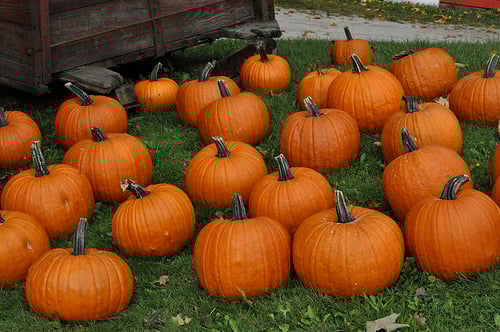
This time of year, a canner’s fancy turns to pumpkins. Tis the season for all things round, orange and squashy, after all. However, as you start searching for recipes for home canned pumpkin butter from reputable sources, you’re going to find yourself disappointed. You see, both the USDA and the National Center for Home Food Preservation are going to tell you the same thing. Don’t do it.
I’m sure there are more than a few of you out there saying to yourself, “but I’ve been making and water bath canning pumpkin butter for years!” And it’s true, many years ago, there were USDA-approved recipes for pumpkin butter. Unfortunately, the rules of canning are not a static canon and so, in 1989 the USDA changed their recommendations and the NCHFP followed suit. No home canning for pumpkin butter, not even in a pressure canner.
The reasons why homemade pumpkin butter isn’t recommended are several. When cooked down into a butter, pumpkin flesh becomes quite dense, making it difficult for the heat produced in a canner to penetrate fully through the contents of the jar. This means that even in a pressure canner, the interior of the jar may not reach the 240 degrees needed to kill those pesky botulism spores.
Additionally, pumpkin and all other winter squash are a low-acid vegetables, meaning that without careful treatment, they could potentially be a friendly environment in which botulism spores might grow into their toxic adult state. In tests, it’s been found that the pH of pumpkin has a fairly wide range, meaning that it’s not possible to offer a basic acidification ratio as there is for other borderline and low acid foods.
The good news is that pumpkin butter can be frozen and also keeps quite well in the fridge, so it doesn’t have to be entirely off the menu. I’ve also been pondering whether one could make a an apple-pumpkin butter that would be high enough in acid to be safe for canning, but would contain enough pumpkin to be sufficiently autumnal. I may do a bit of playing around, to see if I can get somewhere close to the flavor I’d like to eat.
If you’re curious to read more about the safety hazards of canning pumpkin butter and other squash purees, click here to download the PDF that was the primary source for this post.

Just a thought…manufacturers (ball jars potentially in this case) are all about reputation and liabilities….I’ve made it for years and have not killed anyone, nor made them sick. It’s a tradition for my for family and they LOVE it. Prior to that I bought it at a local apple farm and never got sick. Hmmm odds seem pretty good. Companies cannot afford that .5% that did not get the sanitation right…be true to yourself … 🙂
Joanna, it’s not about sanitation but acidity.
I baked my pumpkin, and now making a butter. I was…actually am in the process of canning. I guess i will take the jars out and put in the frig.
I was planning on shipping the butter to family. I guess thats not a good idea.
Is it possible to get sick of the butter if it is not continually in the frig? Can i keep in my frig and just handout to people?
It’s fine if you keep it refrigerated, as the temperature will inhibit the growth of any botulism spores into the botulism toxin.
I am using manufacturer’s canned pumpkin to make my pumpkin butter. Using a pressure canner, is it still unsafe to can pumpkin butter?
It doesn’t matter what variety of pumpkin you use. Pumpkin butter is not safe for canning whether it was made from fresh pumpkin or canned.
I am really not one familiar with pumpkin or apple butter. I do not want to preserve it, I only
want to refrigerate it the day before so I can use it the next day. How do I store it for this purpose
For that purpose, you just put it in a container and refrigerate.
Ok this is a little to late I just put a pie pumpkin in the oven to roast it so I can make pumpkin butter because I have a lot of customers asking for it. I am getting mixed reviews not only here but on other sites about canning pumpkin butter. I found several recipes that say to add 1/3 cup lemon juice to the recipe. When I make pies I usually pull the pumpkin straight from the oven, puree it and then bake it after adding everything to it. This is the first on pumpkin butter but I was going to treat it like any other fruit/veggie I have canned. Which is anything thing that has low acid add lemon juice to it( lets face it I put lemon juice in everything), I can my extremely hot fruits and veggie ( I know cause I have gotten second degree burns from them splashing up from the pot) and process everything in a water bath for 25 minutes just to be safe. I am hoping doing this it will be safe.
Melissa, it is not safe to can pumpkin butter using any method. You cannot just hope it will be safe. If your customers are demanding it, make it as a refrigerator-only product. You cannot treat it like every other thing you’ve canned. Seriously, don’t do it.
Melissa ~
I would not hesitate to make pumpkin butter as you describe. If you’ve baked the pumpkin at 350 degrees, you have killed any innate botulism. If you are clean and sanitary in the rest of the process, and everything is as hot as it can be, the butter, jars, etc, you should not have a problem.
Folks, once again, I have to beg to differ. Just because you put something in a 350 degree oven doesn’t mean that the actual product reaches 350 degrees. Baking does not kill botulism spores. The only way to dependably elevate temperatures high enough to kill botulism spores is to do so with a pressure canner. However, it has been found that because pumpkin butter is so dense, even when canned in a pressure canner, the heat doesn’t reliably penetrate to the center of the jars. So you can’t reliably can pumpkin butter in any fashion. If you are using lemon juice to elevate acidity, you must check the product with a pH meter in order to ensure that you’ve reached those safe levels. Seriously, I don’t recommend this.
Ok What I am going to say on this issue is that I bake my pumpkins at 400* for 2 hours so that they are nothing but mush and the skins come off very easy. Then I run the mush thru my food strainer and then return it to the stove again and heat it up once move. I use a thermomater and I can tell you that in the middle of that pan it never reads under 275*. And then I make my pumpkin butter. I also add lemon juice just to be on the safe side. SO while I understand that as a whole everyone is saying do not do it. THere are ways that you can make sure that there are no spores.
This is still not safe. There’s no way to guarantee that any present botulism spores are all killed. It’s best not to gamble with this sort of thing.
I have been canning pumpkin butter for over 15 years and never had any problems. I scrub the outside of the pumpkin with a mild bleach solution, rinse well and let dry. I then peel pumpkin, cut it in chunks, puree in food processor, put in in 16 at roaster pan with 1qt water & 1/2 cup lemon juice and cook for 24 hours. From that I make the pumpkin butter. I also wash all utensils in hot bleach water then run them thru the dishwasher. So far I havehad no problems.
You can disinfect all you want, that just doesn’t make it safe in this situation.
that same logic can be applied to every single thing made at home. its called mitigating the risk. there is a very low probability that it will contain botulism spores. the government has a duty to warn you and strongly recomend not doing it because a ton of people do not know how to make it reasonably safe.
Actually, I’d say the government has no duty to protect us from ourselves. And if it stopped trying we’d no longer have to endure constant warnings about the horrific dangers of things people have been doing safely since forever.
You have killed all the botulism by baking it for so long at such a high temp. If you dont add spores to it after that….you wont have any in it.
I have been making and canning pumpkin butter for years. I add lemon juice, I make sure the pumpkin butter is very hot, the 1/2 pint jars are very hot and the lids are very hot and I water bath it for 25 to 30 minutes. I have never had a problem, neither has my Mom. The USDA recommended it for years, then all of a sudden changed their minds. I still do it. Like I said, I have NEVER had a problem. You just have to make sure everything is very hot and you process it 25 to 30 minutes.
Don’t forget, the USDA also made all restaurants get rid of their wooden cutting boards in a mad frenzy, without doing much research at all, only to find out that they were perfectly safe after doing research.
The USDA, also in a mad frenzy, passed laws saying that all apple cider must be pasteurized (with extremely few exceptions) because a child got salmonella from un-pasteurized apple cider. But alas, once again, after actually doing research it was found the child got it from lettuce. The damage to local apple orchards was already done and many have since gone out of business because the mass hysteria was supported by the USDA without ANY research and the laws on pasteurization remain (lord forbid they put as much media attention into their mistake than they did the frenzy).
if you are making it to sell, BY LAW, you have to adhere to USDA/UCHFP regulations. if its for yourself them by all means risk your life so you can store it outside the fridge. when you start risking others is when the law steps in and tells you no. also do you really want to risk sending one of your customers to the hospital? just tell them to refrigerate it. put it on the label and if they dont its on their end not yours.
i am also trying to find a mix that keeps the flavor yet takes away the density. but i might just have to settle keeping a few jars in the fridge for the next couple of months.
Question: To all of you who canned pumpkin… on Saturday, I canned pumpkin. Today, their seals popped. I’ve created the perfect environment for botulism to occur b/c I didn’t allow enough space in the jar or heat the low acidic pumpkin hot enough after it was canned. Since the pumpkin has just begun to expand, if I boil this pumpkin for 20 min., could I kill all of the spores, then freeze and reuse this pumpkin? I’m even wondering if putting it on high in my crockpot overnight, then freezing it in the morning… thoughts?
If you canned pumpkin and did not process it in a pressure canner, you must discard it.
I cannot freeze anymore food- we are bursting with two ful freezers AND my husband hopes to get a deer. I make pumpkin chutney and pumpkin pear and cranberry chutney. I use the basic recipe from Putting food by which is plenty acidic. Chutneys and picles are acidic by nature. I have made the wonderful apple zucchini butter in Costenbader’s Preseving the Harvest. It too has vinegar added and I would think that could be used for a butter recipe.It is savory , however. Perfect for turkey sandwiches or cheddar cheese.
I have squashes and winter luxury pie pumpkins that are not hardening in this moist weather. I need to process them. I am thinking that a cranberry pumpkin butter would be very acidic. Boiled down cider could help get a nice gloss to the final product. I also have seen pumpkin marmalade recipes . Have you tried them? I will pressure cook quarts – I am used to having pumpkin soup all winter long. I cannot lose that harvest!
It seems that this comes up for you at this time every year, but did you ever come up with a good pumpkin apple butter recipe for canning? I’d love to try it. Thanks for all the good information!
http://www.ext.colostate.edu/pubs/foodnut/09305.html
This is a website from the Colorado State University Extension that explains botulism. Since botulism spores come from soil and water and don’t grow in air I am wondering why the commercially canned pumpkin would become infected when opened in the house and canned with commercially canned apple juice. Thanks.
Does not matter if it does not mean * to you are not. You are entitled to kill yourself any way you see fit. Not looking to start a flame war, just trying to clarify. The issue is not botulism, not other food poisonings that cause a little tummy ache. Botulism kills, period. It is relatively rare, so does not kill often, but when it does it takes out whole families. You want to run the risk, then fine, go ahead and risk your self and let Darwinism take its course. USDA recommendations are not draconian and to deny you your rights, they are to try to keep you from killing others without their knowledge of your poor practices and to provide the information to those who wish to make informed choices.
Thank you to the author and other informed readers who provided the good explanation for the rule. I actually found the USDA basic write-up deficient in reason for the rule.
Well if we have been doing something safely for years and the USDA says not to it doesn’t mean shit to me, seriously. Oh so we have been doing it for a few hundred years with no ill effects and the USDA now says not to and we are supposed to agree that, “the rules of canning are not a static canon”.
That is the dumbest statement I have ever heard in recent times. Seriously! So the USDA says, do you know what else the USDA says? How about GMO foods are perfectly safe and have no need of testing. So go ahead and trust the fricken USDA in conflict of two or more centuries of fact if you want to be the governments bitch if that is what you want to be.
Perhaps the key word is GMO . If one uses GMO pumpkins in their Pumpkin butter , it may not be shelf stable after home canning. Ahh the wonders of progress. I say go NON GMO !!!
USDA also says that the radiation that is now used to treat meat before sale is perfectly safe, so is the growth hormones they use to feed chickens, cows, etc. I wonder if that has anything to do with our kids being bigger, enter puberty at a much earlier age, alter behavior. It is not just the meat that these hormones are found in. You still have the milk, eggs, cheeses that come from the animals. And the list goes on and on and on…..
Marissa, where can I get a ph tester. to check the pumkinbutter I made. The recipe does have applesauce and applecider and lemon juice in it. Thanks G.
Just so you know, pumpkins and winter squashes are, botanically speaking, fruits, not vegetables. Anything that is the fruiting body of a plant is a fruit. Things where you eat the leaves (kale, spinach, lettuce), stalks (asparagus, rhubarb) or seeds (beans, peas, corn) or roots (beets, carrots, potatoes) are vegetables.
So OK… I haven’t canned in a few years, and only did tomatoes, pickles and such when I did do it… in a nutshell you are saying that IF you were to safely can pumpkin butter, as long as the ph level is below 4.6 (albeit by adding 1/2 apples, apple cider, lemon or whathaveyou) it would be OK!! Sounds like a good experiment!! 🙂
Julie, if you were to bring the pH down to an safe level and ensure that it wasn’t too dense, it would probably be okay.
Did it work? If so, recipe please?
I’m not taking any chances. I am a Master Certified Canner and believe that the rules set down by the USDA are for a reason, my health. I don’t want to take a chance. “B” is a nasty horrible bacteria. It has a high mortality rate. No, I’ll freeze my pumpkin butter. Thanks for the information.
Thank you for this. I was just about to turn over 60 pounds of pumpkins into butter with the hopes of selling it at our Farmer’s Market. Thank you, thank you, thank you. Do you know how long you can store the butter frozen?
Ms. Glaze, pumpkin butter holds well in the freezer for at least 6-9 months.
I am also researching how to make pumpkin butter that is safe for public sale. I was advised today that I must get the pH level below 4.0 in order for it to be acceptable. I’m also going to try the apple-pumpkin butter recipe that uses apple cider, brown sugar, and applesauce. I have a pH tester and will post the resulting pH level once I get a test batch made.
Joyce, what was the results of your experiment?
Wow, I have only been canning a few years now and only jams and butters, but I canned pumpkin butter last year from a recipe, and used a steam canner to boot! I must have made 40 pints of butter last year and gave away most of them as gifts. Looks like no more canning pumpkin butter for me from now on! Time to start doing better research.
But as far as the steam canning, I have the jars come out so hot its unreal, and the caps seal almost immediately as I take off the cover. I haven’t had a issue yet with it but after reading all of this it makes me consider the hot water bath now, although I do like how the steam canner heats up with less power waste than the hot water bath. One more question though, I am looking to purchase a steam juicer and would like some input on that item if possible as well. Thanks for all the info here, glad I stumbled upon it
I have a steam juicer made by “back-to-basics”. Love it~
Stonewall Kitchen sells maple pumpkin butter to the masses via the internet. Hmmm.
I would also like to know if any one out there has tried a pumpkin jelly.
I am also into canning jellies and jams. I am glad to know about the pumpkin butter
because I was going to can some tomorrow
glad I stoped by to see what is up with pumpkin butters. just starting up my own jam,jelly business in Idaho,boy making that butter could of killed my business. I have a juicer and have used it to make jellys. can I combine the pumpkin juice with apple or orange and make a jam or jelly using the water bath method? if anyone knows let me know. thank you BEARPAW JAMS
I was just wondering if I could freeze pumpkin butter in canning jars or do I need to buy freezer containers also do I freeze it while it is still warm or wait until it is cold. Forgive me but I am new to canning etc.
Debra, you can freeze pumpkin butter in jars as long as you leave plenty of headspace for expansion. Wide mouth jars are better for freezing than regular mouth ones. You can put the pumpkin butter into the jars while it is still warm, but do not place them in the freezer until the butter has cooled to room temperature.
I would have to disagree with leaving the butter to cool before freezing. Your suggestion is to pack the jars while the pumpkin is still warm. This is where botulism starts. The jars aren’t pressure canned/sealed and the pumpkin isn’t over 240* so the potential is still there. It’s just like refrigerating leftovers. Food shouldn’t sit out to cool before it’s refrigerated.
Botulism cannot develop in oxygenated environments. So provided you don’t seal the jar, botulism will not begin to grow there. I recommend waiting to put it into the freezer until cool so that you don’t overwork your freezer.
Any ideas on how long the Pumpkin butter will stay safe if I do put it in small jars? All my experience with cooking has proven that if it’s delicious, it will be tasted and eaten and gone within 3-5 days. SOOO if I want to give it out to friends and family, how long can they keep it in a refrigerator before they “die” of contamination? Two weeks? A month? Can I put it in a jar at all or does adding it to a container that’s not for freezing immediately lend it to botulism?
I really just want it to be safe for a few weeks on the rare chance that its not opened TODAY- any ideas on that?
It keeps safely in the refrigerator for several weeks. It can also be frozen for months at a time. The botulism issue only comes into play when it is sealed into an airtight environment and kept at room temperature.
I read the ingredients on Williams-Sonoma’s pumpkin butter and it contains lemon juice not apple juice. Would this make it acidic enough to be safe to make at home?
Nope. Chances are that Williams Sonoma processes their pumpkin butter under more heat and pressure than can be achieved in a home kitchen. Your pumpkin butter would have to be at least 1/4 lemon juice to be safe (and that is just an educated guess. Don’t quote me on it). That much acid would totally negate the flavor of the pumpkin.
I was wondering if you can boiling water process the SMALLEST jars, since it would surely get up to a high enough temp? Is that a silly question? I hope not, as I’ve really been noodling on how to can the pumpkin butter. I used to do it years ago, and want to follow the new guidelines but am not sure if there are any ways around it….
Is freezing it the only option now, regardless of size jar?
Wondering if something like this might be safe: http://www.food.com/recipe/apple-pumpkin-butter-387950
I have 2 sugar pumpkins on my counter that I was going to make into butter w/recipe from: Canning by Sue & Bill Deeming, HPBooks, 1983. My kids are going to be MAD if I don’t find a good substitute or convince them frozen is just as good.
The only way to definitely determine whether that recipe is safe or not would be to test the pH of the finished product. There are instructions as to how to do that in Stephen Palmer Dowdney’s two books, Putting Up and Putting Up More.
I’ll just use my pre-1989 Blue Ball canning book and can the way my mom, grandmother, and great-grandmother did in 1988 (and yes, they were all alive and canning in 1988). I grew up with canned meat and vegetables, all from a water bath canner, that the government says is unsafe since 1989.
My Grandmother always told me when making apple butter or even pumpkin butter … I must always use vinegar in the recipe. This is for safety reasons … Plus you never taste it … Once the final product is finished. It has always worked for our family. Note: She also never canned pumpkin butter … It was always frozen or placed in the frig. My grandmother was in her nineties and never knew anything about the above USDA recommendations. She was from the old school and this is how she taught me when I was just a little girl.
Well poopie! I guess I will stick to storing some of my butter in the freezer and giving the rest away to be used right away. 🙁
A positive note is that I guess it makes all the more enjoyable to eat when it’s purely seasonal………. Something to look forward to every year. 🙂
So I was looking at Pumpkin Butter jars (8 and 16 oz) in a store and saw that most listed citric acid as an ingredient. Anyone using this as an acidifier in their home canning?? I have some on hand (from wine making) but clueless as to how much to use. Has anyone sent butter samples to lab for testing?? Anybody using a pH meter at home to test their butter recipes??
I keep seeing recipes for pumpkins/squash butter that call for orange or apple and lemon juice. Seems like this would add the acidity required? I was going to make some butternut squash butter for gifts but I think I”ll do a bit more sleuthing before I embark upon that project. Till then I’m on to a pear-vanilla butter, photos and story should be up soon on http://www.storiesformysister.wordpress.com !
Apple-pumpkin butter sounds divine!
I admit that I am awfully new to canning, but it strikes me that with the addition of apples and a healthy dose of lemon juice you could counterbalance the low acidity without too much of a problem.
However, because of the density issue I would only can it in the Ball Elite 8oz jar (or something similar in design). The fact that it is so wide and flat would make it a lot easier for heat to permeate through the entire jar of apple-pumpkin butter. And hopefully, the addition of the apples would also make the butter less dense thus making it less of an issue anyway.
“it strikes me that with the addition of apples and a healthy dose of lemon juice you could counterbalance the low acidity without too much of a problem.”
You’re right. Just be sure you achieve a pH of 4.6 or lower.
Glad that I did the right thing by accident…I froze mine, but I did it because I’m not confident in my canning.
After this post the other day, something was tickling at the back of my brain because I actually pressure canned cubed pumpkin last year and I was pretty sure it was a reliable cookbook recipe. I did a little digging and, sure enough, the Ball Complete Book of Home Canning (the thick one…not the Blue Book) has a recipe for cubed pumpkin or butternut in water. Apparently, cubing it produces an even enough density that they felt comfortable publishing the recipe.
Incidentally, I haven’t cracked them open yet. They seem to have held-up well but have discolored a bit to a dark brown instead of bright orange.
In addition, last year was my “maiden voyage” (if you will) for canning and I did make canned pumpkin butter from a recipe I found on the Internet (I know, I know…reliable sources and all). I had seen the “don’t can pumpkin puree” warning from the Feds but I just assumed it didn’t apply to butter, which has a ridiculously high sugar content and is cooked a very long time. Sugar is also a great preservative (many buggies can’t survive in a high sugar environment).
So what to do with the sugar pumpkins sitting on my counter and all those family and friends begging for a jar of butter this year?? Freezing is out and constant refrigeration is not an option since these will likely be Christmas gifts, sitting under a tree or in the car for a bit.
I think I’m going to chance it, personally, and take a few extra precautions using some sound food science to guide me. My thoughts:
1) As I mentioned, sugar is a good preservative and butters have such a high concentration, that should help. Butters are cooked for hours, probably covering all your bases *except* botulism.
2) I think I’ll pressure can it this year just to be extra safe and I won’t use anything bigger than an 8oz jar. I’ll also make sure there’s plenty of room between the jars for better heat absorption.
3) I think I’ll try adding a few teaspoons of acid (lemon juice) at the end of cooking. It may change the flavor a bit, but a little extra insurance is probably a good thing.
4) As a triple safeguard, I’ll be extra careful about boiling the jars and equipment and keeping it out of the air as much as possible until the jars are closed.
Mind you, I’m no professional. These are my personal feelings on the matter, but I feel comfortable with the extra precautions and the food science behind them. You should always use your own good judgment.
Incidentally, Marisa, if you happen to do that recipe with part apples, I’d love to see it too! I just may see if I can get my hands on some PH test strips and see how bad the taste is if I add enough lemon juice to get to an acceptable level. I’m just curious…
Lisa and Justin, I am sure you know more than the pros but please don’t send me any. I remember a few years ago, everyone in the family of 7 died of botulism except the 2 week old baby who was too young to eat big people food. No way is that risk worth it.
For cloristridium botulinum, acid OR very high temperatures are the fix. This bacterium can survive nicely in sugar. This is why ancient methods of lacto-fermentation (pickling) are relatively safe. C-bot cannot survive below 4.6 ph.
Many websites (this one included) cite the “why not home canning” language about density, acidity, water activity and whatever else. But no one explains the commercial canner magic that makes their commercially canned pumpkin butter safe. We follow this rule simply because it is a rule?
Well, drat. I’ve got to say I’ve been wanting to make and can pumpkin butter, but you’ve convinced me not to do it. Our freezer is full to overflowing, but I’ll see what I can do. Thanks for the great information, as always!
There is a Greek recipe for pickled pumpkin that I’ve been meaning to try for years. I’ve finally grown enough pumpkins to make a serious batch. Obviously we’re dealing with vinegar here, but I was wondering if anyone’s made pickled pumpkin before? What’s the texture? What do you use it for? Antipasti? Pies? As a side dish?
Pumpkin can be pressure canned if it is in one inch cubes. ( http://www.uga.edu/nchfp/how/can_04/pumpkin_winter_squash.html ) I add some pumpkin spice when I can them and then drain and dump in the blender with some sugar when I want pumpkin butter, or just dump in the blender when I want puree.
how long do you pressure cook pumpkin?
My post on that topic can be found here: https://foodinjars.com.s164546.gridserver.com/arugulapesto/2010/11/how-to-can-cubed-pumpkin/
I have a bunch of sugar pie pumpkins sitting on my counter right now, just waiting to be made into butter. Do you know how long they last in the fridge? Until Thanksgiving? (Hope!) Putting anything new in my freezer requires tetris-like manipulation at this point in the season.
Well, if you process them in order to get a seal (helps in refrigerated preservation) and use plenty of sugar, they’ll last at least a month (if not longer) in the fridge.
Whoa, bummer. Well, I guess I’ll just have to make fresh pumpkin pie instead! I had a great time at the canning class in PDX last week!
Thanks Anna, glad you could come!
I have been pouring over Pumpkin info all day and I am still confused. Most of the recipes I have seen get cooked for hours with a fairly high sugar content which raises the boiling temperature. I find it hard to believe that anything survives 3-4 hours in a crockpot.
If botulism does survive 3-4 hours in the crock pot, what would happen if I pressure cooked the pumpkin before I made pumpkin butter? Starting with raw pumpkin and then pressure cooking at 15 pounds for 15 minutes should cook it through and kill everything at the same time?
The only way that that would work was if you pressure cooked the pumpkin and then were able to keep it in a sterile environment. If you cook it in a pressure cooker and then take it out and expose it to the air, it can be contaminated all over again. Additionally, length of time plays no role in killing botulism spores. They are only killed at 240 degrees or higher. You can’t achieve that in a slow cooker, even with additional sugar.
Yes, I agree with you. I am going to move on to pumpkin pickles instead!
Even cooking dried pinto beans in a crock pot isn’t recommended because the temperature doesn’t reach high enough to kill the toxins in the beans. Apparently, unless cooked properly, there are toxins in them that can poison you. I’ve cooked them in a crock pot for years with no problems. Scary that I never knew this (nor did anyone I know) but thankful there were no problems.
I’ve found the USDA comes up with these guidelines that go completely against what’s been working for 100+ years. If people haven’t been poisoned for over a century, why would they now? I’m not suggesting going against their rules but it doesn’t make a lot of sense to me. However, I still can pickles the old way because they get mushy in a pressure canner and I don’t like soft pickles. I guess I still believe ‘If it ain’t broke, don’t fix it’. 😉
I have the same idea about the apple-pumpkin butter. Afterall, apples are a fall fruit, perhaps a half and half ratio may be enough to kill thos botulisum spores… and with the added acid of fresh squeezed orange juice, i predict the finished product may be quite tastey!
This is the time of year when my husband begs for Paula Deen’s Apple Butter Pumpkin Pie … would love to try pumpkin apple butter, see if it would fit the bill in her recipe.
I saw that recipe as I was looking to see if anyone else had made an apple-pumpkin butter. Looks quite tasty!
Is pickled pumpkin still ok to do? My husband is looking forward to pickled pumpkin but as a new canner I’m now nervous about the botulism.
As long as you’re following a tested recipe from a reputable source, it should be fine.
I agree, I would love a followup post with the apple-pumpkin butter recipe! 🙂 I bet it will be very autumnal, since apples are an autumn fruit as well!
I hope there is a follow-up post with a pumpkin butter (or apple pumpkin butter!!) recipe! I would love to try this.
I’m working on it!
I find this information very interesting. I know of a business in Georgia, a apple Orchard,Mercier that gets a huge business crowd year around and has several canned products, one being Pumpkin Butter. I have bought this myself and it was wonderful. Mercier of Blue Ridge, Georgia is on the website and not only has constant walk in business but does mail out. They must have found a way to safely can their Pumpkin Butter. http://www.mercierorchard.com
They must have their pumpkin butter processed by a commercial canner. If they don’t, I’d be wary of it.
Simply check with them if they have an FDA-registered process for their pumpkin butter. I was certified to process low-acid/acidified foods here at Kauffman’s Fruit Farm. It’s not rocket science, but it does require keen observance of FDA laws regarding the processing of these types of food. The methods are no secret. Probably the only thing in your kitchen that you don’t have to produce safe pumpkin butter is a pH meter. I’m assuming the only reason the FDA doesn’t recommend home kitchens making this stuff is that they can’t force you to go to a class to learn about safe processing since you aren’t selling the stuff.
Yes, I’m assuming they acidify it.
Any ideas how professional companies make their pumpkin butter shelf-stable? I always assumed they pressure canned it.
They have canners that can achieve higher temperatures than we can at home.
At our farm, we use an FDA-approved process that uses acidification rather than pressure canning to assure that botulism does not occur. The spores cannot survive in pH 4.6 or lower. We acidify we lemon juice concentrate.
That’s a bummer! It’s so good!!
I’ve been making pumpkin butter for several years now without any problems. I water bath process the jars for 30 mins but then I do store them in the frig just to be safe for the same reasons you listed. I also label the jars with “keep refrigerated at all times” & remind everyone i give them to to do so. Although in reality once I give someone a jar it doesnt stay unopened for long anyway then it goes in the frig with all the other open jars of jam. I have always wondered though what the difference is with the thickness of pumpkin butter compared to all the other kinds of fruit butter? I mean isnt that the point of fruit butter to begin with, that its very thick? Also I wonder does the USDA recommendation apply to all forms of pumpkin because it doesn’t really specify. I can see how if you use fresh pumpkin the acid levels can vary but what about canned? I always use canned pumpkin just for convenience & consistency … the canned pumpkin has already been heat treated to be shelf stable to begin with so why is it “unsafe” to heat it again & then can it (again). Oh well, I guess as long as I have enough frig space I’ll keep making it like I have been.
Heather, I really think that the difference between pumpkin butter and all other fruit butters is the fact that the flesh is low in acid, while all other fruits from which you make butters are high acid. Additionally, I have found that there remains a viscosity in apple/pear/peach butter that doesn’t exist with pumpkin butters.
Canned pumpkin isn’t acidified, so its acid level probably varies just like fresh. The reason commercially canned pumpkin is safe is that it is heat treated to extremely high temperatures during processing. It’s far higher than anything you can achieve in a home kitchen. But, as soon as you open the can, the virtues of that heat treatment are gone, and it’s just like any other pumpkin.
Thank you for the information. I was just wondering this very thing since fruit butters are close to the same viscosity as pumpkin butter. I had wondered about adding lemon too but do not have a pH tester. I know it used to be considered safe to can and most of the time would probably be fine but “most of the time” and “probably” are just not worth it to me.
I have a jar a friend gave me. Guess I will throw it out. There is so much misinformation out there.
This post came at a good time. I was wondering if I could can my pumpkin into butter…now it seems that this isn’t an option. But a few questions: Is the texture of a pumpkin butter alright after freezing? and do you know how long it would last once defrosted? Thanks!
Josee, in my experience, once defrosted, the texture of the pumpkin butter is just the same as it was when fresh.
Hello Marisa,
In your experience, how do you freeze the pumpkin butter…in baggies or mason jars?
Thank you!
I do it in wide mouth half pint jars.