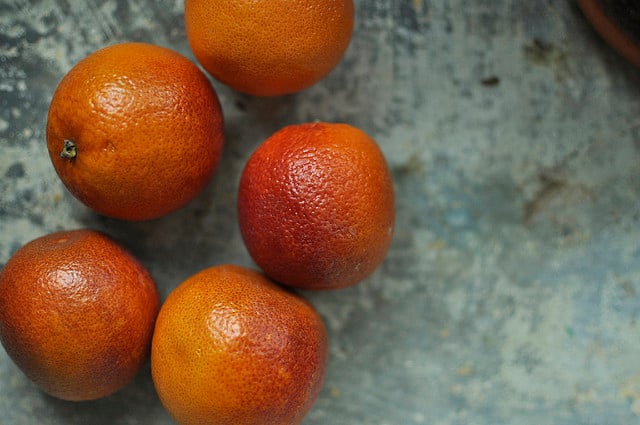
When I first started making marmalade, I thought it was the same as any other preserve. Chop the fruit, combine it with sugar and cook until set. I didn’t realize that citrus needed a more specialized treatment. You either need to cut away the tough, white pith or treat it in some way so that it tenderizes and loses its chewy bitterness.

This recipe uses an overnight soak to help break down the pith, providing a far superior product to the old blood orange marmalade recipe you’ll find on this site. The fruit becomes tender and it fully suspended in a ruby-hued jelly. Here’s how you do it.
Take 1 pound of blood oranges (approximately 4-5 tennis ball-sized oranges) and wash them well. Trim away both ends and slice the oranges in half.

Using a very sharp knife, trim away the core of the oranges and pluck out any seeds that you find. Set the cores and the seeds aside. Not all blood oranges have seeds, so don’t stress if you don’t find any.
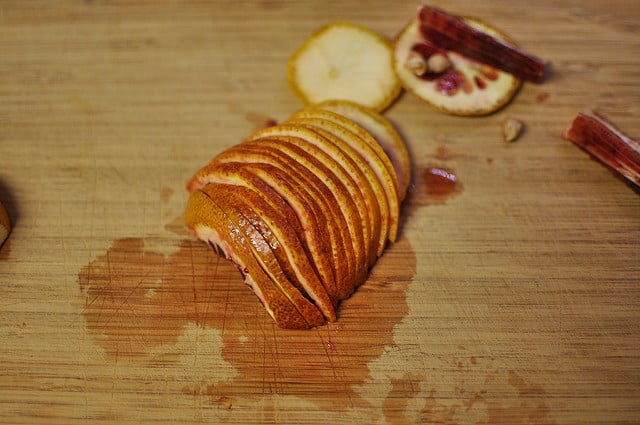
Cut the orange halves into thin slices. Go as thin as you can manage (I recommend sharping your knife before starting this project).
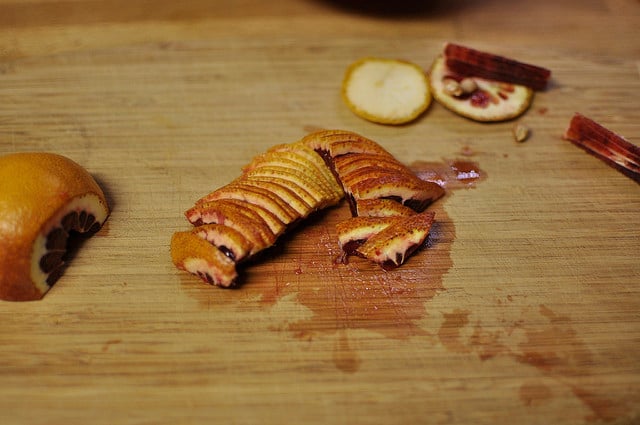
Finally, cut each sliced half in half again, so that you have a number of thin blood orange quarters.
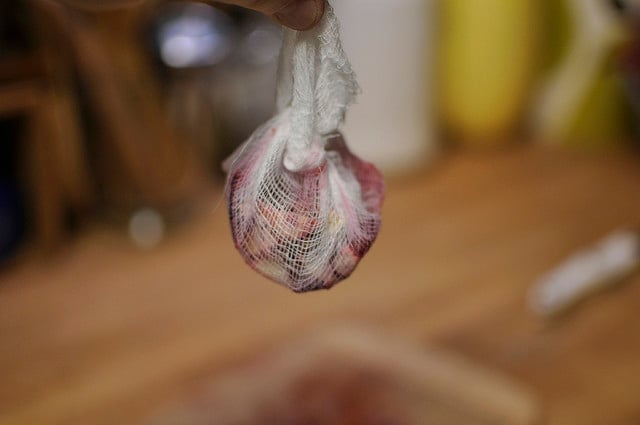
Bundle up all those seeds and pithy cores in a length of cheesecloth and tie it tightly so that nothing can escape.
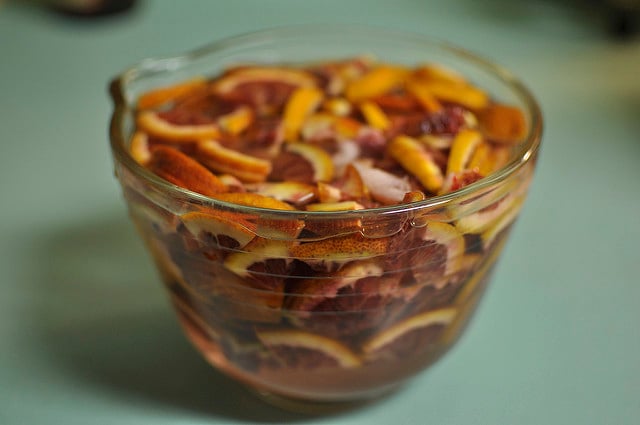
Put chopped oranges in a medium bowl and cover with 3 cups water. Tuck the cheesecloth bundle into the bowl and cover the whole thing with a length of plastic wrap or a plate. Refrigerate it overnight.

When you’re ready to cook your marmalade, remove the cheesecloth bundle. Combine the soaked fruit and water with 2 1/2 cups granulated sugar. If you happen to have a copper preserving pan like the one you see pictured above, make sure to fully dissolve the sugar into the fruit before pouring it into the pan.
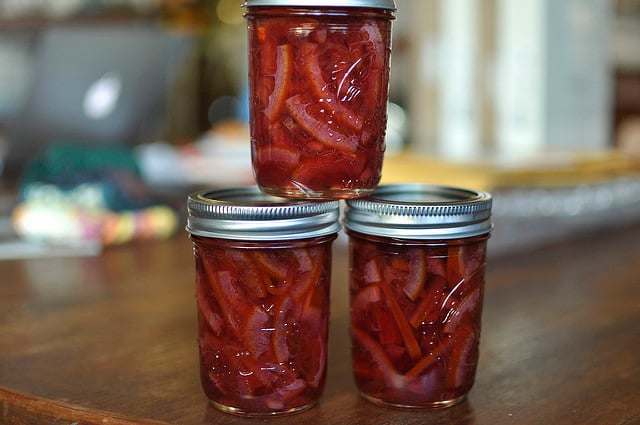
Bring the marmalade to a simmer and cook until it is reduced by more than half, reads 220 degrees F on a thermometer and passes the plate/sauce/wrinkle test. When it is finished cooking, pour marmalade into prepared jars. Wipe rims, apply lids and rings and process in a boiling water bath canner for 10 minutes.

When all is done, you should have three half pints of the most vivid red blood orange marmalade. I’m extraordinarily fond of this particular preserve on peanut butter toast, as you can see above. It’s also good on scones, stirred into yogurt or with crumbly homemade shortbread.

An answer for Amy Kaczur: As oranges age, enzymes begin to breakdown pectin found in the pith, thereby reducing their gelling ability. Use just ripe, fresh oranges from a grocer that you know turns over product regularly.
Thank you for taking the time to share this helpful piece of information!
well this is the one! Recipe came out just like it should. And the blood orange color is tooooo nice. very much like your Myer lemon marmalade (which is the bomb).
When I found your first book Food in Jars several years ago it made me want to try canning again, your instructions were so easy and clear to follow I thought “hey, I can do this”. and i did. I love to make those special jams and jellies, pickles too. I have taught so many of my friends and family how to can, it is a wonderful thing to share with people.
You are such an inspiration to me, thank you for all you do
Thank you so much for the kind words! I’m so glad it worked well for you!
Love this recipe, and have made it for the past 10 years, THANK YOU! Most times it comes out perfectly, but I’ve had two years of batches that don’t set very well. It comes up to 220 with a hard boil for 1 minute. It has taken me 30-45mins to get to 220. What could be the issue? Can I redo by cooking again and adding some pectin?
It could be that the oranges have had higher volumes of water than in past years. You could definitely add some pectin and cook again. You might also want to make sure that your thermometer is giving you proper readings.
Loved this!
What I did to make it just a bit fun.. I added a vanilla bean!
Sounds delicious!
I had 2 blood oranges and a ginormous grapefruit. So I prepped the oranges as above (kind of wishing I’d sliced them into 1/8ths but there’s always next time) and supremed the grapefruit. I happened to have black caps, so crushed a half dozen of them to increase the color of the jelly. OMG this is so bitter-sweet and GOOD.
That sounds amazing!
Been using this recipe for years and it’s absolutely fabulous. However, because I’m above 8,000ft, I rely solely on the cold-plate-wrinkle test to best determine when my marmalade finished cooking.
Thanks so very much Marisa!
I’m so happy to hear that it has worked so well for you!
Came across blood oranges at a discount grocers yesterday and decided to give this recipe a try. The only change I made was to chop the orange quarters smaller since my gang does not care for lots of peel. The recipe (like ALL your recipes!) worked great. Thanks for sharing this one.
I’m so happy to hear that it worked well for you!
So I’m worried I thought it was cooked enough, so I jarred then water processed it, but worried it didn’t cook enough before jarring etc., because it is runny. What can I do to fix it? I know I will have to open all the jars and put marmalade back in pot to cook and re-clean and boil jars and lids. But is it possible to fix to thicken? Or is it a lost cause?
If it’s not thick enough, the solution is to cook it more.
Mine never reached the 220 temp, it got to 200 degrees, had to turn off the heat cuz it was very sticky, like honey. I’m guessing I inadvertently made candied peel and now off to find what to do with it lol
If it got to that super sticky phase, your temperature must not have been giving you the correct reading. There’s no way to candy the peel without achieving a high temperature.
I have 2 Blood Orange trees that are producing a lot of fruit, so I was happy to find this recipe. I have a double batch in the fridge right now. Hoping for good results. Haven’t canned anything for probably 30 years. Have my fingers crossed!
Dear Marissa, I made your blood orange marmalade recipe, first time I ever canned anything in my life, and am for ever thankful to you. The marmalade taste heavenly and with such a wonderful burst of citrus, absolutely divine!
After tasting I ordered right away two of your cookbooks. Looking forward to making more small batches of everything:)
Thanks again, Helena
I’m so happy to hear that you’re pleased with it! And thank you for buying my books!
I made a double batch following the recipe pretty closely, but I included a home grown Eureka lemon of similar size to the oranges. It just needed to be used up. However, due to life intervening, the bowl sat in the fridge for three days, not over night. Then I cooked it up when I had a free morning. It set up pretty well, not tight but definitely jelled. So I want folks to know that if you have to adjust your time table, the marmalade will be fine.
ps The lemon was not noticeable, I don’t know if it affected the setting at all.
I’ve recently made a batch of the marmalade with Meyer Lemons following this recipe, however it is very runny. Did I not reduce enough? This is my first attempt at making a marmalade so I’m still learning
If it’s still runny, then you probably didn’t cook it down enough.
i try to get UK recipes on my Apple Mac but it always gives me US recipes and we don’t do the thing at the end. We sterilize our jars in the oven!
I will try this because it is small batch but as some say it is too sweet i will add a grapefruit ( and Campari…nice idea!)
Hi Marisa,
If I wanted to use 2 lbs blood orange, would I also double the water and sugar?
I’ve already made this as written and it is wonderful.
Yes. If you double the fruit, you’ll need to double the rest of the ingredients as well. Just know that if you increase the amount of volume in the pot, it will increase the cooking time.
Thank you Marisa. I’ve got the fruit soaking. I love this recipe-great taste!
I have many recipes found in your book, and they always turn out well.
I made the blood orange marmalade today, and found it too sweet. Perhaps it is because
I’ve been making bitter orange marmalade lately. I added lemon juice and a bit of Campari at the end for a little snap.
Any recommendations on adjusting things / additional instructions if I plan to do a water bath on this to preserve it for a few months? Thanks!
This recipe actually already includes instruction to process it in a boiling water bath canner for 10 minutes. Read carefully to the end. You’ll see.
I always cook the peel before adding the sugar and after the overnight soaking as the peel won’t really soften once the sugar is added. I do mine in the pressure cooker for 20 minutes
Prepared ready to cook -should I add juice of a lemon to provide pectin?
There should be enough pectin in the oranges to help it set up. But if you find that the flavor is too sweet, you can certainly add some lemon juice to provide balance.
Marisa, what if I want to make it more jam like, less orange peel? Will that affect the set? Was thinking of following your recipe but using lthe peels as part of the cheesecloth bundle during the soak.
Have you looked at one of my citrus jam recipes? That might be more of what you’re looking for. https://foodinjars.com/2012/03/grapefruit-jam/
Instead of adding the piths and seeds in cheesecloth, I used a handful or so of citrus rinds leftover from the making of some simple syrups. Worked like a charm, and easy pick up the halved rinds just before the pot going on. After this they can still go into making citrus “cleaning vinegar” or popped in the steam pot with herb ends for when it gets too dry in the house.
Marisa, didn’t see this addressed anywhere: why would you remove the cheesecloth bag during cooking if it contains beneficial pectin?
Marisa- I just made this marmalade yesterday as a participant in the Canning Mastery Challenge. Just tried it today as you suggested on peanut butter toast. Delish!!!!!!
I have some nice meyer lemons we grew, but they have some sooty mildew on the skin. Most comes off with a gentle scrub, but still some tiny spots remain. Would you use these for marmalade, or stick to something not using the skin?
I’m curious about the fact that you add the sugar before cooking the rind to soften it. Does the soaking overnight soften it enough?
The overnight soak substantially softens the rind.
I made my very first jars of marmalade (indeed any sweet preserve) using this recipe. I used 4 blood oranges and to up the pectin count and to add tartness a lemon and an orange.
Took longer than i thought to cook – i spent about 2 hours hovering over the pan nervously. My sugar thermometre hovered around the 200F for ages, never getting up to 220. It took ages to reduce but then once it had, it thickened up quickly and i took an executive decision to turn off the heat as it began to caramelize in place.
Anyway, thanks for your lovely recipe. I don’t rate myself in culinary terms but boy am I proud of my marmalade jars and I’m going to make some more tonight.
It sounds like you may not have had the temperature up high enough if it took that long! Still, I’m so glad to hear that you’re happy with the results!
“If you happen to have a copper preserving pan like the one you see pictured above, make sure to fully dissolve the sugar into the fruit before pouring it into the pan.”
Why? In copper especially?
Copper is a reactive metal, so if you put an acidic food inside it that hasn’t been buffered with sugar, the acids in the food will draw a metallic flavor from the pan and into whatever you’re cooking. The sugar prevents that leaching from occurring.
I just finished cooking up this recipe, with a half lemon thrown in for good measure (from Ina Garten’s recipe, which called for 2 lemons per 8 oranges). Right out of the saucepan, it tastes wonderful & not as sweet as I thought it might.
However, I may have overdone the cooking, even though it took only 1 1/4 hours, rather than than the 2 1/2 from Ina’s recipe (http://www.foodnetwork.com/recipes/ina-garten/annas-orange-marmalade-recipe.html#sni-reviews). When I checked, the thermometer read 225F. The fruit mixture had reduced by about a half, but the liquid still seemed drippy. I probably should have tried the cold plate test as suggested.
In any case, I have a feeling it will seize up in the jar once cooled, and that I’ll have to use boiling water to make it usable, but maybe I caught it in time. Stay tuned, and thank you for this excellent site and recipe.
Oh my. I just finished two double batches of this recipe, subbing the BOs for meyer lemons. In the first batch I added some lavender, in the second, I added rosemary. Both are absolutely divine.
This is my first time attempting marmalade, and the set is perfect! I’ve always loved marmalade, but I must admit that these two batches are the best marmalade I’ve ever tasted 🙂
Thank you so very much, Marisa, for continuously sharing such wonderful recipes and helping us noobs feel comfortable by sharing your extensive knowledge!!!!!!!
I made a batch of this over the weekend and it was absolutely wonderful. I will definitely be making more this weekend. I had intended to give them away at my local food swap, but now i think i need to save a few for myself.
Hi Marissa,
I tried an experiment this week based on this recipe for Blood Orange Marmalade and the Meyer Lemon marmalade in your book. I live in San Jose, and all my citrus trees are popping just now. Last week, I made the ML and it turned out great. I had a lot of Blood oranges too, and didn’t want to make a small batch of jam. I used the same method as Meyer Lemon, same ratio of fruit to sugar. It worked great, and was a lot less work than boiling everything separately. I also have a copper preserving pan, so I wanted to combine the sugar and water with the fruit in the same big container.
Thanks for the great recipes.
Mona
Would a nut milk bag work instead of cheese cloth?
If your nut milk bag is made of a synthetic material, it might melt in the preserve. In that case, I wouldn’t do it.
just made this with meyer lemons for my first canning adventure! so amazing and also so easy! i am so happy about how it turned out, and excited for my future forays into canning!
i had 2 extra meyer lemons so then i made your meyer lemon curd too! sooo delicious!
That was SO easy and delicious! Love not cutting all that pith off. Thank you. I love that it surprised us with a sweet tartness like a grapefruit and beautiful. I was staring at the lovely gift of 10 blood oranges in wonder but, after mamalading three batches in a week, was tired of trimming rinds.
Will be making this today – found that a mandolin worked amazing to slice the oranges. Must do the z slicing motion to not crush the oranges.
Hi there. I found your website after hearing you on the canning season podcast. Thanks for that.
My question is: my blood orange tree isn’t making oranges yet. But I have a dwarf calamondin orange tree ready to go. Can I simply substitute a pound of these for a pound of those in order to make the marmalade recipe? They can both be bitter and tart as far as oranges go, so my thinking is they could be treated the same… What do you think?
I’ve never tried calamondin oranges, so I can’t really speak to whether they can substitute in. However, if they are similar to oranges in flavor and structure, it should be okay.
In order to sterilise the jars, merely fill them with boiling water and wait a couple of minutes. It is difficult to judge the set of blood orange marmalade. I find that about 35 minutes of furious boiling does the trick and the mixture reduces approximately by half and thickens. I use cling film as a seal before screwing on the jam jar top. Although I usually add a couple of lemons to the mixture, I have successfully used a bergamot for some added pectin.
Hi! I have recently started making jam and you and your blog have been so helpful. I followed your instruction to make small-batch strawberry jam and it turned out beautifully. I just made some blood orange marmalade (my first attempt was an over-cooked disaster!), I have canned it and I’m hoping it sets alright but the zest has all accumulated at the top of the jars. Is that a bad sign?
It sounds like after your first overcooking experience, you undercooked the second batch. The zest accumulating at the top simply means that the jelly isn’t thick enough to keep it fully distributed.
I am in the throes of making your blood orange marmalade recipe in your book, but I am thinking that it is a little too sweet for me. How much can I cut back on the sugar so that it is still safe to can? I will try the above recipe next!
Read this post. Sugar doesn’t play a role in safety, it helps with set and shelf life.
Thanks! Obviously, I jumped right into the recipe, and didn’t read all the supporting information. Marmalade update: it is not too sugary, I jumped the gun. Also, it is the most beautiful color I have ever seen! A true winner, love it.
My 1st go at marmalade making (I love blood orange marmalade – most marmalades are too bitter for me). This was scrumptious. I simmered for quite a while but it wasn’t really reducing, so I ramped up the heat and boiled at 220, it didnt pass the cold plate test, so boiled it for a further 5, then 5 more mins, and a few more. It still seemed runny but I decided that was enough and luckily its just right!
To the previous post – I’ve read a while back that pips have natural pectin in. My blood oranges had a few so maybe that helped not being so runny in the end.
Thanks for the recipe- it’s a keeper 🙂
This is just the recipe I was looking for.
Do you know why soaking the slices with the pith and seeds work? Just curious.
I read elsewhere that the seeds contain pectin, which helps it to gel.
The seeds contain a concentrated amount of pectin.
Hi- My fiancee and I just tried our first batch of blood orange marmalade yesterday (recipe from the big Ball cookbook). Wish I’d seen this one, seems much easier than me spending hours separating the membranes! However, due to being slightly gel-shy since our last batch of clementine marmalade was rock hard from overcooking, we erred too much on the side of caution this time and ended up with 12 small (4oz) jars of ….. blood orange syrup! We are making 100 jars of jams/jellies/marmalades as wedding favors and would like to reprocess this batch. I’ve heard of how to do it for jams and jellies, but is it the same process for marmalade? It seems trickier than our other, simpler jam recipes. I don’t want to add extra pectin, just cook a bit longer if possible. Thoughts?
You can use the same technique outlined in this post for your marmalade. If you don’t want to add additional pectin (though because blood oranges are a hybrid fruit, they don’t have many seeds, which means you don’t have the same opportunities for pectin extraction than you do with seedier citrus), you can just bring it back up to a boil. Cook to 221 or 222 degrees F to ensure your set.
Thanks for the tips! We recanned last night and … let’s just say that the threshold between “syrup” and “hard candy” is a mighty small one! It is now rock hard, and it happened so FAST! It still tastes good, and we’ll be happy to heat and eat as crepe toppings, etc. but won’t be giving this batch away. Oh, well, this IS the Mile High City, so we’ll just chalk it up to “altitude” 🙂 and try again with fresh fruit. This time we’ll use your recipe – the best part of all this may end up being that it led me to your site!
I wish we’d thought of making food gifties for wedding guests. Clever.
I bought 10 blood oranges today and they weigh 4 pounds. Can I use this recipe? How much water and sugar should I use?
Rose, you could multiply this recipe and make a larger batch. Just increase everything in proportion. I would recommend that you separate it into two batches.
I spent quite some time today cutting up 2 kilos of bloodoranges. They are now in the fridge.
I took your advice about a sharp knife to heart so I sharpened my chef’s knife and then proceeded to cut my left index finger. It was my first time in 5 years that I hurt myself in the kitchen. And to have it happen while cleaning bloodoranges made me chuckle.
Tomorrow I sterilize some jars and cook my marmalade. Can’t wait!
Any thoughts on making a jalapeno orange marmalade?
The Ball Complete Book of Home Preserving includes a recipe for Orange Chili Marmalade (or maybe it was jam, but either way, you could adapt). 🙂
KP- i’ve been thinking about chile but not necessarily jalapeno. Tonight I will try it with blood oranges as that combination is a Mexican classic.
Does anyone know why you are to put the pith and seeds into the oranges to soak overnight?I had no seeds and very little pith.