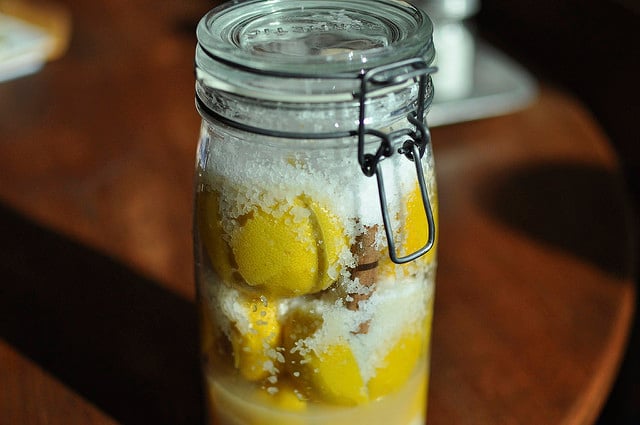
I first tasted preserved lemons when I went out to Ojai for a press trip out to the Sunkist lemon groves two years ago. (What a divine trip that was. Three days in Southern California in the midst of a messy Philadelphia winter.) By the time you eat a preserved lemon, it has little in common with the fruit as we know it. Strategically slit and salted, the lemons change character radically, until all you have left is a savory, tangy, yielding condiment that acts as serious flavor player.
And, as preserving projects go, this one couldn’t be easier. It’s just a matter of scrubbing, trimming, slicing and packing with salt. No boiling water baths or sterilization necessary.
Here’s how it works. You give your lemons a really good wash and then trim both ends to remove the remains of the stem and the little nub. Then slice them as if you’re cutting them into quarters, but not all the way. The goal is to have each lemon cut in four pieces but still attached to the whole. They always look a little like one of those fortune teller games we used to make in elementary school to me.
Once all your lemons are prepped, cover the bottom of the jar you’ll be using with salt (either kosher or sea salt is best). One by one, hold each lemon over the jar and spill a tablespoon of salt into the cuts. Pack them into the jar as you fill them with salt, using a bit of force to get them in if necessary. I used a 1 1/2 liter Le Parfait jar and found that it held nine lemons quite nicely. Spread some salt between each layer of lemons and make sure to top the jar off with a good pour as well.
Keep out on the counter for the first three days, giving the jar a good shake once or twice a day to help spread the salt and activate the juice production. If they aren’t producing a whole lot of juice, feel free to open the lid and press down to help things along. On the fourth day, take a good look at your lemons. They should be submerged in their own juice by this point. If they are not, top the jar off with some additional juice. Stash them in the back of the fridge for at least three weeks. After that, they should be ready to use. However, they’ll keep this way for at least six months (if not longer).
When you’re ready to use one, remove it from the jar and give it a rinse. Chop into tiny pieces and toss in salads, braises or grain dishes. I imagine it would be wonderful in this salad, in place of the braised lemon slices.
If you’ve bought or made them before, what’s your favorite way to use a preserved lemon?

Have you ever tried yo salt preserve Mandarin oranges?
I have not! But I will add it to my list!
Hello, Marissa. Can lemons, preserved in your way, be water bathed after the three days’ wait? I have very little refrigerator room.
I don’t recommend water bath processing preserved lemons. I understand being short on fridge space, but they are worth it!
Ahhhhhh I’m so glad for this comment. I know preserved lemons don’t need to be refrigerated (certainly not immediately), but I was thinking water bath canning them would provide a little extra security against leaking + a nicer presentation, if I were to ship some for holiday gifts. Given it’s LEMONS, i.e. high-acid, plus salt, it seemed like it must be safe for canning but I was having surprising difficulty finding actual info on this. I didn’t even think about how it would affect the texture of the lemons themselves!
Hi Marissa,
My jar has been on the counter for a day, and it keeps leaking liquid. Not a lot, but a little dribble around the rubber gasket. Is this normal? Will they still be safe to eat? Will it keep leaking even in the fridge? Thanks!
That’s normal because while the jar is on the counter, some fermentation occurs. That leads to some off-gassing and liquid loss. They are perfectly safe to eat and the leaking should stop once the jar is in the fridge (because the cold slows down the fermentation process to a crawl). I would suggest that if your jar is full to the very top that perhaps you might want to transfer the lemons to a larger jar or split it between two.
Is it possible to can these in a water bath? Or is that even necessary? I’d like to give these as Christmas gifts, but I don’t have space in my fridge for a dozen or more jars of preserved lemons. Thank you!
I would not can them. It will soften them to the point that they might not be usable.
When you put the jar in the fridge after 3-4 days on the counter, do the lemons need to be covered in juice? I have a lot of juice but they are not completely covered. And if I need to top it off with other juice, can I just use organic lemon juice? Thank you!
Ideally they should mostly submerged with juice. If you don’t have enough, you can definitely use organic lemon juice.
Do the lemons have to be almost quartered? Can they be sliced (thick or thin)? or any variation of cutting them up? Every recipe I come across says to do it this way but I can’t find a reason. Does the configuration have something to do with the fermentation process?
It’s the traditional preparation, but you don’t have to do it that way.
I made the preserved lemons and am really excited to try a new preservation method. But I have a question. Other recipes tell you to leave the lemons out for 3-6 weeks on your counter before refrigerating them! They talk about a fermentation process that gets going. If you only leave them out 3 days that won’t happen.
Have you ever left the citrus out longer?
Jill, you can really choose how long you leave them out on the counter. Some people like to keep them out until until the salt dissolves and the citrus softens a little. Other people leave them out much longer. It just depends on how funky you want the flavor to get (longer fermentation time equals a funkier flavor). These days, I typically leave mine out for a couple weeks before moving them to the fridge.
You suggest kosher or sea salt for these recipes. I am in possession of 50 lbs of Morton table salt. Do you think I could use it for this? *frantically looking for ways to use table salt*
Thanks!
It’s fine to use that table salt. Just know that there’s a small chance of some discoloration as a result of the anti-caking agents in that salt. It’s not dangerous, though.
Nonna (Italian Grandmother from Northern Italy) always put a blended dollop on her toast in the mornings.Sometimes it went on pancakes and such. If she wanted is sweetened (which wasn’t often) she would had a small amt of honey.I am her child LOL. I quit making them when the kids left home. Might make a small jar for the memory.
Hi, I’m wondering if you can give me advice on my first jar of preserved lemons. I washed my lemons, sterilized the jar etc before using. Added salt, topped with additional juice. Things weren’t quite submerged, so I topped off with more lemon juice. As they settled, there was still some on top poking out without liquid etc, so I threw in some more salt for good measure. I’m seeing a bit of, shall we say cloudiness, in the liquid and I’m wondering if that is to be expected? The lemons don’t look like an off color or spoiled, and I’m wondering if the slightly funky ‘thickness’ to the liquid is normal. I thought maybe I didn’t get enough liquid in to 100% submerge everything & that had caused it, but the more I’m reading about it I’m thinking maybe that’s exactly what is supposed to happen? I had gray sea salt on hand so that’s what I used and I’m thinking the minerals in that may be part of the appearance.
Cloudiness and some thickening of the liquid is totally normal. And certainly, the mineral content in the salt you used is also adding to the opacity. It sounds like it’s going exactly as it should!
Whew, thanks! I was so bummed thinking I’d have to start over.
I usually use kosher salt for almost everything including past lemon preserving, but I have a nearly full box of pickling salt, do you think using it to preserve Meyer lemons would be alright? Thanks.
I imagine it would be just fine!
I was given a box of I believe Meyer lemons. They are the last of the lemons on the trees for the
season. They are soft. Can I use these for the preserved lemon recipes? Please advise.
Thanks
As long as they’re just soft and not beginning to rot, you can certainly use them.