These garlic dill pickles are my favorite pickles for every day eating. For crisper pickles, skip the processing step and make them as fridge pickles.
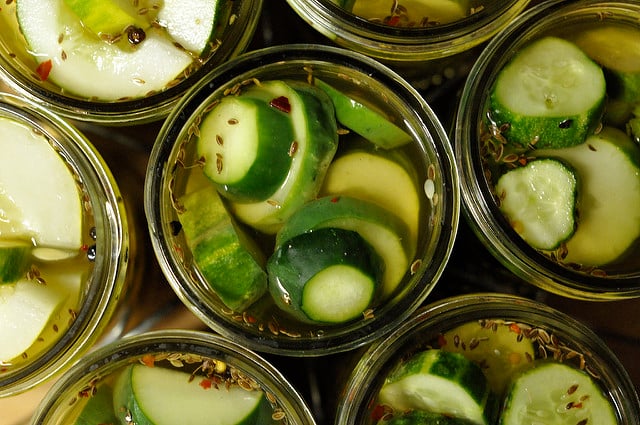
I grew up in a household that appreciated a good garlic dill. As a kid, one of my very favorite after school snacks was a chunky pickle. I would fish one out of the jar with a fork, stabbing until I could get get traction and then drop it into a plastic cereal bowl. I’d slowly nibble away at the pickle over my book of the moment, until all I had left was the stem end of the cucumber and wrinkly, vinegar-scented fingers.
We also believe that no good sandwich is complete without a pickle. My parents take sandwich construction very seriously, and often buy jars of pickles that have been pre-sliced lengthwise just for this purpose (prior to being stacked between the lettuce and the cheese, these pickles are blotted on papertowels, so that the sandwiches aren’t made soggy by too much additional liquid).

However, up until recently, the idea that a homemade pickle was actually the best kind of pickle didn’t occur to any of us (even taking into account the fact that my father has spent the last 30 years hunting for a pickle to replicate his beloved Polski Wyrob that he hasn’t been able to find since they left Chicago in 1978). I began my pickle enlightenment sometime back in the early spring, when I first started combining asparagus with a vinegar-based brine. I’ve been spreading the pickle gospel out west to my parents in Oregon for sometime now, and it appears that the indoctrination is complete.
My mother and I just spent the last hour on the phone and more than half our conversation revolved around homemade pickles (she now keeps a jar of brine in the fridge, and consistently replenishes the cucumber supply). I can’t tell you how proud I was tonight when she said, “I don’t think I’ll ever buy another jar of pickles again, when making them at home is so easy and so much better.” She’s also got her sights set on making these zucchini pickles (I admit, I sent her the link with a note suggesting they’d be a good way to use up the stampede of garden squash that is coming her way).
And, while I don’t think that my dad will ever find a pickle to compare to the Polski Wyrobs of yore, these garlic dills may just give his taste memory something to get excited about.
For those of you who prefer a smaller batch thank these garlic dill pickles, check out my Refrigerator Dill Pickles.

Garlic Dill Pickles
Ingredients
- 2 overflowing quarts of pickling cucumbers sliced into fat coins*
- 4 cups apple cider vinegar
- 4 cups water
- 5 tablespoons pickling salt
- 16 garlic cloves peeled (2 per jar)**
- ¼ teaspoon crushed red pepper per jar*** 2 teaspoons total
- 1 teaspoon dill seed per jar 8 teaspoons total
- ½ teaspoon black peppercorns per jar 4 teaspoons total
Instructions
- Wash and slice the cucumbers.
- In a large saucepot, combine vinegar, water and salt. Bring to a simmer.
- Arrange jars on counter and dole out the spices to each. Pack the cucumber slices firmly into the jars. You don’t want to damage the cukes, but you do want them packed tight.
- Pour the brine into the jar, leaving ½ inch headspace.
- Wipe rims, apply lids and rings and process in a boiling water bath for 10 minutes.
- When 10 minutes are up, promptly remove the jars from the pot and allow them to cool on the countertop. When the jars are cool, check the seals (by pushing/tapping on the lid).
- Pickles can be stored in a cool, dry place for up to a year.
- If you want to skip the boiling water process, these pickles are also wonderful as refrigerator pickles. Just pop the jars into the fridge once they’re cool.

Hello, if you can’t find Pickling Salt anywhere, would you reccomend substituting fine sea salt, or fine kosher salt? And if so, will the recipe call for the same amount.
Thank you.
I have a whole post on substituting salt: https://foodinjars.com.s164546.gridserver.com/arugulapesto/2010/08/canning-101-on-substituting-salt-in-pickling/
Wow, that was a quick response. Thanks so much!
Thank you so much for this website! I grow vegetables, make bread, spin wool, knit, sew, change tires and rope and ride, but I had never canned until this summer. And you have been my trusty guide! So now my pioneer-woman-skills toolbox is complete. I made seven pounds of lovely little cucumbers (or they might have been gherkins) into pickles with this recipe and they are just wonderful. I halved the cukes lengthwise for the pint jars and kept them whole for the quart jars. I also added a slice of lemon to some of the jars because I had a lemon that was about to go soft and I thought it would be pretty. Turns out it added just a tiny lovely flavor, too! I have also made the red onion pickles and the dilly beans and the sweet cherries from your site –all fantastic. I found some early okra at the farmers market last weekend and pickled that with a recipe from the LBJ Ranch (Ladybird’s recipe, supposedly). I waited 4 days before tasting them and they were pretty good, but lacked a little depth or complexity. Do you have any okra suggestions? Or did I just jump the gun on opening them?
I think you definitely just jumped the ball on opening the okra. I’d give it at least a month in order to allow the flavor to develop and deepen.
I hope you’re having fun on your vacay! When you’re back, can you possibly do a post about “never ending” refrigerator pickles, like you mention in this post (keeping a jar of brine to replenish in the fridge)? I keep seeing this mentioned all over the place, but no one seems to explain it! I love the canned version of this recipe (just made another batch today!), but the hubster likes his pickles extra super duper crunchy. Thanks!
I’m going to try these pickles for my FIRST attempt at canning. When you say process in a boiling water bath, do you mean put them in boiling water–or put them into the water and bring it to a boil? I’m “new & confused.” 🙂
Hi,
I really like your website and i’ve done a number of recipes from it. However, I, like Joanne (comment 63), have a problem with your comment 55.1 on the pickle thickness. One inch is about 2.5 cm. So when you say you slice the cukes two inches thick, i think you must be missinterpreting the units. Most of pickling cukes are 2 to 3 inches long. Tere’s no way your slices are 2 inches thick.
Another concern i have is your definition of pint. In the recipe above you keep calling for pint jars, but those in the pictures are clearly half-pint jars (or one-cup jars). The problem also is that this isnot the first time i see this disrepancy in your blig and now i doubt every time you call for a particular type of jar. Do you mean pint jars or half-pint jars in this recipe? How about in the one for dilly beans? Or whole canned tomatoes?
Thanks!!
I’ve changed that comment to say an inch. However, I do sometimes cut my pickles two inches thick. And, as far as jars go, those are indeed pint jars. They are wide mouth pints. They hold two cups. I frequently use wide mouth jars, which if you are unfamiliar with them, can look like half pint jars, but I promise, they are pints. I mean pints with the dilly beans. And I use quarts (often wide mouth quarts) for the whole canned tomatoes.
I have grapes growing in my garden and I was wondering if it had to be a specific kind of grapes that you could use there leafs for theses pickles? Also is there anything other than washing them do I have to do to them before jarring them? And I can use the leafs in the boiling method right? Thank you for your help, I just want to be safe 🙂
Any kind of grape leaf will do. And yes, you can use them in the boiling water bath.
We made a batch of these the other day and are loving them! Such a delicious recipe!
I am a little confused . . . re: how thick to slice the pickles (55.1) you note “When I do these as chips, I slice them nearly two inches thick.” But in the picture at the top the slices appear much thinner then that – maybe not 1/4 inch but not 2 inches. Since I am new to pickles I am curious what is appropriate. Also, does anyone have any experience with a product called “pickle crisp” made by Ball?
I do sometimes slice my pickles two inches thick. You can do them to your preference though. Just know that the thinner you slice them, the soggier they’ll be.
Found it.. excellent.. I love a simple recipe. I will also pop a grape leaf in each jar (I hope the Japanese beetle left me a few!) and I will let you know how that goes. Though I will be using the water bath as a finisher. I like them on the shelf. The ‘fridge gets a bit crammed this time of year! Thanks again c
I just made these as refrigerator pickles. After about a week they are fantastic! Great site by the way.
Do you think it would be OK to substitute fresh dill for dill seed?
Travis, you can substitute fresh dill, but it doesn’t store as well as the dill seed. It can sometimes get a little murky after a while in the brine.
I love your blog. And find myself doing more and more canning (cannot wait to try the tomato jam). But need help, I have hit my first canning dud. I tried this recipe for garlic dills (what i not to like about the flavor combo!!)
I sliced the cukes to 1/4 inch thickness and followed the rest of the recipe. We waited 2 weeks and tried them last night…they we incredibly mushy and were not good at all. any suggestions?
Thank you!!
Yikes, a quarter inch? Unfortunately, that’s way too thin for this recipe. By slicing them that thin, you cut across most of the cell walls of the cucumber, releasing all the liquid and leaving the pickle with no internal structure. When I do these as chips, I slice them nearly an inch thick. Additionally, pickle crunch is also helped when you use the freshest cucumbers and keep the processing time as short as possible while sticking to the recommended time, of course.
A quick question: when you say water, do you mean (filtered) tap water or do you mean the pickling water that one can buy at the store? I always buy the water, but as I do not have much storage space, it would be great to learn that I can simply use tap water….
When I call for water, I just mean tap water (filtered is best). The only time I’ll call for or use bottled water when canning is when I’m making a fermented pickle and want to make sure there’s no chlorine in the product.
I just made ~20 pounds of these and they were great!!! The only “problem” I encountered was that they attracted fruit flies!!! They were literally coming in from outside! I had none (that I know of) inside my house before hand but afterwards… OMG, they were everywhere! I know fruit flies are attracted to ACV so I made a trap (ACV with liquid dish soap). It’s working, but talk about a pesty situation! LOL
THATS SO FUNNY! FRUITFLIES ARE ATTRACTED TO THE APPLECIDER VINEGAR. THEY WILL ACTUALLY LAND IN IT AND EVENTUALLY DIE. THATS HOW WE GOT RID OF THEM IN MY HOUSE LAST YEAR .
Thank you!
I made a small batch of these and popped them in the fridge and overnight the garlic turned bright blue. I googled it and it is maybe something to do with metals in my water? Just wondered if this ever happened to you? Should I use distilled water for pickles or just stop including garlic in my pickle recipes? I was going to make some more for little gifts, but bright blue garlic cloves floating around the pickles are a little off-putting. Advice?
Here’s a good, if slightly technical explanation for why your garlic turned blue. http://whatscookingamerica.net/Q-A/bluegarlic.htm
It’s a common phenomenon and your garlic is still perfectly safe to eat. It just doesn’t look so good.
@37, @38:
ok, I’ll bite ;
is there a recipe for Kosher (non-vinegar) pickles available?
Marisa, this summer I have made three batches of dill pickles from our garden with a slight variation on this recipe. First, I have been adding 1/4 cup sugar to the brine, and I adjusted the spices in the jars by adding 1/2 tsp mustard seed and using only 1/8 tsp red pepper flakes. I can’t stop eating them! It is especially exciting that I was able to use home grown dill seed and home grown garlic, along with the home grown cucumbers. Thank you so much for the class last summer and for this recipe!
go to freshpreserving.com where you can get ball or kerr jars at a really good price.
I just made these as a refrigerator pickle and wow, they are awesome. I’m wondering if the texture will be completely different if I can them. Will they lose the crunch?
Can anyone tell me where to buy Polski Wyrob whole dill pickles
in a jar?
I have not seen them in the stores for a long time.
Carol, I don’t think they make Polski Wyrob pickles anymore. My father and I have been looking for them for years, to no avail.
I could almost promise that is the brand of the tiny pickles sold in a two jar pack at my local Costco(Utah). Extremely crisp.
Mount Olive Pickles, out of NC, used to make a polski wyrob. Now they have zesty kosher dills, which may (or may not) be the same thing. Mount Olive is available widely- at least throughout the South, and they’re family-owned.
Joel, nowhere in the post or its comments does anyone suggest that these are kosher dills. I was careful to call them garlic dills, to avoid confusion. These pickles are exactly what they claim to be, a vinegar-based garlic dill pickle.
Sorry to burst everyone’s bubble, but real Kosher pickles have NO vinegar in them.
I just used this brine to make 13 pints of pickled veggies. We pickled beets, turnips, carrots, and parsnips (mostly separate, but some parsnips and turnips did get mixed together and a beet snuck into one can of the carrots). Not sure how the parsnips will turn out, but we’re expecting great things from the others. We also ended up with a pint of plum-pear butter. A friend who’s never canned before came over for her first ever canning experience (and my second!) and we have plans again next weekend for more canning. I love your site, it inspires me every time I come here!
Opened our first jar today–I couldn’t even wait a couple of days. The pickles are really delicious, thank you for the recipe! We couldn’t stop eating them.
I have everything on hand to make these lovely pickles–my first try at canning something other than fruit. Can these pickles be eaten right away or do they need to stay in sealed in the jars for a few days/weeks before they reach a true pickle flavor? Thanks!!
Brittany, if the pickles are sticking up just a bit, because they’re floating in the brine, you have nothing worry about as long as the jars sealed. Food sometimes floats after being canned, and there’s nothing you can do about it other than packing the jars more tightly next time and using regular mouth as opposed to wide mouth jars (the shoulders of the regular mouth jars keep the pickles in their place better, particularly if the jar is well-packed).
Also, before processing, make sure that you’ve only left a 1/2 inch of headspace and that you’ve tightened the rings well. However, consider this batch a learning process, don’t wait forever to eat them and don’t worry!
Hey Marisa,
I made these pickles and they are to die for! The only problem is, in some of the jars I canned the pickles are sticking up above the brine. Will these mean that they go bad? Did I pack the jars too full? Not use enough brine? It looks like the pickles are floating, and them some stick up out of the brine and are in the dry air space at the top of the jar. Will they keep like this unrefridgerated?
Thanks a million!
Brittany
Hi there! Can you tell me how long the refrigerator pickles last in the fridge before they go bad? Thanks so much!
Tracey, refrigerator pickles can last up to a couple of months without a problem. Just keep an eye on them and if they begin to look sludgy or slimy, toss them.
Can you tell me how to make the crisp refrigerator pickles like Klaussen’s? I’ve been trying for years to duplicate them. In the meantime, these garlic dills are great!
Hi, I just made your recipe and wondered how long I have to wait to crack open a jar. Any suggestions on a minimum?
I’ve just started canning and pickling. I did an experiment with one of my first batches. To half of the jars I added a grape leaf or two. Those pickles were crisp and perfect. The grape leaf-less pickles tasted great, but had a soggy texture.
Hi Lydia from Perfect Pantry sent me your way. I want to make the rhubarb and apricot chutney from her site. However it is not canned and I was wondering how long to process a boiling water bath.
Thanks so much.
I just started a pickle fermentation experiment.
The pickles I made last year were too soggy, so this year I’m cutting 1/16th inch of the blossom end from my pickles and adding grape leaves.
Some I canned “raw” and some I am brining for 3 to 4 weeks and then canning.
I tasted one (Ok, two) and they were great! Can’t wait to test the rest!
Love fridge cucumber pickles – good way to use just one or two cukes.
I love the fact that your recipe calls for NO sugar! Too many recipes have way too much sugar. Thank you.
I keep a constantly replenished jar for my cucumbers in the fridge too. I’ve never tried garlic dill though!
Kelly, you would most definitely have to let whole pickles sit longer than the sliced ones. If you’re making refrigerator pickles, I would give them at least 3-4 days in the fridge to get nice and pickly.
If you use whole pickles (instead of slicing) for the refrigerator method, do you need to let them sit in the fridge longer before you can eat them?
I remember those Polish pickles. They were a favorite of my family when I was growing up.
Great minds think alike; I made pickles this week, too. And they absolutely would not be the same without the garlic. Beautiful photos, Marisa.
I thought I was the only one who wiped off pickles before inserting them in my sandwich. If the sandwich is traveling with me to the office I actually take it one step further and wrap the bread in a separate covering from the meat and cheese and place the dried pickles in another covering so that everything is crisp, dry, and fresh when I actually get the chance to assemble my sandwich.
Your pickles look lovely!
As far as the crispness of pickles go, these stay fairly crisp, particularly if you use kirbies (other slicing cucumbers won’t stay quite as snappy). However, if you are a fan of super crisp pickles, then skipping the hot water process is the right thing to do. That does mean though that you should only make as many pickles at one time as you can eat over the course of a few weeks. I’m shooting to make enough to have them through next summer, so I’m forgoing a bit of crispness in order to have shelf stable pickles.
One thing to note: I have been told that if you have access to a cherry tree or grape arbor, a leaf from one of those inserted into the jar with the cucumbers and brine will aid in preserving some additional crispness. I haven’t had access to either, so I can’t offer first-hand knowledge, but I’ve read this tidbit in a number of places, so I’m assuming it’s true.
Although I have made jam in the past, this is my first summer pickling. I’ve used the final boiling water process on my dilly green beans and pickled jalapenos. For my dill pickles, I put them in the fridge because I have been reading that the water processing can make the pickles less crisp. What do you think?
We also believe that no good sandwich is complete without a pickle. My parents take sandwich construction very seriously
I’m with you guys on the pickles. I’ve yet to make one that I loved, but will give this a try.
If you guys ever get out to Long Island, there’s a couple guys called the Pickle Guys who sell FABULOUS pickles at farmer’s markets. They make a sweet pickle with red peppers that we buy in quarts to take home to NJ, but they never survives the weekend.
Have you had problems with these being soggy? I always seem to have the soggy problem with homemade pickles.
I use 1 grape leaf per jar helps keep pickles crunchy.
Ball makes Pickle Crisp Granules that do n excellent job keeping pickles crisp. Grape leaves work as well, but you have to be careful to avoid bacteria and fungus that can grow on them.
Fran, thanks for catching that error again! It should be corrected now.
You wrote teaspoons instead of tablespoons for the pickling salt, like you did for the recipe you handed out in class on Saturday. I am enjoying the pickles we made in class, by the way, eating them with my lunches as a side! Thank you again for the class!
I just told my husband that I don’t know if I want to can any more pickles this summer. I think I’m going to have to try this recipe. This site is so alluring to the canner in all of us. Everyone have a great canning week.
I’m so making these! I had a ton of garlic from the Gilroy Garlic Festival and this would be the perfect way to use some of them. Thanks for the recipe it looks delish.
I love pickles.Hey the recipe was so good I think I like these the most.
Just found your site, and I love it! I’ll be trying the pickles and my family always loved those Polski Wyrobs too, and I don’t remember the last time I read that word. Thanx for your post.