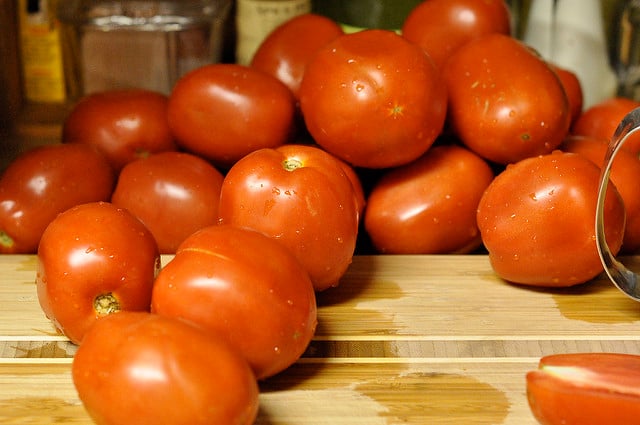
Before tomato season comes to a close, I want to talk about my favorite way to preserve tomatoes. I typically only can them one way – (mostly) whole and peeled, in their own juices. I do them this way because I like the versatility they retain when put up in this manner. Later down the line, I can choose as to whether I want to puree them down, make a chunky sauce or just crush them with my hands and use them to top homemade pizza (Mmmm).
One thing to note is that my tomatoes aren’t perfectly whole. I do crush them a bit while cramming them into the jars, in order to generate enough liquid to totally cover the ‘maters. I find that I’m able to get three romas into a pint jar and six into a quart. On occasion, I’ll cut a tomato in to thirds or halves in order to finish off a jar and still have the proper amount of headspace.
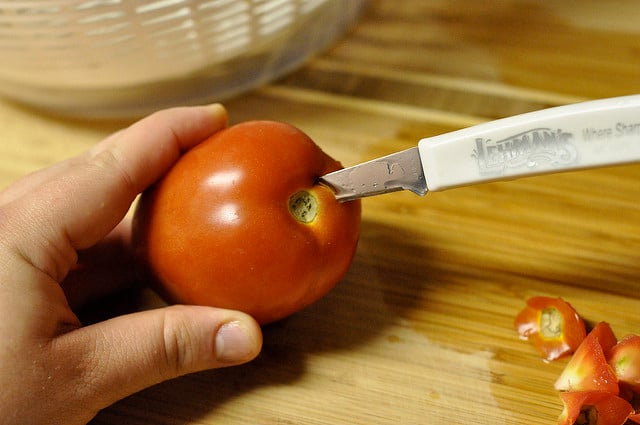
Take your tomatoes and core them. This isn’t an absolutely necessary step, but I hate dealing with the cores when it comes time to use the tomatoes on the other end.

A cored tomato. Seriously easy.
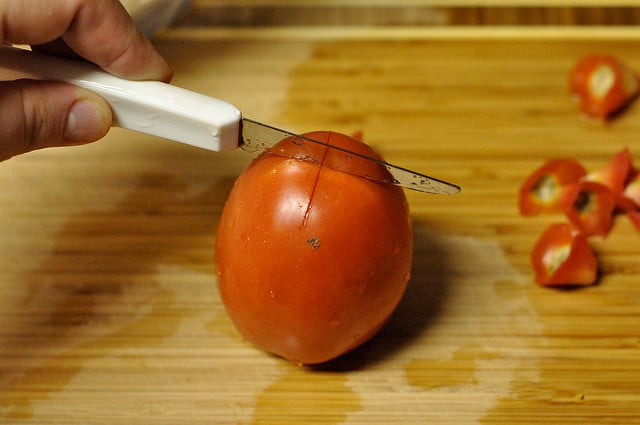
Make two shallow cuts on the bottom of the tomato, to ease the peeling.
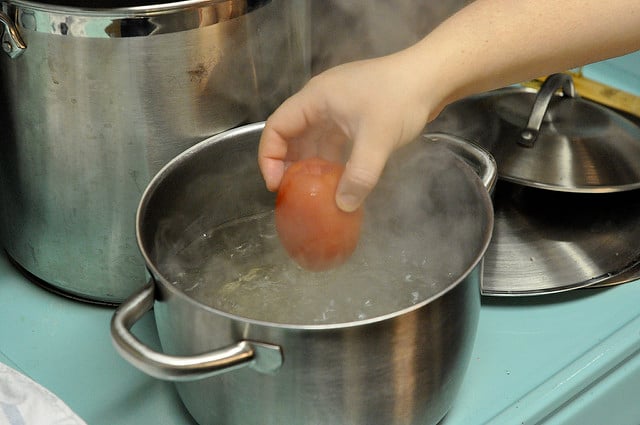
Drop cored and scored tomatoes into a pot of boiling water (don’t put too many in at once, or you’ll drop the water temperature drastically and it will take forever to return to a boil). Blanch tomatoes for 1-2 minutes, until the skins start to blister or loosen.

Put your blanched tomatoes into a boil of cold water, to halt cooking and to make them handle-able.
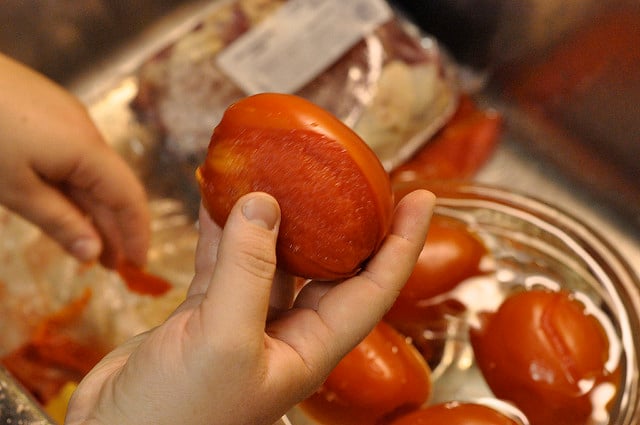
Peel tomatoes. The skins should slip off easily after the blanching and the cold water dip.

I put the tomatoes into the jars as I peel. Two standard sized romas typical fit at the bottom of the jar.
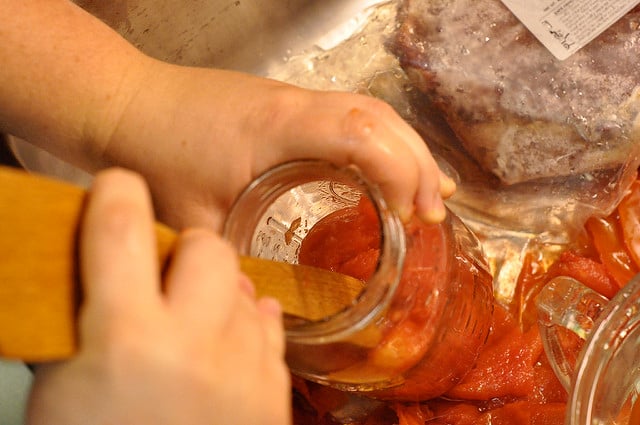
You may need to give them a little help. I use my hand when filling wide mouth jars, but when dealing with regular mouth openings, I employ the handle of a wooden spoon.

Look! A jar that’s filled with tomatoes! All the liquid you see here came from the tomatoes, as I gently smashed them to fit the jar.
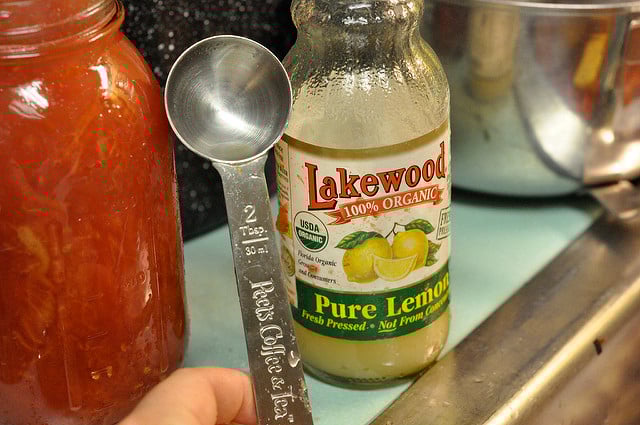
Don’t forget to acidify. It’s one tablespoon of lemon juice for pints and two for quarts. I pour it on top of my filled jars, and then use a chopstick to remove the air bubbles from the jar and work the lemon juice down into its contents. You should have approximately 1/2 inch of headspace remaining after you add the lemon juice and de-bubble the jar.
After that, I wipe the rims, apply my lids (carefully simmered for 10 minutes at around 180 degrees), screw on the rings and lower the jars into the heated boiling water canner (remembering to use a rack so that the jars aren’t resting on the bottom of the pot).
Quarts of whole peeled tomatoes get processed in a boiling water canner for 45 85 minutes. Pints get processed for 40 minutes the same amount of time. Tomatoes that are packed in water are processed for 40/45 minutes.
Because my life is busy, I rarely do my tomatoes in one great, big canning day. Instead, I stretch the process out over several post-work weeknights. I’ll do four quarts at a time, because that’s how much my stock pot can hold during processing, and it keeps me from feeling overwhelmed. I find that a 25 pound box of tomatoes will make approximately 12-14 quarts of tomatoes, and so I do four jars a night for three nights in a row. It keeps me sane and keeps my pantry filled with wonderful, local tomatoes all winter long.

Hi Marisa I did do the tomatoes in pints added one Tbs lemon juice and did them in water I blanched and peeled cut in half and added water to recommended head space and processed for 55 min per nchfp , its been a few months but looking at jars now the water is not above the tomatoes more like even with them could the tomatoes hv absorbed some of tht water im kinda worried about botcholisum or is the one tbs lemon juice enough to not let tht happen ? Thank you so much for your advice and knowledge.
Tomatoes often lose some water during processing. As long as the seals are good, they should be fine. This is not a botulism worry. The only issue here is that the tomatoes that are not submerged may dry out and will be of a slightly lower quality. It’s not a danger, it’s just an annoyance.
Hi, I’ve wanted to do tomatoes in their own juices like this ,but hunt bcuz I got conflicting info on times I’m at 6450 ft so I would add 15 min if I followed the 40 min it wud b 55 min.nchfp says 100 min for pints ball says 55 and others say less what is your opinion on doing pints at my altitude like this recipe plz and Thank you
If you are doing tomatoes packed only in their own juices above 6,000 feet in elevation, the National Center for Home Food Preservation says you need to process them for 100 minutes. Reference here: https://nchfp.uga.edu/how/can/how-do-i-can-tomatoes/whole-or-halved-tomatoes-packed-raw-without-added-liquid/
Thank you for this website and your wonderful books! I love Muir Glen’s fire roasted tomatoes–is it safe to briefly broil tomatoes before canning them to add a roasted flavor? (while still maintaining the proper acidification, canning time, etc.)
Sometimes, instead of peeling the tomatoes in a water bath, I cut them in half, arrange them on a rimmed sheet pan and broil until the peels loosen. Then I pull of the peels, pack them into jars and process for 85 minutes. They are super flavorful and concentrated in flavor.
Two of my five quarts didn’t seal. What’s your recommended course of action? Thank you!
If you have the fridge space, I’d just pop them in the back of the fridge and use them within the next month. If you can’t spare the space, you could also try putting new lids on the jars, placing them in a pot of cold water, and then slowly bringing the jars and the canner up to temperature. Then process and let the jars rest in the canner (heat and lid off) for an additional five minutes after the processing time is up.
Hey Marisa!
I plan to preserve whole roma tomatoes using your method this weekend and have a question. Could I add a couple of leaves of BASIL to the jars and process as you indicate? Or would I have to make changes to ensure safe canning?
Thanks very much – I love your site!
You can add a couple of basil leaves without impacting the safety.
Hi there!
First time canning this evening and then had some separation and after a quick google I was led here! Love your site, very helpful with great explanation. I canned some cold diced tomatoes this evening, which had quiet a bit of their own juices but I added some hot water to each jar, not a ton, maybe 2 tablespoons to each pint. I figured I needed to process for 45 minutes but after reading I’m not so sure. How much water would I need to add for it to be considered safe to process for 45 minutes instead of 85? And what can I do with the jars I did this evening to make sure they are safe to eat? Thanks so much!!
Hi Marisa, I followed the directions and some of my jars didn’t seal. I wiped the rim very well, so not sure what happened. I didn’t notice this until the next morning when I was putting them away. I refrigerated the 2 jars that didn’t seal. How long can they stay in the fridge before I use them?
Thank you
Maggie
They’ll keep a couple weeks.
Wait…85 mins now…? I did this last year and it was 45
Whole peeled tomatoes packed in their own juices need to be processed for 85 minutes. Whole peeled tomatoes packed in water get processed for 45 minutes. Documentation here.
Hi, I just canned 7 quarts of tomatoes. everything looks good. However, I just realized I only added 1- heaping tablespoon of lemon juice to each quart with 1/2 of a teaspoon of salt. Ugh! Should I just refrigerate and use them as fast as I can or start over, and if I start over do I add an additional 2 tablespoons of lemon juice or just 1 tablespoon. Can’t believe I’d made this rookie mistake!
You either need to refrigerate those tomatoes or open them up and recan them with the necessary lemon juice (2 tablespoons per quart is required).
Thank you! Will do. 🙂
I know this is an old post… But I was reading your raw pack technique and I hesitate, I did this last year and I busted a few jars… Not sure what happened, first time I’ve ever broken a jar. I did raw pack (not for the first time though)with one difference – I didn’t skin them. Skins don’t bug me, and they’re easy enough to remove later.
Could leaving the skins on have done it? Or maybe being cool, or not putting them straight into the jar post boil have done it? Or maybe they exploded? Or maybe that time my jars weren’t very hot?
Hmmm…
My best guess is that because you did a raw pack with skin-on tomatoes the contents of the jar were too cold when the jars went into the hot canner. Peeling the tomatoes does warm them up a bit, which helps prevent heat shock. Or the jar could have been old. Or poorly tempered. There are any number of reasons why the jars broke.
I notice you recommend bottled lemon juice. Is there any reason fresh lemon juice should not be used?
Yes. Read this: https://foodinjars.com/2010/09/canning-101-why-recipes-call-for-bottled-lemon-juice/
Last year I used your recipe. I passed it on to my sister. We are delighted with the results. (My son-in-law ate them as if they were a condiment – put them on cheese on toast. Wants more this year.)
I am just about to bottle/can another 6 jars (1 pint size). Thank you for such a super recipe. I use San Mazano tomatoes – we can grow them in the UK.
Website is my husband.
Hello. I just found your website and am SO excited to try this recipe! Is it cool to add Basil or would that mess up processing or the flavor on the other end?
You could add a basil leaf or two, but you don’t want to add more than that, because it could change the acidity of the preserve and potentially make it unsafe.
Hi, can anyone help me here- I processed tomatoes for the first time yesterday, and I ran out of time. I only processed the jars for 15 minutes. I cold packed them, and I added the lemon juice. Less than 24 hours later I have them back in water and am processing them for the recommended 85 minutes. I’ve put the jars in, with the ater and heated them together so the jars don’t crack. Is this safe? The lemon juice deters botulism, and the hot water processing kills any other bacteria?
Thanks!
Hi Carrie! Like I said in my email reply to you, reprocessing those filled jars is not the recommended manner for dealing with this. However, if this is the approach you’re taking, you would have needed to start with the jars in cold water and with new lids on the jars.
You are correct though, the lemon juice creates an environment that is unfriendly to botulism and the boiling water bath process sterilizes the jars and their contents.
Hi, I messed up and only boiled my raw packed jars for 35min, what is the best way to deal with this. I’ve done this recipe a lot before and for some reason I had 35min in my head… whoops. How can I fix it! Thank you, Joanna
The best course of action is to turn those tomatoes into something else at this point, like stewed tomatoes or sauce.
Thank you! What will happen if I left them, would they just get loudly or could botulism develop? Just curious…
As long as you acidified the tomatoes properly, there is no risk of botulism. You just have an increased risk of spoilage.
Hi, I’m about the embark on my first batch of tomato canning. Was doing some internet research earlier today on methods. What are the pros and cons of not cooking the peeled toms first before putting them in the jar (cold packing?). I thought I read somewhere it’s best to cook them up for 20 mins or so (boiling) and then put them in the jar, was deemed safer. Any insight is much appreciated as I’d rather do your method…seems waaaay easer! Thanks!
You get more in the jar and the processing time is a bit shorter when you cook the tomatoes first. However, a raw pack helps preserve a fresher flavor.
Question, do you have to peel the tomatoes before you can them whole? I would be using homegrown tomatoes, some are quite small and it just seems like so much trouble to peel them all. I have made tomato soup and sauce (roasting the tomatoes first with skins on cut in half, then pureeing) and it was super easy and simple without peeling, so I thought perhaps I could can them the same way, perhaps just cutting them in half without peeling after washing well of course. Thanks! 🙂
Love this recipe. After years of sweating over making endless jars of sauce, I’m now going to do this with half my tomatoes.
Question, what so you think about adding basil for some added flavor? Have you tried that?
Hi Marisa,
They’re back! Yay! Thanks again for creating such a fabulous canning resource.
Cheers,
Jane
Hooray! And you’re very welcome!
Hi Marisa,
Firstly, let me say how much I love your site and that I’ve used it as a canning resource for a couple years now! Imagine my surprise then when I opened up your canning whole tomatoes entry and discovered that all of your ever-so-helpful pictures aren’t displaying! Is this intentional? I’m still enough of a newbie at this whole canning thing and, since I really only do one or two canning sessions a year, I love the refresher your site provides me.
Cheers,
Jane
Jane, it’s not at all intentional that the pictures aren’t displaying. The images in those older posts are hosted by Flickr, and they appear to be down right now. I imagine that as soon as they are back up, the images will reappear.
The picture with you packing next to the raw meat is a little unsettling and would be a violation under commercial sanitation code. These jars must be CLEAN CLEAN CLEAN as well as the area surrounding. Also, this website has great info on processing. http://extension.missouri.edu/p/GH1456#2 It explains the time differences in processing (water pack, no added juice, raw pack, etc.) 40 minutes is the correct processing time for boiling method or 10 minutes at 10lb weighted pressure canned for raw water-pack pints. Citric acid can be used instead of lemon juice at 1/4 tsp per pint.
Jim, if you read through some of the previous comments, this is well-covered territory. I was in a home kitchen, not a commercial one. The meat was frozen and in a fully sealed package. And if any bacteria escaped from that frozen and sealed package, the jars were vigorously boiled for 85 minutes, after which no bacteria would be left alive.
Thanks Marisa. I meant no offense, but I’ve been a professional chef for 30 years and have taught Sanitation and professional cooking at the college level for the last 13 years. I also home can, pickle, and bake at home as a hobby. I love your pictures and clear directions but that one is simply incorrect and not a good example. Freezing does not kill bacteria and boiling for however long does not effect botulism toxins. Sorry if I’m beating a dead horse here, I just found your site today. 🙂 Like I said, nice job. Love your site.
I didn’t say that freezing kills bacteria. I said that the boiling of the jars would kill the bacteria. And botulism isn’t a concern here, because I was making a high acid product.
Actually C. Bot toxin is quite easily destroyed by heat greater than 176F. The issue is spores which are not easily killed with heat. However the cook procedures suggest when followed correctly actually do kill the spores (C. Dificulus is the basis normally). The 12D processing is the industry standard and is affected by suspension media, pH and osmotic pressure hence the different processing times.
As for the meat, the cross-contamination risk is real, but likely minimal risk for contaminating you jarred food. Most meat pathogens are obligate aerobes and would die via the pH, heating and lack of oxygen.
Certainly good to call out risk, but Jim you are propagating incorrect info here wrt C. Bot.
The more important issue is not to lead people with little experience or training to believe they will do the right thing by chance. Monkey see – monkey do. I understand the meat was probably placed for a photo opp, but it’d be smart to not encourage people to follow that example, just in case…
The meat was there because it’s my home kitchen and it was defrosting. Life happens sometimes.
Hi! I’d like the try this recipe today with my extra garden tomatoes but was wondering if I need to boil my jars first?
The jars you start with need to be clean, but not sterilized. Just follow the recipe as written. Because the finished jars process for so long, any pre-packing sterilization is unnecessary.
Is it possible to can tomatoes in a pressure cooker instead of a water bath? – And without peeling? Why is peeling necessary?
Process: Wash and core tomatoes; remove any bad spots. Add tomatoes whole to jar; add lemon juice as directed; remove bubbles; clean rim; add heated lid-rim. Would this not work as well? And would it not eliminate any bacteria because of the pressure cooking? A quick reply would be appreciated before I start on this. Many thanks.
It would work. However, leaving the skins on the tomatoes during processing means that you don’t get as many into the jars and they can get a little bitter over time. But in terms of safety, it’s cool.
i love canned tomatoes in bolognese, it goes down a treat and even the kids eat it.
thanks for the post, loved reading it and very helpful.
Hi Marisa. Just did these yesterday and followed your recipe exactly. Made sure i burped out the bubbles as directed, and when the jars went in the pot for processing, they were full of juices. After processing it looked like a lot of the juices “cooked off” and there are some pretty obvious air pockets throughout. And though the lids did seal, I never heard them ping, which I thought was odd. Does this all sound normal to you? I supposed I’m just being paranoid, but am mostly looking for some reassurance. Thanks!
What you’ve experienced is totally normal. Read this post: https://foodinjars.com/2011/08/canning-101-tomato-float-sauce-separation-and-loss-of-liquid/
I was looking at the Ball website and they still say 40-45 minutes of processing time, so I’m not sure what to do. You mention that tomatoes that are packed in water can be processed for 40-45 minutes, not the 80 minute length. Does this just mean that if I add any water to the tomatoes in my jars, I can process for the smaller amount of time? Thanks for the clarification, I’m just starting out so want to make sure I am doing everything safely!
If you raw pack they say to do it 85 minutes, if you boil the tomatoes first and hot pack the jars you can use the 45 minute processing time.
When did Ball increase the canning time and do you know why it increased so much?
They increased it around 1988-89. I don’t know why they increased it so much, but I imagine they found that the extended heat exposure was necessary to kill all the bacteria.
So, I canned tomatoes this way but didn’t have quite enough to cover themselves in juices/eliminate a large amount of head space. There is an inch and a half of space at the top of the jar. Do I have to throw it out? Lid is sealed right & I added the citric acid but I’m not sure because there is so much airspace.
If you were going to do a ‘big canning day’, or if you don’t have enough tomatoes because your garden’s small, would you recommend freezing them first (I have a vacuum sealer, it’s instructions take the tomato all the way to being ready to put into jars, but after blanching, peeling, and reserving the squished out juice to freeze seperately you bag/vac/seal and freeze until canning day).
Can you tell me, if I froze them, then what steps would I need to take to thaw and prepare to hotpack before processing?
Thank you for any guidance you could give!
First time Canner,
Becky
When you freeze whole tomatoes, the skins just slip off as they defrost. So you can just chuck them in a freezer bag until you’re ready to can. Then defrost them and use them to make crushed tomatoes or sauce.
I just caned 3 pints of tomatoes following your instructions. A couple things happened that I didn’t expect: 1) a lot of water separated from the tomatoes and collected at the bottom of the jars and 2) some bubbles have appeared in the jars even though I was careful to be rid of bubbles before putting the jars in the water bath.
Did I do something wrong or is this normal?
Totally normal. Read this post: https://foodinjars.com/2011/08/canning-101-tomato-float-sauce-separation-and-loss-of-liquid/
As I haven’t been able to find tomatoes jarred I, too, am going back to doing my own. The difference is that I will freeze mine. Wash, core and put in bags or containers in the freezer. May be air thawed or in a glass bowl in the microwave. The skin comes off as they thaw. So fast and easy!
Dear Marisa,
I just started canning tomatoes for the first time today — made ten 1L jars using the hot water bath method, boiling for 85 minutes. I made an error in judgement about the size of my jars (thinking my 1L jars were 500ml), and so only used one tablespoon of lemon juice per jar. The rest of the liquid is tomato juice/water strained from the seeds.
Will the lower acidity be a problem? I’m boiling my almsot last batch right now, so I can only correct the one last jar that hasn’t gone into the pot yet. Should I break my seals, add another tablespoon, and process again?
Thank you for any advice you can give me!
Hi! I’m a big fan and followed this recipe last year and my tomatoes were delicous all winter. On Sunday I preserved about 8 jars worth of tomatoes and this morning I noticed some of the tomatoes are growing mold? Do you know why that would be? I use a foodsaver sealer and it sealed perfectly but my lemon juice might not have been that fresh, do you think that could be the reason?
I appreciate your help! Thanks!
Did you process your jars in a boiling water bath? Or did you just put the tomatoes in jars and seal with the foodsaver?
My husband and I were gifted a large box of large tomatoes- like, as-big-as-your-face tomatoes. We can’t get one into a quart jar, let alone six, so can we chop the huge maters into large, Roma-sized hunks and successfully can them? Or does cutting them compromise the texture, shape, etc.?
Crushed is probably your best bet: http://nchfp.uga.edu/how/can_03/tomato_crushed.html
Great, thank you!
I have been scared to try canning tomatoes in the past, but this year I have decided to give it a try (since my tomato plants have produced so much more fruit that I can keep up with!).
I just did a small batch of whole tomatoes, but now I am slightly concerned. I used lemon juice from concentrate, and I just read elsewhere that it is a no-no.
Is this going to compromise my tomatoes?
Thanks!
Typically, the only lemon juice that is to be avoided is fresh lemon juice. I imagine the concentrate was fine.
I have referred to this web page often in the past couple of years. We used to have home grown tomatoes come in faster than I could use them, but not fast enough that a “Canning Day” was merited. Being new to canning, I just assumed it needed to be an all day event! Thanks for challenging that notion and showing me how to responsibly manage my back yard harvest. I love knowing my tomatoes came from my own back yard.
I made the canned tomato’s last night following your recipe. It was my first time using a water bath I thought I was supposed to cover the jars with water 1/4 of the way up the jar (that’s what I thought the canner direction said). Anyway I was using 500ml jars and so left them in the bath for 45min. I didn’t see any bubbles in the jars before I sealed them and had used a spatula to move things around to get any out. This morning I was getting ready to put the jars away I see bubbles in the jars did I do something wrong are they going to spoil. The seals are all nice and tight.
I found this discussion when looking for shelf life.
Glad to know I can use for many years. My wife and I are fraily new to canning and freezing also dehydrating. We process in a presser caner and follow instructions for presser and time. We are using canned tomatoes three years later and are still very good after in the pantry.
One thing has me curious, I do not use acid to can. I use salt, smashing the tomatoes in the jar using my wife’s smaller hands.
You really do need to add some acid to your tomatoes when next you can them. Modern tomatoes have been bred to be lower in acid that older strains and so may not have enough acid to ensure safe preservation.
Marisa, I bought 35lbs. of Tomato ‘seconds’ at the very last farmers market sale today while it was 30F with a 15F windchill. I can’t wait to put them up tomorrow. As a wee-little one I remember my mom, grandma, and aunt canning BUSHELS of tomatoes for an entire weekend and finish with over 100 qts. between the 3 of them. Mom would put them in soups, stews, chili and dad would even eat them as a “vegetable” with dinner! Thank you for sharing your love of canning with us.
I tried to can whole tomatoes this year because I find them to be much easier to cook with / give the most flexibility. I didn’t see your tutorial and was using a different method. I froze the tomatoes and then thawed them just enough to get the skins off. However, when I pulled the jars out of the pressure canner, I had half water, and half tomatoe pulp in each jar. FRUSTRATING! Do you think my method was flawed, or is this just something that happens occasionally? We did the pressure canner method rather than water bath. I know it isn’t your method, but it was so easy to peel the tomatoes! Suggestions?
Jessica, so sorry to hear that you’re frustrated with your tomatoes. Read this post for an explanation of what happened. https://foodinjars.com.s164546.gridserver.com/arugulapesto/2011/08/canning-101-tomato-float-sauce-separation-and-loss-of-liquid/
I proceesed my entire tomato harvest in pint jars in there own juice with the exception of three quart jars. I did most of the tomatoes in julhy and august with the exceptions of some that I did today. I did 35 pint jars and 3 quart jars for my harvest. However I have messed up big time. I proessed the tomatoes in there own juice at the times if they were in water so instead of 85 minutes I did them for 45 minutes except for this recent batch after i looked at the reipe. Did i just waste an entire harvest is there anything I can do? Can i reboil the jars. Need help big time someone please help I’m am besides myself that I may have wasted all this food. thanks
Jeff, did you add the required acid to the jars? If so, then I would leave them as-is and watch them carefully. As long as the proper amount of acid went into the jars, the worst thing that can happen is that a jar or two could experience some bacteria growth and spoil. If you pay close attention, you won’t accidentally eat those spoiled jars. However, if you didn’t acidify the jars (one tablespoon of lemon juice per pint jar), then they could be quite dangerous.
Marisa,
Thanks for the info. So you recommend basically not doing anything. I will probably give ball canning a call on monday and see what they say to. I actually did somthing correctly by adding lemon juice and salt to the jars as the ball blue book says to. One tablespoon lemon juice for pint jars and two tablespoons for quart jars. Anything I should look for when I open the jars smell etc.? This was my first season canning and I am so mad that I mixed the recipe up for tomatoes in water and tomatoes in own juice very disappointed. I know I should boil the tomatoes from the jar for ten minutes when I open it according to the ball blue book. I will probably eat these tomatoes myself as I was going to give some to relatives but now I’m not sure. Thanks for your hekp much appreciated.
Jeff, that’s essentially what I’m recommending. If you call Ball, I’m fairly certain that they will tell you to throw them out. Since you properly acidified them, the worst that will happen is that in six months, one of the jars could start to mold or ferment. There’s nothing to look for in them now.
I was very tired last night, and kind of dazed. I just realized this morning that I processed my whole, peeled tomatoes for 75 minutes, not 85 minutes. The lids are sealed. Will the 10 min make or break my tomatoes? Should I reprocess them tonight? Thanks!
Hi everyone
Just tried this and two of my jars broke 45 min or so into processing. I was reading that it may have been due to the uncooked/headed contents being placed in boiling water? Should the water in the canner just have been hot? Then slowly brought to a boil? I’m heartbroken and would love any suggestions. I took the other two cans out early and will just freeze them this week. I was too worried they would break too.
Thanks
Were your jars free of flaws, cracks, chips, etc?
I am new to canning. When I put the jars in the canner, the water is hot and gently simmering. I bring it back to a boil after all the jars are in place and begin timing at that point.
I just did my first batch of tomatoes and ran into a few issues. I realized after packing the jars (1 qt jars ) that they just barely fit in the stockpot with very little space left at the top for the water. They were covered with water the entire time, but not the 2 inches I’ve seen recommended. I went ahead and processed them anyways, for 85 min. But I was wondering how important the amount of water covering the jars is? I also noticed afterwards that there are a lot of bubbles in the jars. I saw on your applesauce post that bubbles are ok, as long as they don’t rise when I open the jars. Does this apply to tomatoes too? Thanks!
If this has already been asked I appologize. I have a TON of yellow tomatoes, Is the process the same for canning them? I thought I read somewhere here that they have less acidity than red ones. Thanks!
Thanks for this post, just in time for taking advantage of all the great looking tomatoes at the end of season farmer’s markets. I’ve never canned whole tomatoes before, so I’ll use your process and let you know how it goes.
I just realized I didn’t process my tomatoes for enough time last night – 45 minutes, rather than 90 minutes. After I finish swearing at myself, what should I do to re-process? Can I just open, replace the lids and re-process for the correct amount of time? Thanks,
Andrea
How long do I need to process in a water bath for 2-quart jars?
Anita, the USDA does not recommend the use of 2-quart jars for anything beyond fruit juices.
Do these need to be kept refridgerated? Or can I keep them in a cool, dark place? Also how long would they last? Thank you!
They do not need to be refrigerated. The canning process makes them shelf stable. A cool dark place for a 12-18 months is best.
Marisa, would it also be wise to add some oil to canned tomatoes? Helps seal out air in case bacteria needs the O2, as Ive been told. But then again there are anerobes that grow well without O2 as well… But I’ve found that the oil bubbles up and out leaving an oily mess in the canning water. Also another poster asked if it was ok to can basil w/ their tomatoes as well- will the basil darken and discolor? Thx.
Emil, it is actually unwise to add oil to tomatoes. It can compromise the seal if it sneaks out during processing. You can add a basil leaf to your jars, though I don’t find that it contributes much in terms of flavor.
Do I need to peel the tomatoes before processing them? I usually blend all my tomatoes before using them because my kids don’t like them and will try and pick them out. I tried blending them before processing them and I had problems like those you described as caused by not bubbling your jars adequately.
I find that I like the quality and flavor of the finished product better if I’ve peeled my tomatoes, but you don’t HAVE to do it. I’ve been told that tomatoes can become bitter if the peels are left in the product, but I’ve never noticed it myself. Leaving the peels on the tomatoes will not impact the safety of the finished product.