
Earlier this year, Instant Pot announced that they were adding a multicooker to their line that would include a canning setting. The internet (well, as least the portion of it interested in home food preservation) went wild with hope and curiosity. Would this be the electric pressure canner that many of us have hoped for?
It quickly became clear that the answer was no. The Instant Pot Max is a very able electric pressure cooker that has the ability to go up to 15 pounds of pressure, but it is not the electric pressure canner of our collective dreams. There are a couple reasons for that.

The first is that no testing has been done by the National Center for Home Food Preservation or any other US-based cooperative extension to determine if products processed in the Instant Pot Max reach a sufficient internal temperature to kill off any botulism spores that might be present.
Additionally, when pressure canning times are developed, the time required to come up to temperature and back down again are factored into the total process. These pre- and post-processing times are altered with an Instant Pot Max and there’s no understanding yet of how that change will effect the finished product.
Setting aside the first reason (which pretty effectively shuts down one’s curiosity about the device from a canning perspective), the second reason why the Instant Pot Max isn’t an ideal canning vessel is simply its size.
It’s a six quart pot and can only hold four pint jars. If you are someone who does pressure canning on any scale, you will find this limitation totally infuriating. There’s very rarely an instance when four pint jars is the sum total of a batch of stock, or beans, or pumpkin cubes.

Despite knowing all of the above, when a representative from Instant Pot reached out back in the spring to ask if I might want to test a review unit of the Instant Pot Max from a canning perspective, I said yes. I wanted to be able to speak about this particular unit with some level of first-hand experience and this seemed like a very good way to gain it.
(If you’re curious about how Instant Pot instructs people to use this device as a pressure canner, click over to the user manual and read that section – pages 23-26. It is quite thorough.)
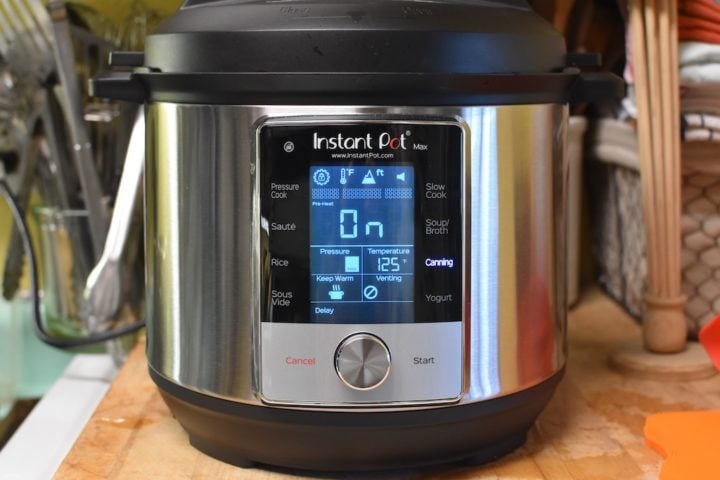
So sometime in June, the Instant Pot Max arrived at my apartment. I used it for cooking almost immediately upon arrival and I quickly found myself preferring it over my Instant Pot Duo. I appreciated the large LED screen and the fact that the controls were more intuitive.
I liked the fact that the read-out always showed the pot’s internal temperature. And I loved the Automated Steam Release feature, that allows you program the pot to do a quick release when the cooking time is up (this is particularly useful when you’re using it to hard boil eggs).

Because I’m a thorough person, I even tested the canning setting. While I didn’t feel comfortable using the Instant Pot Max to process low acid food (my hesitations are laid out in the third and fourth paragraphs of this post), I decided it wouldn’t be too risky to use it to process an acidified product that had optional pressure canning instructions.
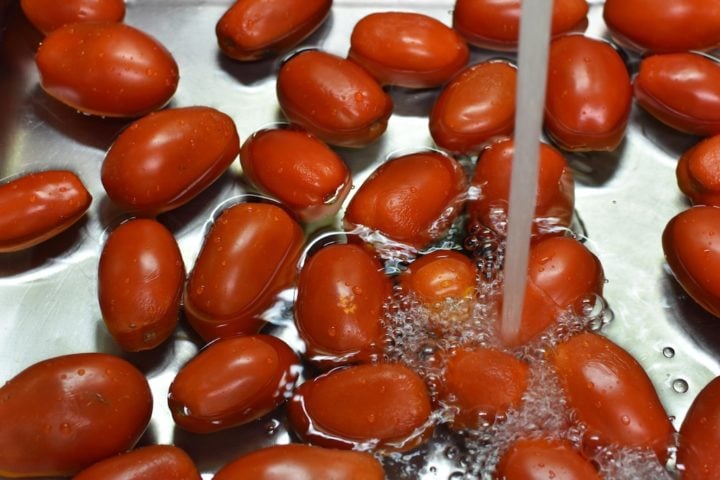
And so I made a batch of acidified whole peeled tomatoes packed in water and used the timing for pints in a weighted gauge canner. When you can in an Instant Pot Max, it gives you two pressure options. There’s the low setting, which reaches 6.5 PSI (this setting is recommended for high acid foods), and the max setting, which reaches 15 PSI (this is the level they recommend for low acid foods). For my tomatoes, I opted to go with the max pressure, thought it was more pressure than was strictly required.

It was an entirely smooth experience and the jars came out beautifully. There was less siphoning than you often see with water packed tomatoes processed in a pressure canner. And I loved the fact that I didn’t have to watch a dial gauge and monitor my stove temperature.
I look at this experience canning in the Instant Pot Max as a glimpse of what might be possible in the future. I makes me wish that Instant Pot would team up* with the National Center for Home Food Preservation and fund some extensive testing on this device so that we home canners could use this unit for pressure canning without reservations. Once that was done, I’d then wish for a slightly larger capacity unit that could hold quart jars in addition to pints.
The bottom line is that if you are looking for an exceptionally user friendly and hard working multicooker, the Instant Pot Max is a fantastic unit. However, until more data is available, I cannot recommend that you buy it to use as a pressure canner.
Disclosure: Instant Pot sent me a review unit of the Instant Pot Max at no cost to me. No additional compensation was provided and all thoughts and opinions expressed in this post are entirely my own.
*Just after I published this post, my contact at Instant Pot provided the following information:
For Max Canning, Instant Pot is currently working with McGill University, a 3rd party food science research facility to validate the Max meets canning regulations. There are 3 phases to the process, (1) Validating the temperatures, (2) Canning food (low and high-acid) and verifying post-canning result, and (3) Potentially, developing new canning times for certain food groups.
We can confirm phase 1 has been completed and the “Low Pressure” 230°F (110°C) setting sustains an average temperature between 110 and 111°C which can be for high-acid canning foods. With “Max Pressure” we can confirm a sustained temperature of 240-247°F (116.5-119°C) for low-acid canning foods.
When canning, recipes must be closely followed, modifying cooking times, ingredients or temperatures can be dangerous.
So some testing is being done, but I worry that because it’s being done at a Canadian university, the National Center for Home Food Preservation may still not accept it. Additionally, until all three phases of testing are complete, I still do not recommend that people go out and buy an Instant Pot Max expressly for canning.

I want to clarify statements made about Pam Cantrell and her testing of the Instant Pot Max on her YouTube channel, RoseRed Homestead.
First, she does not make recommendations. She does her testing, which by the way is quite scientific and, in my opinion,quite reliable coming from a Phd in Science who is a professor at university in Utah, and tells her viewers whether SHE would feel comfortable in using the tested equipment for her family. She encourages her viewers to do their own research and make their own decisions.
Secondly, she consistently refers to the USDA book and website for tested recipes and processing times, and food safety..
And for those who haven’t viewed her testing of three digital pressure canners, you should really view her video and data and come to your own conclusions.
Thank you for your comment. However, I cannot endorse her testing or recommend it to others because it would open me up to liability issues that I’m not interested in entertaining.
RoseRed Homestead extensively tested the Instapot Max and recommends it for canning. She is a professor, highly educated in food preservation. Look Pam up on Youtube to review her video.
I understand that she recommends it. But I cannot recommend it unless it is approved the National Center for Home Food Preservation. I’m not willing to open myself up to that kind of liability.
Please see the thorough pressure canning testing completed on the YouTube channel: Rose Red Homestead. Pam is a PhD college science professor that purchased equipment and had logged data showing the success of this product meeting USDA guidelines! 🙂
I love love my instant pot for not only cooking which I have done little of, but love it mostly for the canning feature. Since I’m the only one in my home and preservation of all foods are a must for me, I do love this item. I’ve had it about a year now and won’t do without it. I’ve given my slow cooker to the Goodwill and a few more items will be given away that I’m finding the instant pot can do. Thank you for inventing this marvelous piece of kitchen magic.
🤣 I bought 2 they are great ! My only wish would be they hold quart jars but pints are fine for a meal for 1 person or same as a can of veg from the grocery so with 2 I can do 8 pints at a time. I’ve canned all meats with vegetables in meals and eaten them a year later and I’m not dead so I’m good to go 🤣
I really do want an All American Pressure Canner but they are way over my pay grade.
I’m glad it’s working for you!
Watch Rose Red Homestead on YouTube test the Max complete with temp probe inside jars at various positions. Using the USDA algorithm, the Max met the requirements to kill the botulism threat. She is a college professor of mathematics and clearly understands the scientific process. I don’t care if the NCFHFP ever gets off their beaucratic bottoms and does anything. I have become so skeptical in the past few years that I wonder what financial incentives might be required to motivate them. I also wonder why you don’t mention that in EU only water bath canning is used for both acidic and non-acidic foods, but the non-acidic require prolonged cooking times. Yet Europeans that want to can meat do it.
Great article on a very timely subject which is of great interest to many of us, but even more so considering shortages and rising prices and the desire to eat food without so many preservatives and other chemicals.
The big question then is the ability of the Instant Pot to maintain adequate pressure and temperature. I think it can be attained, but they might have to design a newer model.
On the other hand I wonder if the pot can’t safely manage to can in small jars with some prep-processing of the food. Or possibly by adding acidity to the food in the jars.
If it can’t be used to can low acid foods then maybe since it can provide both the low and high pressure settings, people can use it as a water bath canner alternative.
Seems to me if you can can in an open vessel and then you add pressure that you are actually adding another degree of safety.
I have been watching videos by Melissa Mir (Name of her channel) on YouTube where she demonstrates a process she has been using for years which is essentially open water bath canning except most of the recipes and foods must be kept very cool and they generally last only 1 or maybe 2 years.
I wonder if the people who study food preservation have over looked or are unaware of other methods of food preservation. And while I will follow their guidelines and confide in my local county extension office, if people have been practicing a particular method for years be it a family favored method or one used by an entire culture or at least a lot of people then I don’t see why it should not be checked out so we can take advantage of another method.
Have you reached out to your Instant Pot contact again? I am very interested to know at what point they are in the testing process now.
I have reached out repeatedly, and they have never responded. Which is why I’ve not updated this post. My apologies!
Extensive testing was done by Dr. Pam Cantrell and her reviews are on YouTube at RoseRed Homestead. She bought a very expensive (around $400, I believe) data logger that recorded temperatures inside jars in her various canners. She is a long-term storage canner, a university science professor, and a survivalist who has canned for over 50 years. She was very impressed with the information she was able to get from the data logger and recommends the IP Max. She shows and explains the charts that were produced by the data logger for time and temperature during canning. She pitted a Presto against the Instant Pot, and now does not recommend the Presto over 5000 feet, but the IP Max performed like a champ. I’m not interested in long-term canning. We are two eighty-year olds who want/need .some time off from cooking, but want homemade food, so several meals ready to heat and eat are what we are after. I am having a series of surgeries and my husband doesn’t cook, and I need to eat during home recovery, so again, the convenience factor. Four pints at a time is perfect for us. Even a hungry grandchild needs a meal sometimes, too, so they will have them easy-peas. We live in Florida retirement housing, so little good storage and a month’s worth of canned food is all I intend to have on hand if that. I’m ordered my Max today and will start canning immediately. Besides, he wants beef stew with gravy, and I prefer vegetable beef soup in a beefy tomato broth. We can each have what we want. One size doesn’t fit all, and from watching all of Dr. Cantrell!s videos, with her scientific testing, plus McGill’s, the IP Max is the perfect size for the Hubs and me. I am satisfied as to its safety. If the Nat’l. Center changes it’s recommendations every few years, then they don’t have it in final perfection either.
The Instant Pot MAX like many things these days is made in China. They are represented in North America by Instant Brands a Canadian company. I would guess that that is why they are using McGill University to try to verify its use for pressure canning. I recently bought a IP MAX for its ability to use for sous vide, making natto and amazuke, yogurt etc where a specific temperature range setting is needed as well as being an ordinary an instant pot. There are other machines and methods to do these specific tasks but I have only so much room on my kitchen counter. I have used a Brevill Fast-slow Pro instant pot like device (twice as costly as IPs) for several years and I like it quite well but one can’t set a temperature, only pressure and time. So far I think I prefer the Breville to the MAX for ordinary pressure cooking tasks. It remains to be seen how well the MAX preforms for the other tasks I want to use it for as a brief test indicates that it is a couple of degrees off in maintaining a specific temperature.
I have a real large Presto Canner which I have used years ago to can high and low acid foods, meats, fish etc. but I have not used it for several years probably because I don’t have gas service in my house only an electric stove and it requires a lot of attention when canning. I probably won’t use the MAX for canning low acid foods until more approvals and/or confidence is forthcoming. I will monitor you site for this purpose. I may yet bring the Breville back from the cellar.
Thank you for the review. I have been watching YouTube videos from Red Rose Homestead and she is a college professor. She used the same internal gadget that is used in testing canned products in which it is put into the jar of food being canned as it is programmed to show time and temperature lengths used. Very informative. She is very intelligent and I have no fear canning in the Max.
I have a question I was wondering if I have to reprocess my jars of applesauce. I heated the jars and the applesauce was boiling and I put the lids on and left overnight. They all sealed but I didn’t have time to process the jars like it says so I was going to do it the next day can I re process sealed jars?
At this point, you need to reopen the jars, reheat the sauce, apply new lids, and process. In the future, if you have to stop midway through the process, the better choice is to stop while the sauce is in the pot. Cool it and refrigerate it overnight. Then reheat, funnel into jars, and process. Once the sauce is in the jars, you have to process.
As a highly experienced canner of high and low acid foods, I have to commend A. Canner for the insightful analysis. I’d trust an IP Max far more than my manual canner any day to maintain an even temperature over the time period required based on food type.
The USDA does not test any equipment or recipes and hasn’t since 2016. It does not recommend any canning equipment other than dial-gauge which MUST be checked and calibrated annually (good luck with that) or weighted gauge. USDA certainly HAS NOT tested or recommended the Presto Digital Canner.
USDA has not tested Tattler lids or Weck jars. I use those. They have not specifically tested canning of cured, brined or corned meats and don’t recommend those either. Yet those items are likely just as safe to can as fresh meats, perhaps more so with the additional preservatives they contain, such as salt.
Stovetop canners must be used precisely and properly and monitored continuously during the entire canning process, rendering them highly subject to human error and variations depending on the heat source.
I have every confidence in my Max which attains proper temperature and maintains it beyond the time necessary to kill Clostrudium spores based on the time guidelines from NCHFP including the natural realease cooldown period which is extensive. I have watched my Max through the entire processing time. It adjusts pressure automatically based on your altitude (which must be programmed in for altitudes above 2000 feet.) Venting is an automatic process without having to manually time for 10 minutes. The interior temperature is monitored and displayed continuously. If it were to drop below 240 degrees F at any step of the process (mine never has) it would shut off and display an “error” code.
I don’t need anybody else to do my thinking for me, nor will I rely on the corrupt US government to test and approve my kitchen equipment.
Gee..I just bought and started canning chicken in the max bc I did watch rose red. She seemed to be convinced by her findings that the canning feature was usable. I wonder …she didn’t question why the max wasn’t certified yet? Thats strange. With her background you would think she would have. I guess i wasted my money. Yes I agree Marisa until we all see the verifications from the research centers the max is not a canner.
Do you think you would be able to use two layers of half pint jars, instead of one layer of pint jars? There is just me and my husband and sometimes even a pint jar is too much.
I would only do that if the manufacturer approved the process.
Canada is NOT a third-world country, and I’m confident that the data coming out of McGill will be accurate and trustworthy. Data seals the deal.
No one said that Canada is a third world country. I was simply trying to express the fact US institutions can be myopic on occasion and might not be willing to accept those findings. I would be perfectly willing to accept the data from McGill, but as far as I know, so data has yet been released even though it’s now been three years since I was told that the research was being done.