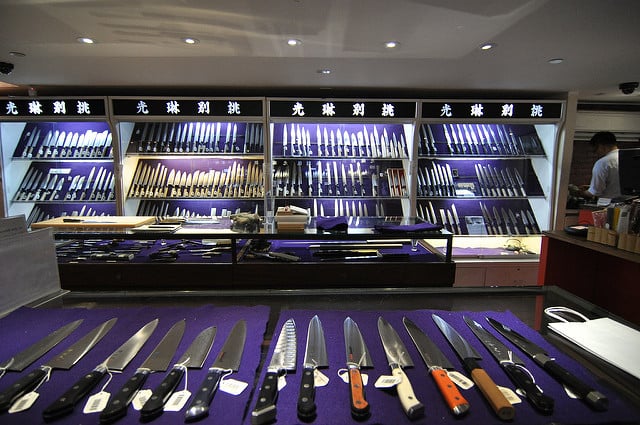
Last Wednesday, I hopped on a double decker Megabus and rode to New York in order to learn about knives. Many months ago, I’d gotten an email inviting me to visit Korin, a specialty shop that sells Japanese knives and tableware and finally the day had arrived for my trip. As a fan of good kitchen knives, I was incredibly excited to learn a little more about the breadth of knives available out there.

Located downtown near City Hall, Korin has been in the business of knives and tableware for 30 years. A family operation, the store was initially open only by appointment to the restaurant trade (they currently work with the likes of Nobu, Grammercy Tavern and Per Se) but in recent years, the shop has been open daily to the public as well.

In addition to selling an incredibly vast array of knives and tableware, they also offer sharpening services using a variety of Japanese water stones. They can sharpen and repair nearly any type or style of knife, save those with a serrated edge.
Having seen what they were able to do with some of my more beat-up knives, I am a true believer as to what a good sharpening can do. There is no one that I know of in Philadelphia producing this level of edge quality. Happily, you can mail your knives to Korin should you not live near enough to drop in for sharpening.
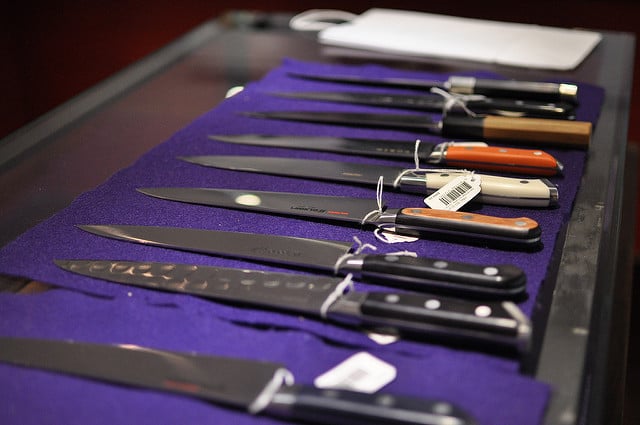
Korin sells Western-style knives, traditional Japanese knives and a Japanese-Western hybrid. The difference between these knives is in the edge. Western edges are sharpened so that they have a symmetrical edge. This offers a blade that is fairly durable and relatively easy to maintain. Japanese knives are traditionally sharpened on just one side of the knife. This makes for an incredibly sharp edge, but not as easy for the home cook to maintain.

Then there’s the hybrid knife. Made of thin, high-grade steel, the edge is sharpened to an asymmetrical edge that leads to a sharper, more durable blade. The only issue with selecting a knife with an asymmetrical edge is if you have multiple cooks in your household who have different dominant hands. These knives are sharpened differently for righties and lefties. Just something to keep in mind.

One of the things that my hosts stressed when showing me through the knives was the fact that in Japanese culinary culture, there are different knives for different tasks. The giant knife with the extended blade in this picture? It is designed for cutting soba noodles. Thicker blades are designated for butchering, while thinner ones are for making more precision cut. Blade shapes also vary depending on region and maker.

One blade that I fell particularly in love with while visiting Korin was the Petty knife. It’s seen as an analog to the paring knife, as it’s both light and highly maneuverable. However, as you can see (it’s pictured below), it’s got a longer blade that you typically find on a Western paring knife. Since introducing it to my kitchen a week ago, it’s rapidly become my favorite knife for quick tasks like slicing up an apple.

If you’re a knife nerd like me, make sure to visit Korin the next time you’re in New York!

My very favorite kitchen tool is the ribeisen. I use it to grate potatoes and onions for my family’s stuffing and potato latke recipes. I’m not sure if they are still being made but I come across them at flea markets once in a while.
Favorite tools are my kitchen aid mixer, Viking range, and cast iron skillet. A new knife would go well with these!
Ohhh, my favorite kitchen tool… that is hard. I think it is tongs. Not only do I have several pairs in my kitchen, but I like to buy them for everyone else in case they don’t have any.
My favorite kitchen tool is my crockpot. =) I love putting dinner on to cook before I leave for work and then smelling it when I walk in the door.
My vintage hand-held egg beater.
I just love my 12-cup food processor! It can do so much!!