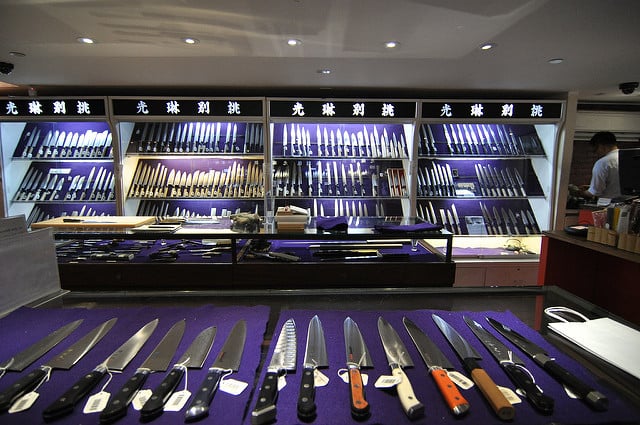
Last Wednesday, I hopped on a double decker Megabus and rode to New York in order to learn about knives. Many months ago, I’d gotten an email inviting me to visit Korin, a specialty shop that sells Japanese knives and tableware and finally the day had arrived for my trip. As a fan of good kitchen knives, I was incredibly excited to learn a little more about the breadth of knives available out there.

Located downtown near City Hall, Korin has been in the business of knives and tableware for 30 years. A family operation, the store was initially open only by appointment to the restaurant trade (they currently work with the likes of Nobu, Grammercy Tavern and Per Se) but in recent years, the shop has been open daily to the public as well.

In addition to selling an incredibly vast array of knives and tableware, they also offer sharpening services using a variety of Japanese water stones. They can sharpen and repair nearly any type or style of knife, save those with a serrated edge.
Having seen what they were able to do with some of my more beat-up knives, I am a true believer as to what a good sharpening can do. There is no one that I know of in Philadelphia producing this level of edge quality. Happily, you can mail your knives to Korin should you not live near enough to drop in for sharpening.
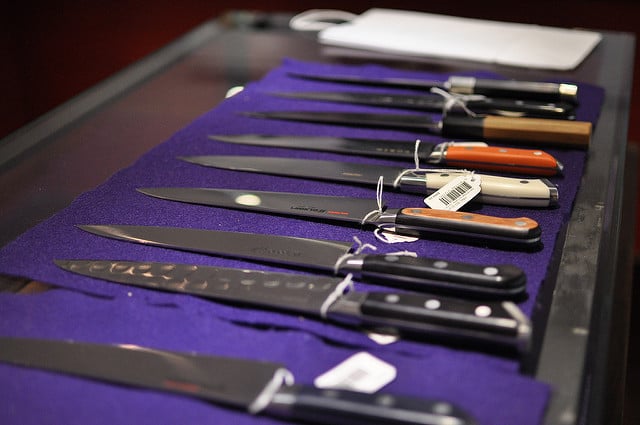
Korin sells Western-style knives, traditional Japanese knives and a Japanese-Western hybrid. The difference between these knives is in the edge. Western edges are sharpened so that they have a symmetrical edge. This offers a blade that is fairly durable and relatively easy to maintain. Japanese knives are traditionally sharpened on just one side of the knife. This makes for an incredibly sharp edge, but not as easy for the home cook to maintain.

Then there’s the hybrid knife. Made of thin, high-grade steel, the edge is sharpened to an asymmetrical edge that leads to a sharper, more durable blade. The only issue with selecting a knife with an asymmetrical edge is if you have multiple cooks in your household who have different dominant hands. These knives are sharpened differently for righties and lefties. Just something to keep in mind.

One of the things that my hosts stressed when showing me through the knives was the fact that in Japanese culinary culture, there are different knives for different tasks. The giant knife with the extended blade in this picture? It is designed for cutting soba noodles. Thicker blades are designated for butchering, while thinner ones are for making more precision cut. Blade shapes also vary depending on region and maker.

One blade that I fell particularly in love with while visiting Korin was the Petty knife. It’s seen as an analog to the paring knife, as it’s both light and highly maneuverable. However, as you can see (it’s pictured below), it’s got a longer blade that you typically find on a Western paring knife. Since introducing it to my kitchen a week ago, it’s rapidly become my favorite knife for quick tasks like slicing up an apple.

If you’re a knife nerd like me, make sure to visit Korin the next time you’re in New York!

I LOVE my grandpa’s very well seasoned cast iron skillet! It’s awesome for so many things and I love that it has a bit of ‘history’.
Couldn’t live without a good kitchen scale!
My ipad! I can look up tasty recipes and easily view them whilst cooking.
Probably my stick blender…. I honestly have no idea how I got a long with out it before.
A good knife is worth it’s weight in gold…of course …but a close second immersion blender ..it saves time and clean up
Love my kitchen aid. It is my nicest piece of equipment/tool in my kitchen so far and it gets lots of use.
The chef’s knife that my husband gave me for my birthday back when we were still dating was a life-changer — and not just ’cause I decided to keep him!
My fav kitchen tool is my yellow Le Creuset pot. I made my first batch of Sweet Whiskey Marmalade in it last weekend! Little whiskey for the jam, little whiskey for the chef! Love your site.
My favorite kitchen tools are my cheese plane and apple corer. They never stay clean for very long as I use them each a couple times each day.
There is nothing better than my good old cast iron. The older it gets, the better it is!
My favorite kitchen tool is a sharp knife. My hubby does the sharpening for me!
I guess a cutting board and knife are the tools that I use nearly every time I’m in my kitchen. And I could use a new one of each!
PRETTY SEXY STORE. PRETTY SEXY KNIVES. FAVE TOOL… CAST-IRON SKILLET.
Oh, my. Favorite kitchen tool? Probably that would be knives. Just about everything else can be improvised. Good knives have no substitute.
If I could have only one, it would be a Gehring mid-sized knife. But an old, cheapy chef’s knife would be a close second.
I love my cast iron pans. I use them everyday and will pass them down to my children!
My favorite kitchen tool is my blue silicone spatula. It’s incredibly versatile, doesn’t ruin my pots and pans, and I use it every single day.
I love my cast iron pans. I have three that are very well seasoned, and I use them for almost everything.
My favorite tool, which is not necessarily the same as my most necessary tool, is my zester. There’s just something about its scalloped shape and the way it peels curving lines of zest as the citrus oils rise up.
Mine is probably my microplane Swiss vegetable peeler. It’s one of my least costly tools, but most useful!
My fav kitchen tool is my microplane grater. I used to hate zesting citrus – now it’s super easy.
My favorite kitchen tool is my milk frother so I can have cappuccino every morning.
My favorite tool is my cast iron pan. It was my Grandma’s and she was the best cook in the family! I love using a tool that she used, too.
No lie – I’ve been wanting a noodle knife. Probably because it looks so awesome. lol!
Right now, my favorite kitchen tool is my flexible bench scraper. I’ve been making a lot of bread recently. 🙂
My favorite tool is the Kitchen Aid mixer my husband bought me for my annual cookies swap.
My kitchen shears are probably the most used, but my favorite is an old twirly rusty whisk that my Mom gave me. She got it for her wedding, and I consider it my family heirloom. It’s great for gravies and stirring tomato soup.
My favorite kitchen tool isn’t directly used for cooking: the container I use to hold all of my kitchen utensils (like spatulas, spoons, whisks, etc) is made from an old french press decoration. It’s been beaten up over the years, but it still holds everything exactly where I need it to be. It doesn’t fall over, it’s easy to move, and it’s still pretty.
Gorgeous knives!
These knives are absolutely stunning.
Right now my favourite kitchen tool is a steamer/juicer that I received for my birthday (it’s this one http://www-podunk.com/ ). It’s perfect for juices and making jellies!
One of my favorite hand tools is an old wood handled chopper I use for egg salad. It was given to me 45 years ago and now that I have chickens giving us their bounty it comes in very handy.
Heh- My favorite kitchen tool is my French Press! Though my favorite related kitchen tool is my Shun Deba.
A good knife is my favorite tool!
hhmmm….favorite kitchen tool……might have to be a grater. I feel like I can get along without other things, but a grater is something you can’t replicate the product from.
Other than a good knife, it’s got to be my immersion blender. Life is so much better (soup is so much better) when you don’t have to move hot liquids around and risk exploding the blender.
My favorite kitchen tool is my kitchen aid mixer. I couldn’t cook or bake without it!
My favorite kitchen tool is simply a wooden spoon that I use when I make my bread.
I love all those mixers with their bright colors but I am not at the point where I want to purchase one. This wooden spoon sits in my container next to my stove top. I have had it for years.
My favorite tool would be my gas stove. After cooking on a glass top electric stove for years I finally got a gas stove about a year ago. I love being able to regulate the heat as I need.
My favorite kitchen tool is my cutco knife
I love my Ninja blender and my cast iron cookware. I don’t have a decent knife, though!
My favorite tool is my OXO small mandolin. I slice salads, fruit, meat, nearly every thing with it. So I would love a good knife! Favorite use of it is slicing jalapeños for pickling.
Wow, what an amazing place! My favorite kitchen tool right now is my new beautiful Kitchenaid Mixer. I have been begging hubby for a few years now and finally got the one I’ve been drooling over for Christmas. The best gadget ever!
My “couldn’t-live-without-it” tool is a rubber spatula. I have a favorite, and I use it for nearly every kitchen project.
My favorite kitchen tool is my tea kettle. I probably use it about 10-12 times a day: coffee in the morning–start the tea kettle, hot cereal for breakfast–start the tea kettle, feeling under the weather and want some citron tea–start the tea kettle, want to top off my water bath canner with hot water–start the tea kettle, making miso soup–start the tea kettle, need a cup of chamomile and lavender tea before bed…well, you get the idea!
My favorite kitchen tool is my silicone spatula.
Interesting article. After thinking about it a bit, my favorite kitchen tool is probably my chef’s knife. It’s the tool I pick up most often, the one I’d be lost without. Sure, there are other tools that are more fun, but I could live without almost all of those. But if I lost my knife, there would be no lunch or dinner!
The tool I use everyday is my VitaMix blender. But I definitely love a great knife!
My favorite kitchen tool has to be my library of cookbooks.
After that I would have to say assorted knives, kitchenaid stand mixer, and 1970’s Dansk enamel cookware.
My favorite? I love them all! Scoops and spoons, mixers and tomato corer. But I use my Wustof Santoku knife all day. It makes a showing in pretty much every meal and snack I make for my three boys and I. A great knife makes such a difference.
I think I love my Kuhn Rikon Swiss Peeler as my favorite the red one.
I have to say that my favourite kitchen tool would have to be my mandolin. It just makes slicing veggies faster!
I love your blog and I am excited that we just moved to Portland which you’ve written lots about. I love using my pancake pen from Williams Sonoma.
I love my wok! I use it as much as I can.