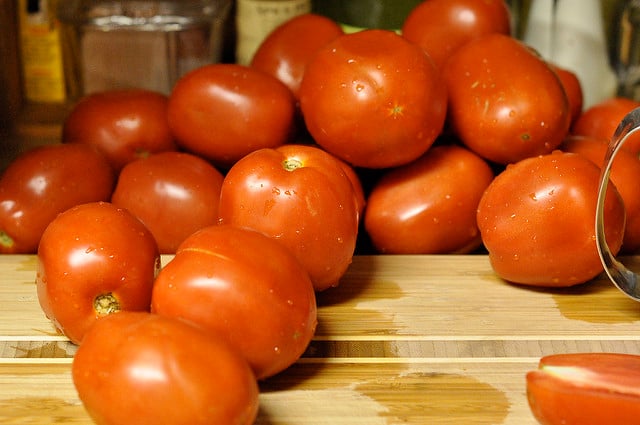
Before tomato season comes to a close, I want to talk about my favorite way to preserve tomatoes. I typically only can them one way – (mostly) whole and peeled, in their own juices. I do them this way because I like the versatility they retain when put up in this manner. Later down the line, I can choose as to whether I want to puree them down, make a chunky sauce or just crush them with my hands and use them to top homemade pizza (Mmmm).
One thing to note is that my tomatoes aren’t perfectly whole. I do crush them a bit while cramming them into the jars, in order to generate enough liquid to totally cover the ‘maters. I find that I’m able to get three romas into a pint jar and six into a quart. On occasion, I’ll cut a tomato in to thirds or halves in order to finish off a jar and still have the proper amount of headspace.
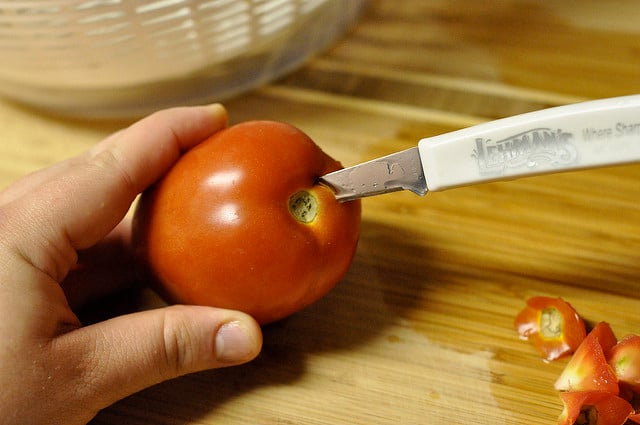
Take your tomatoes and core them. This isn’t an absolutely necessary step, but I hate dealing with the cores when it comes time to use the tomatoes on the other end.

A cored tomato. Seriously easy.
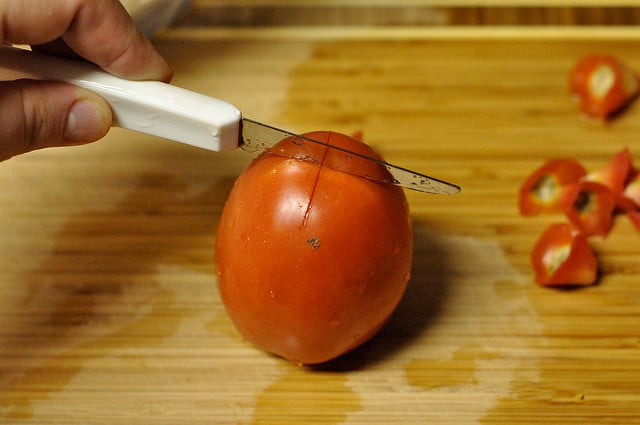
Make two shallow cuts on the bottom of the tomato, to ease the peeling.
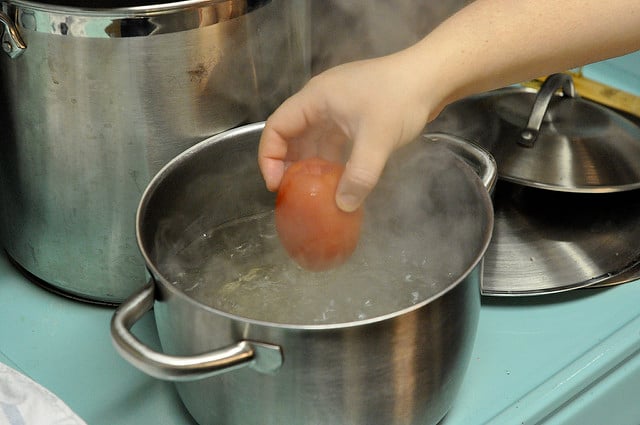
Drop cored and scored tomatoes into a pot of boiling water (don’t put too many in at once, or you’ll drop the water temperature drastically and it will take forever to return to a boil). Blanch tomatoes for 1-2 minutes, until the skins start to blister or loosen.

Put your blanched tomatoes into a boil of cold water, to halt cooking and to make them handle-able.
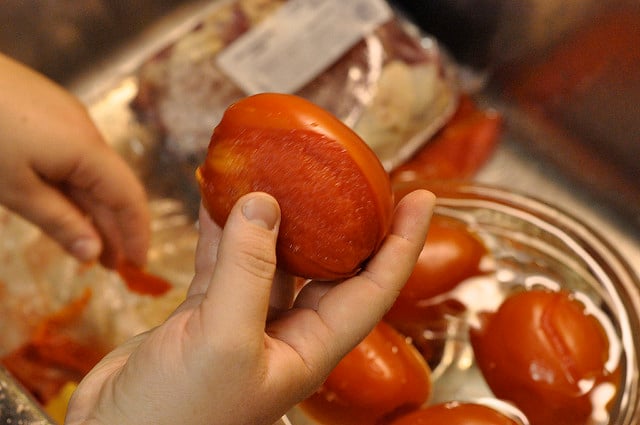
Peel tomatoes. The skins should slip off easily after the blanching and the cold water dip.

I put the tomatoes into the jars as I peel. Two standard sized romas typical fit at the bottom of the jar.
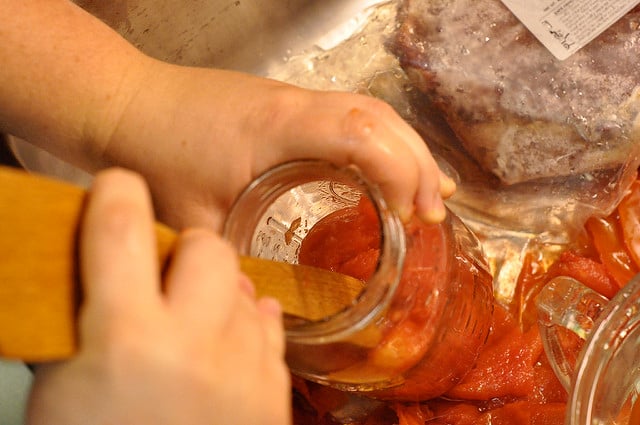
You may need to give them a little help. I use my hand when filling wide mouth jars, but when dealing with regular mouth openings, I employ the handle of a wooden spoon.

Look! A jar that’s filled with tomatoes! All the liquid you see here came from the tomatoes, as I gently smashed them to fit the jar.
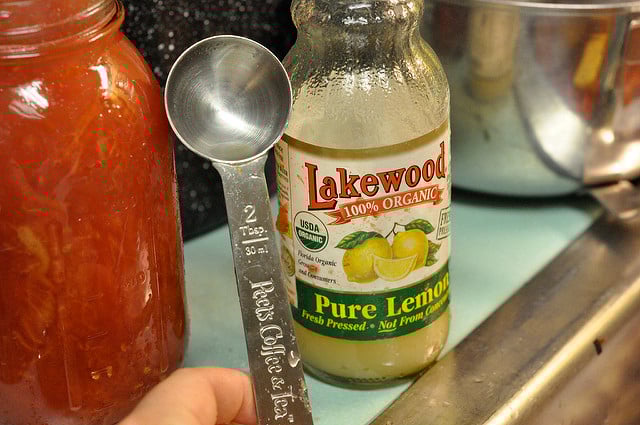
Don’t forget to acidify. It’s one tablespoon of lemon juice for pints and two for quarts. I pour it on top of my filled jars, and then use a chopstick to remove the air bubbles from the jar and work the lemon juice down into its contents. You should have approximately 1/2 inch of headspace remaining after you add the lemon juice and de-bubble the jar.
After that, I wipe the rims, apply my lids (carefully simmered for 10 minutes at around 180 degrees), screw on the rings and lower the jars into the heated boiling water canner (remembering to use a rack so that the jars aren’t resting on the bottom of the pot).
Quarts of whole peeled tomatoes get processed in a boiling water canner for 45 85 minutes. Pints get processed for 40 minutes the same amount of time. Tomatoes that are packed in water are processed for 40/45 minutes.
Because my life is busy, I rarely do my tomatoes in one great, big canning day. Instead, I stretch the process out over several post-work weeknights. I’ll do four quarts at a time, because that’s how much my stock pot can hold during processing, and it keeps me from feeling overwhelmed. I find that a 25 pound box of tomatoes will make approximately 12-14 quarts of tomatoes, and so I do four jars a night for three nights in a row. It keeps me sane and keeps my pantry filled with wonderful, local tomatoes all winter long.

Is it ok if I squish the tomato into the jar so there is no space in between? My tomatoes aren’t very juicy and I don’t want to add water.
thanks!
If you want to pack your tomatoes like that, you have to process them for 85 minutes, not 45.
Hi there,
I was wondering why it is a drastically longer processing time for tomatoes when they are in their own juices…. I do more fermentation preservation and therefor I am less knowledgeable when it comes to canning, but I also do not want to add unnecessary heat time if it is not needed. It does seem like such a long time… 85 min. for pints too… wow.
BTW I love your courage in attempting to use the glass top bailing lid jars… I have been wondering about this. I do believe that since the major processors came in, we have been led to believe that we must leave food prep and processing to the so called experts in order for it to be “safe” and wholesome. I have found the pedantic brainwashing a trend in many areas. It is quite awakening when one realizes this. I was raised on processed manufactured food, but today I enjoy local, biodynamic food, raw milk, grass fed meats, fermented veggies, homemade yogurt and rarely make a trip to the grocery store. Now I am looking forward to canned tomatoes and peaches in my root cellar this year! Thank you for helping in this effort to reconnect with our nearly lost traditions. 🙂
Jamie, it has to do with the density of the contents of the jar. The more dense it is, the longer it takes for the heat to penetrate to the very center of the jar. Processing times are set by the USDA, so it’s not just me randomly selecting times for products. 🙂
Is the process time on quarts 85 minutes or 45 minutes? I am a bit thrown off by the time crossed out. Thanks!
If you pack the tomatoes in their own juices, as demonstrated here, the processing time 85 minutes. If you pack them in water, the processing time is 45 minutes.
Have you ever canned whole tomatoes with basil and garlic in the jar? I added a tablespoon of vinegar in each pint as well.
I was under the impression that tomatoes had to be canned with a pressure canner. This makes me very happy!!!
Though I can tomato sauce, I’ve always stored my whole tomatoes in the freezer.
After reading your post, this might be the year to can the whole tomatoes as well!
You mentioned heating the lids before using. Is this necessary to sterilize, or get a good seal?
This to soften the sealing compound and ensure a good seal.
After the 85 min boil time and jars are removed, if the lid can be pushed in and out making a popping sound, does this mean the jar isn’t sealed well?
The jars should seal within 10 to 15 minutes of the jars coming out of the canner. However, if some time has elapsed and the lid wiggles in and out and makes a popping sound, that means the jar didn’t seal and isn’t shelf stable.
Thanks for all the info. I use your website as a jump off and resource regularly. For canning the whole peeled tomatoes do the jars need to be “prepared” ( as in hot…)?
They should be clean, but they don’t have to be hot.
Hi there,
I used this recipe tonight to can about 5 pints of whole, peeled tomatoes. After a 45 min hot water bath, I pulled the jars out and noticed some settling. The jars now have about 1/2-1 inch of yellowish liquid at the bottom. Is this normal? I wonder if it’s just some of the juices of the tomatoes that have settled. What do you think?
LOVE your website!!
-Charity
Totally normal. Read this post: https://foodinjars.com.s164546.gridserver.com/arugulapesto/2011/08/canning-101-tomato-float-sauce-separation-and-loss-of-liquid/
if I canned tomatoes and added lemon juice do I have to add lemon juice when I use my canned tomatoes to make tomato juice?
It makes sense to me that you would have to add acid for the tom juice……
Your 100lb tomato story inspired me to try my own. Made a few small batches last night and I have to say the jars look BEAUTIFUL! I can’t wait to try them out…I don’t think I will be going back to the can stuff anytime soon! Thank you for your inspiration and for making canning scare-proof (lol!)
Now to find a local farmer to sell me some amazing cases….
Thanks so much for posting this! I was looking to start canning tomatoes (I’m a new canner), and it’s very helpful to have a per-jar amount to go for, and a method that is straightforward and doesn’t require dedicating a whole day (or carrying home cases of tomatoes at once). I’m seeing myself more as canning some here, some there, and so it’s nice to hear you do them stretched out. 🙂
Seconded! I’ve been wanting to try tomatoes for a long time, but found them unaccountably intimidating. This seems wonderfully straightforward, and I think I know what I am doing this weekend!
Hi Marisa! I’m a new canner, and I’m about to try this. My question is, what do you use canned whole tomatoes for? Sorry if that’s a stupid question – I’m really trying to get to a place where I rely less on commercially preserved foods for my cooking, but I don’t use canned whole tomatoes too much.
Thanks!
I use them is soups, stews and pasta sauces. They are my go-to canned tomato. However, if they’re not something you use in your cooking, you might want to look into canning a different kind of tomato. Maybe tomato puree is more your speed?
Just wanted to tell you how much I have enjoyed the tomatoes that I put up this past summer! I’m already looking forward to next summer and planting our garden, that we tripled in size in the fall, planting many more tomato plants and putting up many more jars because this summer I wont be hugely pregnant so I will have more energy to do it! My family and I both thank you!
I usually cold pack whole tomatoes, but I wanted to avoid all the water I end up with in my jars so I am boiling down the whole peeled tomatoes right now. Can I leave out the lemon? How does this change my process? I am at 9,000 feet so I usually can for 60-70 min.
No, you cannot skip the lemon! It is what makes them safe for boiling water bath canning.
Marisa, you seem like an expert.. why do we end up with some of the water from the canner inside the jars? Is it even safe? Is there a way to avoid it? the lids and screws are tight, what are we doing wrong?
Also, I’m at sea level in CT, do I still need to process for 85 min?
Also – sorry, I’m somewhat new to this 🙂 – while in the canner my tomatoes split from the sauce, they end up at the top of the jar while all the water goes to bottom. Makes for an ugly jar.. What am I doing wrong? HELP PLEASE!!! Thank you in advance!
Elle, you should read this post: https://foodinjars.com.s164546.gridserver.com/arugulapesto/2011/08/canning-101-tomato-float-sauce-separation-and-loss-of-liquid/
85 minutes is the processing time for tomatoes packed in their own juice canned at sea level. I don’t think it’s water from the canner, tomatoes also release their own water into the jars during the canning process. As far as ugly jars go, there’s not much I can do to help you. That separation happens to me too on occasion.
Thank you so very much, great help.
Marisa, I have another question. This is regarding a recipe I came across in an Italian cook book. Sometime you see whole unpeeled tomatoes packed with lots of greens, peppers, spices etc in a clear brine (those fancy jars sold in italian specialty stores). The recipe suggests cold packing method: packing tomatoes in hot jars along with dill, parsley, basil, garlic, black pepper corns etc; pouring boiling water into each jar and leave it until they cool off, for about 2-3hrs. Then pour the liquid back into the pot, bring it to a rapid boil and pour back into each jar, having added salt and vinegar to each jar. Then seal the jars, leave them overnight in a warm wrap (like a blanket) and put them away for about a month and a half. Notice, there is no water bath process. I have never come across this method in any of the US canning recipes. Do you think it’s safe? Thank you!
I guess I should be more specific:
The peppers are: a hot dry pepper or black pepper corns, not bell peppers.. Also, for a 1L jar the recipe calls for 2tsp salt and 1Tblspoon vinegar (5% or higher acidity).
I mean.. we all look for inspiration in other cultures.. if we were to “translate” this recipe using American methods and guidelines for canning however preserving the taste this recipe produces, how would you make it? I hope it’s not too much of a question 🙂 These tomatoes are wonderful, they are salty but yet not vinegary at all! I kept looking for something similar in our cookbooks but can’t find anything remotely close. Would you be able to “invent” an American way for this recipe? Thank you a billion times!!
I love this site. I am new to canning since this is my first year completely away from home. The instructions are so helpful, and my pantry is slowly filling with wonderful garden items.
Just bought a half bushel of tomatoes and have 7 pints in the HWB right now. They look great.
Am I supposed to heat the tomatoes (after they’re peeled and cored) before I pack them in the jars? I just don’t want them to break in the BWB. Thank you!!
Nope, you don’t need to heat them. That’s why it’s called a cold pack and why you process them for 85 minutes.
Thanks again! and thank you for this very detailed instructions.
I forgot to acidify my tomatoes. Can I open them acidify them and reprocess? Is it safe?
Thanks
Thanks so much for these instructions! I am new to canning, so would not have known to add lemon juice, or use a spoon to smash the tomatoes down. Just canned 7 pints of mixed heirloom tomatoes, and next we’re doing quarts of red tomatoes! So excited to have self-preserved local tomatoes all winter!
Doing my second round of them with tomatoes picked an hour ago from my garden!!!
Way to keep a nice clean work area. Raw meat next to the canning jars is a wonderful edition.
Good lord. It was a fully sealed package that happened to be defrosting in my kitchen sink. No harm was done.
Not to mention the jars were going into boiling water for awhile!
Wonderful English…you mean “addition” not “edition”.
Goodness! No need to be so unkind! Pete’s meaning was clear.
Just got finished doing 3 quarts! This was so much easier than I thought it would be! I thought it was easier than doing jam! Thank you so much!
Your post on 8/8/11 had a link to Simple Bites where I saw your post on canning whole tomatoes. And I see this post too. As I continue to up the anti on canning, I’m puzzled by the variety of opinions on temperature of water when processing tomatoes. I was recently told by a master food preserver to hold the temp at 180F the entire time. However it doesn’t seem necessary when you will use your tomatoes for sauces, etc. I haven’t canned enough other veggies/pickled items to see if holding the lower temp makes a difference in product crispiness vs. getting mushy. Curious about your experience Marissa- thanks!
Processing food at 180F is called Low Temperature Pasteurization. It is typically recommended for fragile foods that will degrade in the heat of boiling water. I have NEVER seen it recommended for tomatoes though. Just for those easy-to-wilt vegetables like cucumbers.
Have you ever tried to can tomato sauce without peeling the tomatoes? I have seen where you can just remove the stem and blend the tomatoes into a smoothie and cook. I’m not sure how the texture will be.
Hello, I have been “canning” tomatoes for over 30 years and see that there is confusion in the posts above as to the time to process whole tomatoes in quart jars by the water bath method. Some say 45 minutes and some say 85 minutes. The time is dependent on whether you use the “hot pack” or the “cold pack” method. See the web site address below for a description of the the methods. Happy canning!!!
http://www.recipetips.com/kitchen-tips/t–1293/canning-tomatoes.asp
Great resource recipe – I am going to follow this with the exception of the lemon juice and use my pressure canner instead! Nice cross-trainign by Marissa for the recipe and Doris & Jilly for the pressure-canner info.
I have a question I hope you can answer, I am new at canning, this being my first year. I have made 2 batches of salsa, my first one turned out great (made 2-weeks ago), I though my second one did as well (made 1 week ago) until I opend a jar last night and it did not spell right. When looking at the salsa i noticed that it is seperating, I look at all the other jars form that bactch and most of them seem to be doing the same thing. I did not do much different between the batches (I added more peppers and some cherry tomoates for extra flavor). Did this happen because I did not get all the air out or were the jars not sealed correctly? I would like to make a new batch this weekend but now I’m worried I do not want to waist that amount of food again.
I am new at canning. This is the best instructions I have found on the internet. It is a shame there was no printer friendly app.
I’m puzzled by the time difference, as well–I am doing halved tomatoes but my second round over-blanched as I was worrying about something else; unlike my first batch, these were softer and oozed out juice as I crammed them in the jar. I still topped them with hot water and used my butter knife to remove air bubbles and move the water through. Does that make these juice-packed and in need of an 85 minute bath? Or are they still water-packed and get 40? Or do I just split the difference? Aye.
As for your question, Leslie, the pick your own website says this:
What about the reverse: liquid at the bottom and solids at the top? That indicates too much preheating (more than 5 minutes). Pectin breaks down when it is overheated; then separation results. If separation occurs, just shake the jar before opening or decant the water off.
References: Ohio State University
Mine did the same thing. I’m not going to sweat it!
I know this is late for a comment…. I bookmarked this last year and just tried my first batch of canned tomatoes following this method. After processing for the full 85 minutes, the tomatoes seem to have separated from the juices; the bottom 2 inches or so of each jar look like water and the tomatoes have floated to the top. Is this normal? Perhaps you have some suggestions on how to prevent this separation from happening?
I am so glad I canned as many tomatoes as I did. I am starting to use my canned tomatoes and can’t believe the incredible fresh-tomato smell when I open up a jar. We will be planting more tomatoes next year just for more canning tomatoes.
I have always processed my tomatoes in boiling water for 40 minutes (pint jars). I have never had a problem. I purused around the internet for a few minutes, and many sites recommend the 40 minute time as well.
Gorgeous blog! Thanks for the inspiration.
I’m bummed. It must be cold in here or I need to work faster next time. I peeled and packed six pints of red and yellow tomatoes from my garden. As soon as I put them in the canner, two jars broke. Wah! They must have cooled down quite a lot and the boiling water was just too much. So much work, literally down the drain.
I just cleaned the mess up and refilled the canner. I put the four remaining jars in to heat up with the water. Then, another 85 minutes plus extra for altitude. This is going to be awhile…
Just wanted to share to vent 😉 and to warn others not to let the tomatoes cool too much.
I recently took pictures of my tomato canning planning to do an instructional blog post like this, but your pictures are so much prettier than mine! 🙂
I use citric acid instead of lemon juice or vinegar. I have not found a tart taste… I just taste the tomatoes! I prefer this over adding a lemony taste, besides which, most bottled lemon juice has added sulfites.
I hadn’t thought of scoring the tomato BEFORE blanching. That’s a great idea.
And your Romas must be huge to only get 6 into a quart! I have a lot of little Romas from the Farmer’s Market, but even my home-grown ones which are larger, aren’t big enough to get 6 into a quart!
I’ve been ripening green tomatoes indoors this year, I just have them sitting out in a big bowl, and they’re ripening beautifully. I also have a couple whole plants hung upside down in a closet, also ripening beautifully. It almost doesn’t seem to matter what I do with them, they ripen beautifully heh 🙂
I’ll have to try the lemon juice method, as the jars I’ve canned with citric acid(per BBB instructions) tasted too tart!
Tim M, thanks, that was interesting. I would like to see more people who understand canning like that. Instead, friends of mine who want to can panic over getting ever detail straight. So maybe if people understood the biology and physics behind it, they would be more confident. I know canning intuitively from watching my mother, aunts, and grandmothers, but still, I like knowing the reasons why it’s done that way.
For example, I never bother to water bath things with vinegar in them. I just use the open kettle method (gasp).
Margo: I think the thing is that the new food methods are meant to be more failsafe. The thing is that in home canning, recipes and canning methods take many precautions to make sure that spoilage does not occur. For example, jam is loaded with sugar, acidic, sterilized in boiling water and sealed. Just two or three of the above would be enough to stop most pathogens, so even if someone does something wrong or uses a flawed method, chances are they will still be okay.
Canning with paraffin has fallen out of style not because of a rash of food-borne illness, but because food scientists had found that the wax had microscopic perforations in it that could, in theory, allow germs to get in. The fact it was mainly used on jams and jellies meant that they weren’t high risk in the first place. However, everyone makes mistakes, and it’s good to defend against the worst case scenario. Thus, the modern system pretty much only advocates using mason jars.
Daisy Mae, I had the same problem!! I’ve heard you can wrap green tomatoes in newspaper and then, around Christmas, check on them. They should be completely ripe. My husband says the old-timers call these “Christmas tomatoes.” I might have to try it since I have so many green ones and don’t feel like frying them.
Amanda, I’ve been canning tomatoes for several years now just as Marisa described and always used the water bath for 45 minutes for whole tomatoes (also my favorite way to can tomatoes – so simple, so versatile). I’ve never had a problem with a jar spoiling.
I do think home preservers need to be careful, but I think the Ball book and other officials get a little over the top. My mom raised me on home canned applesauce that she canned using the open kettle method. And all my cousins – 30 of them! – were raised the same way. I actually do water bath my applesauce now, but I do wonder: how could it have been safe for us back then? What changed??
heh. I guess I’m getting off subject, but I would be interested to hear what other experienced canners say. . .
I asked my extension office the same question while getting my pressure lid tested. It is my understanding that the tomatoes of years ago (like the 1950 Ball book I adore) were much higher in acid than the varieties of today thus needing more acid added. I have also always added a teaspoon of sugar and a 1/2 teasp of salt into each jar. It all dissolves in the processing.
I have my work cut out doing pickles. green and pears this week and tomatoes, and carrots next week Oh and not to forget applesauce too !!
If you read the directions for the lids it says: heat lids in hot water, not boiling.
Hi, I love your site. I am new to canning, and have recently learned how important it is to have the freshest produce. Otherwise you end up with a jar of mushy gunk! So, I was wondering if with tomatoes that is quite so important. We don’t have much fridge space as we share the house with another family.
Hi, I canned 25 lbs last night and only processed the tomatoes for 40 minutes based upon your instructions in canning class. What would you do with the tomatoes in this situation? Thanks for any thoughts you have to share.
Since I grow my own tomatoes, it takes a while to get enough for me to make a big enough batch of sauce to can. As my romas ripen, I just pop them into a ziploc freezer bag. When it comes time to make sauce, I take the bags out of the freezer – as the tomatoes thaw, the skins pop right off.
Unfortuneately this year has been a bust for my tomatoes. They just aren’t ripening. I think I’ve gotten a dozen total red tomatoes – and that’s from 8 plants. Next week I’ll be desperately looking for ideas for green tomatoes!
Hi! I’m new to your blog (through Ree) and I’m really enjoying your beautiful site! My family has “put up” in a variety of ways for generations, and just in the last few years have I started doing this in earnest myself. I’ve found that there is simply nothing better than opening a home-canned quart of tomatoes in February – it’s like a time-warp back to August!
I’m curious to know, though, if you ever do any pressure canning. I do some hot water bath, but mostly I do pressure. I really appreciate that I can get through a couple canners full of jars in one evening after work during the week and still have some down time.
Thanks for your great step-by-steps, and for all the great ideas!
Hi there, lovely tomatoes 🙂 I did 20 quarts of sauce and 9 quarts stewed which brings me to a totoal of 29 stewed and 20 sauce, I still have anothe 25 sauce to go and another 10 pints of salsa and then I am officially TOMATOED OUT!
I’ve been posting a bit about my canning and also keeping a list of my yearly canning goals on my blog….come for a visit 🙂
So all of the literature I’ve found says to process for 85 minutes with this method. Why is your processing time so short?
I just canned tomatoes a couple of weeks ago using your same technique and processed them for the full 85 minutes recommended by the Ball book and on various websites… I’d love to have had a shorter processing time!
Oh, nice. I’ll remember that next year and plant an extra tomato plant or two.
I’d given up on home-canned tomatoes ever since I tried a friend’s mom’s jars and found that they tasted too much of vinegar and weren’t as pleasant as the cans I could buy in the store.
But if you are acidifying completely with lemon juice instead of vinegar, I am tempted once more.
Thank you.
I am so much less intimidated after seeing this. Nice.
Brilliant! And I love that your measuring spoon is a Peet’s coffee spoon.
Great step by step breakdown. I wish I had seen your technique earlier in the month when I was looking for different things to do with the tomato glut.
Thanks for the great site!