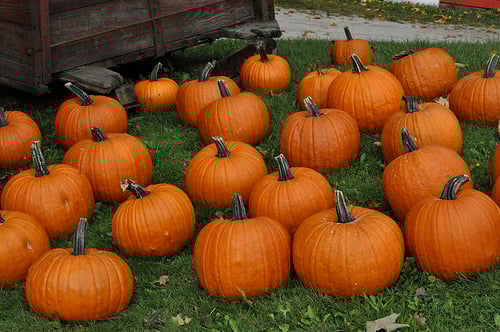
This time of year, a canner’s fancy turns to pumpkins. Tis the season for all things round, orange and squashy, after all. However, as you start searching for recipes for home canned pumpkin butter from reputable sources, you’re going to find yourself disappointed. You see, both the USDA and the National Center for Home Food Preservation are going to tell you the same thing. Don’t do it.
I’m sure there are more than a few of you out there saying to yourself, “but I’ve been making and water bath canning pumpkin butter for years!” And it’s true, many years ago, there were USDA-approved recipes for pumpkin butter. Unfortunately, the rules of canning are not a static canon and so, in 1989 the USDA changed their recommendations and the NCHFP followed suit. No home canning for pumpkin butter, not even in a pressure canner.
The reasons why homemade pumpkin butter isn’t recommended are several. When cooked down into a butter, pumpkin flesh becomes quite dense, making it difficult for the heat produced in a canner to penetrate fully through the contents of the jar. This means that even in a pressure canner, the interior of the jar may not reach the 240 degrees needed to kill those pesky botulism spores.
Additionally, pumpkin and all other winter squash are a low-acid vegetables, meaning that without careful treatment, they could potentially be a friendly environment in which botulism spores might grow into their toxic adult state. In tests, it’s been found that the pH of pumpkin has a fairly wide range, meaning that it’s not possible to offer a basic acidification ratio as there is for other borderline and low acid foods.
The good news is that pumpkin butter can be frozen and also keeps quite well in the fridge, so it doesn’t have to be entirely off the menu. I’ve also been pondering whether one could make a an apple-pumpkin butter that would be high enough in acid to be safe for canning, but would contain enough pumpkin to be sufficiently autumnal. I may do a bit of playing around, to see if I can get somewhere close to the flavor I’d like to eat.
If you’re curious to read more about the safety hazards of canning pumpkin butter and other squash purees, click here to download the PDF that was the primary source for this post.

I was wondering after freezing and thawing how long pumpkin butter can stay in your fridge and be used. Should i make ice cubes of it to freeze to keep it minimal.
It will be fine for a few weeks! The higher the sugar content, the longer it will keep.
Marisa,
Thank you for continuing to educate people on the most up to date safety standards. It’s really important to keep current. I love passing on home preserved items to friends and family. I take it very seriously that I only offer things I know are made to the best of my knowledge to be the most up to date standards. Sure, canning can be a fun hobby but it’s also a responsibility. When you know better, you do better. I know I can always count on your website to have current information. Thank you!!
If you read it says, “When cooked down into a butter, pumpkin flesh becomes quite dense, making it difficult for the heat produced in a canner to penetrate fully through the contents of the jar.” I don’t know if any recipe that actually uses the flesh of a pumpkin.
All pumpkin butter uses the flesh, the meat, the interior of a pumpkin (or, if it’s not a pumpkin, it’s a winter squash, which has the same issues).
I want to make the pumpkin butter as a recipe stated and I want to freeze it. Bags are just a mess sometimes. Can I place in a jar and freeze after? Or if not is there another alternative to bags. Thanks for the help 🙂
Yes. Just make sure to use straight sided jars for freezing and leave plenty of headspace.
Why couldn’t we increase the acidity to a level that would be safe in canning by using citric acid in the puree before canning and boiling the jars. It seems to me that if the pumpkin acidity is too low, the use of Citric acid would even it out without changing the taste in a bad way. Especially since the spices in the pumpkin butter would over power the resulting tangier taste. I understand about the density of the pureed pumpkin, but there has to be a way of doing it safely at home.
I am curious about doing a 50/50 ratio of pumpkin to apple butter mixture to can in pint sized or smaller jars. Has anyone done this safely? What was your experience?
It’s just really not a good idea.
Lynda, I don’t know if you have found one yet but I have found this recipie that I was going to try.
http://www.food.com/recipe/crock-pot-apple-pumpkin-butter-no-added-sugar-466151
We can pumpkin in half-pint jars, at fifteen pounds, for about ninety minutes. Since all spoilage, including botulism, creates gases, and none of our jars have broken the seals for several years, and none of us have sickened, we are figuring that we are safe.
Just how many of us have ancestors that have canned pumpkin/squash, ans have sickened and/or died from canning-borne poisons?
Certainly everyone is free to do as they wish in their own homes. Personally, the idea that no one has ever died isn’t enough of a safety net for me. Nor is the idea that no one has ever gotten sick. Often people did get sick from canning but it wasn’t diagnosed as such, simply written off as a bad stomach virus. Lastly, fruits and vegetables are different today then the heirloom ones our grandparents and generations prior preserved. They have been ‘bred’ for drought and disease resistance, to produce larger and more desireable crops. This has changed some of the acidity levels. So by all means for your immediate family do as you wish. I think it is only fair before passing these items on to others as gifts, or to consume in your home, you let them know the current recommendations so they can make their own informed decision if they want to consume it. Happy Canning!
You handled that well, Michelle. I hope she heeds your advice (here and in the post).
My understanding is that botulism does not necessarily produce gas, and is therefore near impossible to detect. This study (https://www.ncbi.nlm.nih.gov/pmc/articles/PMC242325/) states that “gas production is an unreliable indicator of growth and toxin production by C. botulinum”. And as a farmer, I agree with Michelle above that crop characteristics have changed greatly over time due to breeding and selection. That is definitely not to say that we should not trust the wisdom of our grandparents and elders, but that it’s a good idea to check if the science backs up our assumptions. I see a lot of blogs out there with great recipes but with no explanations of their thought processes/assumptions in regard to safety – which is why I use Marissa’s blog as a resource!
I like Brady’s thinking. I’m also going to try using a combo of apples, pumpkin and lemon juice. I’ll let you know if I die!
I’m not an experienced canner but I am curious that if you can’t can pumpkin butter then how is it that I was able to purchase it in a jar unrefrigerated at my local Sprouts grocery store? Is that not the same thing just done commercially?
Commercial canning facilities are able to achieve higher levels of heat and pressure than can be reached at home. That’s how they’re able to preserve those varieties of pumpkin butter that you see in the grocery store.
Thanks for the quick response! I apologize for my ignorance on the subject (trying to educate myself) but isn’t there some way to get to a higher temperature? What temperature does commercial canning reach? Your info is very helpful!
There is simply a limit on how much heat and pressure a pressure canner designed for home use can achieve (the top safe temperature is 250F and you don’t want to take a until beyond 18 pounds of pressure). You need more than that to reliably penetrate to the center of a dense puree like pumpkin butter and kill off any present botulism spores. Unfortunately, there’s just no way to safely can pumpkin butter at home.
The pumpkin butter recipe that I have used for years (grandmas) says place all ingredients in a sauce pan .. bring to full rapid boil (240 degrees) pour into hot sterilized jars, put lid on tightly and turn upside down to seal. By the way this article reads it is not suppose to work? I haven’t killed anyone yet ??
Like the article says, pumpkin butter is a very dense, low acid product and so cannot be safely preserved in the home for shelf stability. Every time you make it the way that you do, you are rolling the dice. Additionally, a full rolling boil only reaches 212 degrees, not 240.
Canning manufactures use steam and high pressure temps to can safely. I have worked in those manufacturing companies. This is impossible to do in a home kitchen.
Below for your education.
-Water becomes steam when heated to a temperature of 212 degrees Fahrenheit. That temperature equates to 100 degrees Celsius or 373.15 degrees Kelvin. Steam is the gaseous state of water. It forms when water boils and is technically invisible, although a person can briefly catch glimpses of it when it mixes with cooler air and forms water droplets in the form of mist.
Steam has many purposes, including electricity generation and soil sterilization. It also serves as a wood and concrete treatment and works in autoclaves to sterilize medical and laboratory equipment with high pressure.
Hi!
I was looking for the official government info on pumpkin canning for a friend and came here knowing you would be the one to have the link to it. You do! But sadly, the link you offer (and everyone else too! ) is dead :-(.
Has the opinion of our great and wonderful government changed on this topic?
Oh shoot. I’m sad to hear that that link is now dead. However, the government hasn’t changed its opinion on canning pumpkin.
http://nchfp.uga.edu/tips/fall/pumpkins.html
I just wanted to say that I was going to can my pumpkin butter after reading several people on other sites say they’ve done it safely for years. But then I came across your site. I do NOT want to risk anyone’s lives – and especially those of my children – just to can pumpkin butter. I think I will just freeze it now! Thank you so much for your many comments addressing all of the concerns, so helpful. 🙂
I realize this is an older post, but since you mentioned adding pumpkin to an apple butter…
http://www.sbcanning.com/2011/10/pumpkin-butter-safe-to-can.html
Is that recipe likely to truly be safe? it seems to be an apple butter base (though the instrcutions are a tiny bit vague on that front), with dehydrated pumpkin powder added for flavor.
I’d really love to be able to can a pumpkin-flavored butter as so far I’ve had to tell all my friends and relatives that it isn’t possible.
Marissa,
I understand your concerns about pumpkin butter. Adding citric acid does the trick. I’ve been canning butter for years as my mom and grandmother did in the past. It can be done. You can find it in Amish stores throughout Ohio and most do it at home, not commercially.
So let me get this straight: I can disregard USDA recommendations and can my pumpkin butter, which takes 20-30-however many minutes and requires canning jars, a pot or pots for sterilizing and canning, etc.
OR… I can simply put the butter in containers and store it in the freezer – a process that takes maybe 5 minutes and requires no special equipment whatsoever. How DARE you try to save me time, money, and effort! 😉
Seriously though, it amazes me how many people are arguing vehemently in favor of pointlessly doing extra work! “Well, Gramma always did it that way.” Gramma also washed clothes by hand; so I guess you’ll be trading in your HD washing machine and dryer for a washboard, wringer, and clothesline too. Because, after all, if it was good enough for Gramma…”
So, i didnt know about the risk of pumpkin butter. I roasted the pumpkins at 400 for an hour. Then crockpot for 6-8 hrs with lemon, sugar and spices. Then i water bathed for 30 minutes.
If i had it on the garage for 3 days can i put it in the freezer? Will it be safe?
What if I got ph strips and test them before i cook with them?.
You could pH test it. If it’s been in the garage for three days, you could open up the jars, reheat the pumpkin butter and package it for the freezer.
Well This old cook learned something new today DON”T CAN PUMPKIN after years of canning pumpkin and butters I won’t do it anymore. All your info was helpful and will freeze what I make and when giving it to people for gifts I’ll make sure they understand to use it up it about three weeks and keep refrigerated. One thing about pumpkin butter they don’t last long since its eaten up right away. Thank you so much I am glad I was looking for a new recipe today.
So I understand the issues surrounding canning pumpkin butter/puree but what about pumpkin juice? I have searched online for a while but cant find a definitive answer on processing times (or its safety). Does anyone have any info if its safe and if so what should it be processed at.
Thanks!
I’ve never even heard of pumpkin juice. However, because pumpkins are low in acid, I imagine you’d need to pressure can the juice.
I am shocked that so many on here on not questioning the USDA. Their track record is horrible. And their ties to big business give us another reason not to trust them. They give the green light on many unnatural things while trying to ban things such as organic eggs and fresh milk. For example, there have been many studies saying you should not eat microwave popcorn because of carcinogens but it is still on the market. They let us eat hot dogs! Use the toothpaste with the hand sanitizer ingredient (banned in Europe), food coloring (many of which are banned in Europe), and the “yoga mat” bread. Ever researched the quality of meat provided to schools? Don’t! But it is USDA approved. But please don’t eat farm fresh eggs, drink raw milk or make your own pumpkin butter. Marisa, are you being compensated by the USDA for this war on pumpkin butter? Instead of responding that it is not safe, maybe look into the many cases where the USDA has steered us down the wrong path and decide that it is okay to doubt their “logic.” I have not heard of any pumpkin butter botulism outbreaks.
Sarie, I will be the first to admit that the USDA is sometimes suspect, but this really isn’t a matter of a corrupt government body. This is a matter of science. Pumpkin butter is too dense and too low in acid to be canned safely in a boiling water bath at home. It’s not a matter up for debate, it’s about botulism spores, heat penetration, and pH levels.
I would like to start with “I totally don’t plan on canning any pumpkin butter unless the answer to my question is yes because I get that we’re talking science and I have no desire to risk any lives”. That being said, if I added an acid to the pumpkin butter and tested it to ensure that the pH level was high enough would that make it safe to can or would the density counter the addition of the acid?
Even if it had the proper acidity (which would require a LOT of citric acid or lemon juice), the density would be such that one could not guarantee that the heat of the canner would be able to fully penetrate to the center of the preserve and kill off spoilage-prone microorganisms. This means that it could still go bad, but it would do so in a way that would not be fatal, just unfortunate.
Can I can it in a tree?
Can I can it with a bee?
Can I can it in a plane?
Can I can it on a train?
Can I can it in a house?
Can I can it with a mouse?
NO! UNLESS YOU HAVE INDUSTRIAL EQUIPMENT OR WANT TO RISK BOTULISM AND GO AGAINST USDA RECOMMENDATIONS YOU CANNOT CAN PUMPKIN BUTTER!!!!!
@Marisa can I can it and just keep it in the refrigerator to make it last longer?
It’s actually better if you don’t can it, because part of what can encourage botulism growth is an oxygen free environment. For storage, the freezer is best for pumpkin butter.
@Marissa, thank you for all your posts and great information, you seem very vigilant and well informed. Can I ask what your your background is? I mean absolutely no disrespect by my question. I am just curious if you have a food safety specialist degree, or if you are self-educated, motivated and well informed. Thank you!
Bless your heart Marisa! Thank you for the information. 🙂
I see cans of puree pumpkin in the supermarket all of the time. Can’t can it? Pfft. This sounds like some kind of old wives tale.
Industrial canning facilities can reach far higher levels of heat and pressure than is possible to achieve at home.
So is botulism present in all pumpkins?
Botulism spores aren’t necessarily present in pumpkin. But the finished product is too dense and low in acid to be safe for canning.
Completely agree. Didn’t have a recipe and used the same method as apple butter…..just opened a jar from the shelf whoooo the smell knocked me over. badbadbad. Don’t do IT! Resist the urge. Now all that work and I have to throw it out. Wish I had frozen it.
Marisa you have the patience of Job. Home canning + Pumpkin Butter of any kind = Russian Roulette.
It’s so funny how controversial canning pumpkin is!!! And both sides are correct, this is isn’t a yes/no situation: you can get sick, but from a statistical standpoint, you’re more likely to get sick from contaminants in the industrialized food system like buying frozen fruit with hepatitis then you are from safely home canned pumpkin. Like raw milk, which can contain listeriosis, and therefore can be “dangerous”, it’s a personal choice. Yes, it’s an “at your own risk” situation, so folks like the USDA and their strict followers can’t ever say “o.k.” since they can’t have any question of botulism being possible. However, as many have said, Grandma never gave anyone botulism, and she canned pumpkin her whole like. So even if you can’t recommend it, once you give someone the facts, it’s up to them to decide wether or not it it might be safe. I mean, the USDA doesn’t suggest you stop eating at Jack in the Box. But I don’t. I will can my own dang pumpkin without fear, carefully, and test the ph since I’m smart and I know how. If you don’t feel confident about it, people will have no problem scaring you out of doing it. Watch how your chicken gets processed in China or a frozen food factory and you might not worry as much about botulism in home canned pumpkin products. Industry can have “allowable” amounts of trace contamination, but oh boy, doing it at home just isn’t as safe. I respect the well done research by Marisa and my local UC extension of Master Preservers, but I disagree with this bias. So once again something as simple as canned pumpkin involves food politics.
Most sensible reply yet! In fact I will stop reading now & go make my pumpkin butter.
I was in Sur La Table and caught this pumpkin butter from Stonewall Farms.
http://www.surlatable.com/product/PRO-149807/Stonewall+Kitchen+Maple+Pumpkin+Butter
It was soo good, that I figured I would take a crack at trying to recreate this recipe, esp. since I already have the freshly puréed pumpkin
Of course the owner of this site has to say it’s unsafe per regulations because it’s her job. However, I did a quick search and found the most recent (2011) CDC confirmed cases of food bourne botulism for the United States – 20 cases.
I believe the old ways are good ways and our country is becoming overly skittish about everything. Heck, I think eating fast food is MUCH scarier than canning what our grandmothers canned.
***Need advice.***
I just cut up my whole pumpkin into cubes. I then put it through my auger-style Samson juicer without extracting the juice. It yielded me just pumpkin pulp. I then took the pulp and placed in my Food Saver vacuum sealed bag, which removed all of the air. It was then immediately transferred into my fridge which is sitting at 36 degrees.
My game plan was to open the bag, put it on the stove and boil/ simmer for about an hour along with my other ingredients…….citric acid, maple syrup, brown sugar, cinnamon, nutmeg, allspice. I was going to make like a pumpkin jam with it. It would then go back into the fridge in another vacuum sealer jar.
Would this be ok to use and keep in the fridge for the next few weeks as a jam, or until Turkey Day next week.
Any advice would be greatly appreciate.
I have seen canned pumpkin butter in stores……
It is not possible to can pumpkin butter at home. Commercial facilities have the ability to process at higher temperatures and pressures than is possible to achieve in a home kitchen, which is why they can produce and sell it.
Hi! I just canned two pressure canner loads of mixed winter squash (kabocha, hubbard, pumpkin) cubes, and after cooling, the liquids in the jars of both batches became semi-gelatinous and opaque. Did something go wrong, or is this a natural reaction from the squash due to its composition?
I’m so sorry, but I don’t know the answer to this question. I’ve not experienced this personally and I don’t have enough knowledge in the composition of winter squash to comment.
What about sweet potato butter (with apples)? Can I process it and keep it?
I was going to repackage commercial pumpkin butter in small Ball jars to give out as gifts. This is ok, right, since the pumpkin butter has already been processed commercially? How long should. I steam it after repackaging?
It is still unsafe. It doesn’t matter that the butter was commercially canned, as soon as you open the jars, you run the risk of introducing bacteria. Because of the density of the butter, the heat of the canning pot struggles to penetrate the product fully and so it runs the risk of going bad. At no time should pumpkin butter be canned at home, whether it’s homemade or commercially produced.
is it ok to take fresh pumpkin that has been mashed, freeze it then later thaw and make pumpkin butter in the slow cooker then refrigerate
Yes. The only danger with pumpkin butter is sealing it into an air tight container and storing it at room temperature.
what if I put it into a container that may not be air tight but is kept refrigerated. Say a little Christmas container that has a lid
So Marisa, if I’m understanding you correctly, you are saying that it’s okay to can pumpkin butter as long as you add enough butter first?
Nope, that’s not what I’m saying at all. It is never safe to can pumpkin butter.
Again, it is OK if I sealed the jars in hot water, but I put in refrigerator and eat within 3 weeks? Right?
I have never canned. I have made pumpkin butter over the years that has pectin in it, and refrigerated for up to 3 weeks according to recipe. Today I made some and actually sealed my jars by putting them in boiling water for 10 minutes and letting stay in pot for 5 more minutes. I refrigerated after cooling. They are sealed. Now this may be stupid question, but would it be safe from botulism as long as I eat it before 3 weeks and it is refrigerated. Does the botulism grow only over time?
If a person uses commercially canned pumpkin, which has been processed to kill the botulism spores, would it be safe to water bath can pumpkin butter?
Unfortunately, it does not matter if it’s been previously pressure canned. It will still be too dense for the heat to penetrate and kill off any bacteria. And botulism spores can be introduced once the jars are opened. It’s really just not safe.
Hello Marisa!
I would like to freeze some pumpkin butter, what do you recommend for storing. Is it safe to store it in Bernardin canning jars to be thawed and used as needed? Your advice would be greatly appreciated.
Thank you
It’s perfectly safe to freeze pumpkin butter. Just make sure you freeze it in straight sided jars and that you defrost it slowly so that you don’t shock the jars.
Lol, this is kind of a funny thread… ITS NOT SAFE PEOPLE! Just because someone hasn’t gotten sick, doesnt mean they WONT get sick. All canning recipes must be approved – you can boil that pumpkin in lemon juice and it STILL won’t be safe. Save your time canning and throw it in the deep freeze! I have both pumpkin and apple butters in my freezer and they thaw beautifully.
not correct, it being safe is a matter of levels of risk. you can reduce the risk by doing alot of things to mitigate that risk. the government has said it is not “safe” under any circumstances to avoid questions and stupid people not using their brain. If you can anything at home you run the risk of having botulism in it. driving a car is not safe but you have a seat belt and airbags….
LOL! Poor you repeating yourself over and over! Why don’t you just can pumpkin with all the spices you need…When your ready to use as butter, toss it in the blender! You got your shelf stable pumpkin that you can ship out to people and everyone is happy ! I wouldn’t mind throwing it in the blender for a few seconds if it was something someone made for me!
I think that’s a great idea!
I buy pumpkin butter every Feb, when i go to TN, and it is canned and on a shelf. And it is homemade. Ive been buying it for the last 3 years now, and actually still have some in my fridge from my last trip, and its still good. And no one that has eaten it has gotten sick.
It doesn’t matter that you’ve not gotten sick. There an inherent risk with pumpkin butter.
Don’t get me wrong…I am very cautious….my grandmother canned everything to include chickens, fruits, vegetables, ketchup…you name it. No one died…she lived to be 87…..
With all due respect, that doesn’t make the practice safe, that makes her lucky. You can cartwheel in and out of traffic hundreds of times and never get hurt, but that doesn’t make that safe either. All it takes is once where your timing is off, and you end up in the hospital or worse. There is no way to make this process safe for home canners. You can neither reliably get the pumpkin to be acid enough to kill off the spores or hot enough all the way through to do it. If there’s botulism in there and it’s not killed off, it will grow and release the toxin, which could paralyze or kill before you know what happened. Botulism is not that common, but it is deadly, so why risk it?
canning anything at home has risk!
The health risk when canning high acid foods is non-existent. Nothing can grow in those preserves that could do you immediate bodily harm.
What if you make an apple butter with a smaller portion of canned pumpkin added, say 8c apples, 2c. pumpkin and then add cider vinegar to the recipe? Wouldn’t these proportions and additional acidity make it safe? It seems like there has to be a way to do it to make it safe to can.
I was going to send pumpkin butter to relatives. What if I packed frozen pumpkin butter and shipped them. And upon arrival give instructions to refridgerate. ?
Unless you pack it with dry ice, I don’t recommend shipping frozen pumpkin butter.
Hi i have a pumpkin butter recipie that has orange juice, honey and sugar is that ok to can?
Nope. No matter what you put in it, pumpkin butter is not safe for canning.
Are you working for some gov office? If not who? My mom canned pumpkin and we are still alive. I cooked my pumpkin for over 24 hours on 250 degrees. It is now in the oven to cook for two hours at 350 degrees before being canned in a pressure cooker? I have added some Apple cider vinegar to the pumpkin. Since this is being stirred numerous times why can’t I can it?
Mary Sue, I don’t work for a government body of any kind. I am just trying to offer the safest and most up-to-date canning information available. The science indicates that there is a small risk associated with canning pumpkin. You can do whatever you want, but because of the risk, I cannot recommend it.
Can someone tell me why we cannot make pumpkin butter using a canning process, when Dickinson’s makes pumpkin butter(citric acid added) and Libby’s and everyone else makes CANNED pumpkin? Sorry if I sound stupid but I want to know how they do it if we are not supposed to.
Bill, I’ve added this question repeatedly in the comments section of this blog post. Essentially, commercial manufacturers have more sophisticated heating and testing equipment than is possible to obtain for home use.
Ok, im new at canning ( some things) but what i dont undetstand is, if youcan do pumpkin cubes, what is the difference if you can puree?
It’s an issue of density. Pumpkin cubes are less dense than pumpkin puree, so the heat of the canner is better able to penetrate and kill the botulism spores.
While searching for a recipe to can pumpkin butter I am now finding that we aren’t supposed to can mashed/pureed pumpkin at all!! Not even in a pressure canner. Since when? I know they insist now you can do it in hot water bath event though that’s how most of our Grandmothers did it but now not even in a pressure canner. That’s nonsense.
http://nchfp.uga.edu/publications/uga/uga_can_pump.pdf
I cooked some apples in butter and brown sugar then I water bathed them. Since I cooked,them in butter will they go bad? I cooked them 2 days ago will they still be good if I put them in the frig?
Were you following a tested recipe? It’s not typically recommended that you can something that contains butter.
several recipes call for butter to reduce foam.
…just a random thought…
Has anyone thought of using a microwave to bring the pumpkin butter to temp before canning or is it still a question of acidity?
THANKS in advance!!
It’s still a question of acidity.
Found your post first when I searched pumpkin butter recipe for canning. I’ve studied microbiology in college (my major). When I saw there was a possible fluctuation of pH in processing, I knew immediately it would be a breeding ground for bacteria. The amount of acid that would have to be added to prevent bacterial growth would make the finished product taste horrible.
Thanks for the new regulations regarding processing of winter squashes!
Thanks for the info! How long will the pumpkin butter keep in the refrigerator or freezer? Also, does the freezer affect the consistency?
If it is well packaged, it will be good for 2-3 weeks in the fridge and 6-9 months in the freezer. Things do lose some moisture in the freezer, so it will get a little bit thicker and stickier over time.
If you place the butter in a mason jar(smaller ones will freeze perfectly fine) there is absolutely zero moisture lost and in a medium to large freezer, will keep much longer than 6-9 months.
So, I can still use the cold pack method to seal the jars nicely, and as long as it stays refrigerated it should be ok?
so has anyone found a recipe with apple that may help? I found a few recipes online with apple but is it just something im going to
have to keep in the fridge?
I’ve not found one that’s safe for canning. So sorry!
If something can be canned in a can, like pumpkin, why can’t it be canned in a jar? How does Libby’s do it?
Commercial canning facilities can manage much higher temperatures than are possible in home kitchens.
What about cooking the pumpkin the Sous /vide method?
That still wouldn’t make it safe for canning.