One of the very first recipes I posted to this blog was one for Orange-Ginger Marmalade. I’m having a bit of a hard time wrapping my brain around the fact that I’ve nearly cooked my way through an entire year of canning since then and that it’s time for marmalade, once again.
I’ve learned a great deal about preserves since then, and I think that this approach to marmalade is easier and more sensible that the one I originally took. This one used the outer layer of citrus zest, but discards the inner pith, making for easier chopping and a more tender product. I’m completely delighted with the way that this batch turned out, and last night, when I served it at a party along side a long of goat cheese, I felt so proud that it was something I had made in my own little kitchen.

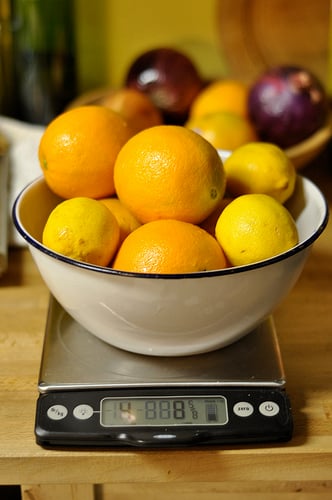
To begin, weigh your fruit. Conventional fruit is fairly uniform in size these days, but there can still be a great deal of variety in weight, depending on storing conditions and length of time off the tree. I used 2 pink grapefruit, 3 lemons and four navel oranges and had approximately 4 and 1/2 pounds of fruit. Feel free to add or subtract a lemon or orange to achieve the right weight. Scrub your citrus well, so that you can feel good about including all that lovely, fragrant zest in your preserve.

Using a vegetable peeler, remove the zest from your citrus. I tried every peeler I own (at least five) and found that the serrated peeler you see above did the best job. Please take care when using one of these tools though, as those little teeth are incredibly sharp. At one point, I slipped and ended up with a series of punctures in the tip of my pinky finger. Not pleasant when working with acidic citrus.
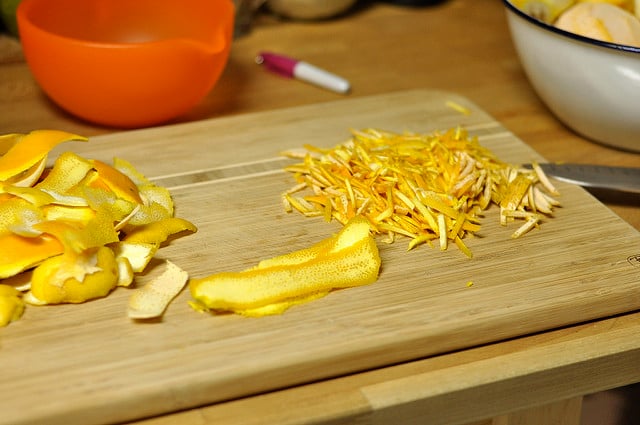
Once your citrus has been stripped, chop the zest into fine ribbons. I found that the best way to do this was to stack four or five strips of zest and then mince them (mind your fingers!) into bits about 1/4 of an inch wide. I found that my 4 1/2 pounds of fruit yielded approximately 2 1/2 cups of zest bits.
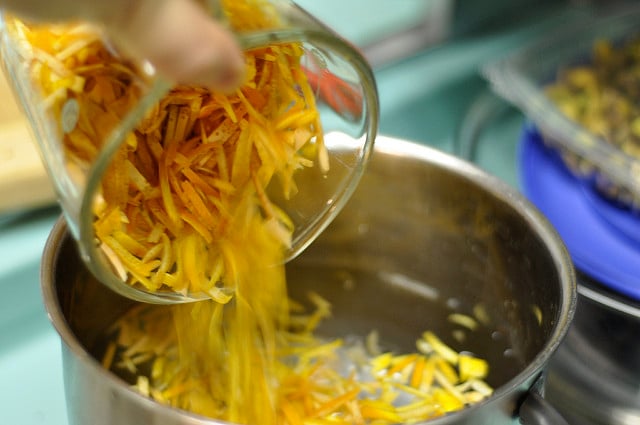
Fill a medium-sized pot with 6 cups of cold water, add your zest ribbons and bring to a boil. Simmer the zest for half an hour, until it’s tender and uniform in color. While it boils…

Use a sharp paring knife to break your naked fruit down. Take a grapefruit and cut the north and south poles off (to give yourself stable bases). Then, working top to bottom, cut the white pith off the fruit (you want to expose the interior surface of the fruit). When all the white pith is removed, use the knife to separate the fruit from the membrane of the fruit (this technique is called supreming and there’s a helpful tutorial over on Coconut & Lime, if my written instructions aren’t doing it for you). Collect the naked segments in a large measuring cup and reserve the membranes and seeds.

When all the fruit has been broken down, gather up the reserved seeds and membranes in a piece of cheesecloth. Bundle it up well and tie off the top, so that none of the seeds can escape. One does this because the seeds, membrane and pith contain a great deal of pectin. You will boil this bundle with the fruit while you make the marmalade, so that you extract the maximum amount of pectin from your fruit.

At this point, the zest should be done boiling. Drain the cooked zest, reserving the boiling water. This liquid has been infused with a great deal of citrus flavor and so some of it will be used in the marmalade.

Finally, it’s time to make marmalade! In a large, heavy-bottomed, non-reactive pot (a stainless steel or enameled dutch oven is your best bet there), combine the zest ribbons, the citrus segments (approximately 4+ cups), 4 cups of the zest cooking liquid, 6 cups of sugar and the cheesecloth bundle.

Bring the pot to a boil. It’s a good idea to use a big pot for this, so that you have plenty of room for the marmalade to bubble. Pair that large pot with a instant read thermometer with a temperature alarm, and you don’t have to watch it the entire time. Set the thermometer to 220 degrees (that’s the point at which the marmalade will achieve set), place the thermometer probe in the pot (balancing it so that you keep the cord away from the burner) and feel okay turning your back to do some dishes (return to it every 4-5 minutes to stir). This will need to boil for 30-40 minutes, in order to reach and sustain 220 degrees.
While it cooks, you can also prepare your canning pot. Position a rack at the bottom of your canning pot and place your jars on top. Fill the jars and the pot with warm tap water until the jars are just submerged. Add about 1/4 cup white vinegar. Place the pot on the stove and bring to a boil.
Wash the lids and rings with warm, soapy water and set aside.

Once the marmalade has reached 220 degrees and has stayed there for at least a minute, check the potential set by putting a small dab of the hot marmalade into the middle of a cold plate. Let it sit for a moment and then nudge it with your finger. If the surface wrinkles and seems firm, it is ready. If it is still quite runny, boil it for several additional minutes.
Once the text yields a good result, turn the heat off and remove the pot from the burner. Using a pair of tongs, grab the cheesecloth bundle. Squeeze it gently over the pot a few times to remove any syrup that it is holding.
Remove the pot from the hot burner and stir for about a minute. I’ve learned over the years that this helps the zest distribute itself evenly throughout your preserve (I hate it when the solids clump towards the top of the jar, and this helps prevent that from happening).

Fill your jars (this recipe makes approximately 3 1/2 pints), leaving 1/4 inch of headspace. When they’re all filled, wipe the rims to remove any sticky residue, apply the lids and screw on the rims. Carefully lower the filled jars into the canning pot (don’t forget to put a rack in the pot). Process in a boiling water canner for ten minutes (starting the time when the pot returns to a boil).
When the processing time is up, turn off the burner and remove the lid from the pot. Let the jars cool slowly in the water for five minutes before removing them from the canner. Place them on a folded kitchen towel or wooden cutting board to cool.

When the jars have cooled enough that you can comfortably handle them, check the seals. Sealed jars can be stored at room temperature for up to a year. Any unsealed jars should be refrigerated and used promptly.
Here’s my serving suggestion: Spread spoonfuls on freshly baked scones, drink black tea with milk and sugar, and pretend you’re in Gosford Park.

Three-Citrus Marmalade
Ingredients
- 2 pink grapefruit
- 3 lemons
- 4 navel oranges
- 6 cups of sugar
- 4 cups of zest poaching liquid
Instructions
- Wash and dry the fruit. Using a vegetable peeler, remove the zest from the fruit. Cut the zest strips into a fine confetti. Combine the zest in a pot with 6 cups of cold water. Bring to a boil, reduce temperature to medium high and simmer for half an hour.
- While the zest cooks, cut the white pith away from the fruit and separate the fruit from the membranes (see instructions above for greater detail). Collect the interior fruit in a large measuring cup and set the membranes and any seeds aside.
- When all the fruit has been broken down, bundle the reserved pith and seeds into a length of cheesecloth, tying the cloth well so that no seeds can escape.
- Drain the zest, reserving the cooking liquid.
- In a large stainless steel or enameled cast iron pot, combine zest, citrus fruit, 4 cups of zest cooking liquid, 6 cups of sugar and the cheesecloth bundle.
- Bring to a boil and cook vigorously until the mixture reaches 220 degrees (this takes between 30-40 minutes).
- When the marmalade reaches 220 degrees and sustains it for one minute, remove the pot from the heat. Grab the cheesecloth bundle with a pair of tongs and squeeze gently to remove any syrup.
- Stir the marmalade for about a minute off the heat, to help the zest bits become evenly spread throughout the preserve.
- Fill prepared jars (see above for jar preparation instructions), wipe rims, apply lids and screw rings. Lower into a prepared boiling water bath and process for ten minutes (starting timer once the water has returned to a boil).
- When the time is up, remove the lid from the pot and turn off the heat. Let the jars rest in the cooling water for five minutes. When that time is up, remove jars and set them on a folded kitchen towel to cool.
- When the jars have cooled enough that you can comfortably handle them, check the seals. Sealed jars can be stored at room temperature for up to a year. Any unsealed jars should be refrigerated and used promptly.

I love this recipe!
Thank you!
I’ve been making this recipe twice a year for several years now, it’s a very popular Christmas gift.
I’m too lazy to faff around with canning, so after sterilising the jars I keep the in the oven at 90°c and use heat proof gloves to take them out, always with a fresh lid and only store the ones which have sealed properly, the ones that don’t seal get stored in the fridge and does not stay there for long!!
Thank you for the to tips.
Can you freeze the jars instead of processing?
Yes.
I love this marmalade and so does my family.
However I feel a big step has been left out. You never addressed the removal of the cheesecloth bundle and how to extract the juices it has absorbed.
Can you please comment on the best way to accomplish this.
Thank you
My apologies that that step is missing. I’ll remedy that right now. But essentially, you pull it out at the end of cooking with a pair of tongs and squeeze it over the pot a few times.
Hi Marisa—I have been making this 3 citrus marmalade yearly, for a long time. I LOVE it. I”,m Canadian – this is so close to the marmalade I had growing up. Now my question–I located a nursing classmate of mine, living in Alberta..I would like to send her this marmalade- she and her husband have marmalade (seviille orange) every morning with their toast or waffles– these oranges are just not available where I live. (I have seen your recipe for Seville marmalade). What do I add more of–lemon or pith ???> to make 3citrus marm.alade a tad more bitter or an other grapefruit? I do not want to mess this recipe as it is. .I would so appreciate your ideas.
thank you — norma s
I would add more grapefruit if you want it to be more bitter.
I’d love to try the recipe, but the free grapefruit I received are yellow. Does that matter for the recipe?
It does not matter.
Am I too late for the jar of marmalade? I am ordering Indian River Valencia oranges and grapefruit for this. Will let you know how the recipe turns out. Looks good. May reduce the sugar a little.
great recipe, delivers a rich intense flavor and the consistency is perfect
I made this and added lime to it as well and it worked out just as she says!
I was quite impressed with myself as this was the first time I made marmalade!!
THANK YOU FOR THE VERY BEST INSTRUCTIONS.
WHAT ELSE DO YOU TEACH????
EVERYONE CAN LEARN A LOT FROM YOU.
G-D BLESS.
Why so much sugar. I prefer my marmalade tangy not sweet. Can I use less?
The sugar plays a necessary role in getting the finished product to set. Read more here: https://foodinjars.com/2015/02/canning-101-can-reduce-sugar/
Hello, Marissa – enjoyed you detailed marmalade instructions, as did so many others obviously. I’m keen on the three citrus fruit recipe, but am thinking I’d like to add some ginger to it. Any recommendations?
I’d add a tablespoon or two of fresh grated ginger.
I’ve had a drawerful of citrus and a yen to try blood oranges in marmalade, so I did the three fruits version, using six blood oranges, four meyer lemons, and two ruby grapefruit. I ended up with just over 4.5 lbs of fruit, which was just about four cups supremed. I used a zester on half the oranges and all the lemons, and cut longer ribbons of the rest. No problems with it setting; I did give the bag of seeds and membranes a good squeeze with heavy-duty rubber gloves on as it was coming up those last couple degrees. Beautiful rosy color, and just a bit bitter, as good marmalade should be. For anyone who worries about it coming up to temp, I found it came to 215 very quickly, but those last five degrees took much longer. I got exactly six and a half pints. It should be wonderful on soda bread on St. Patrick’s Day!
Finally got around to making this glorious marmalade. The flavor is heavenly.
It’s also absolutely beautiful! However, it’s so labor intensive that it may or may not be made again. Also, I messed up something and ended up with a very loose set. More like syrup. It’s terrific on blueberry pancakes!
Thanks, Marisa, for posting links to other bloggers who have tried this. Thanks to one of them, I may try this again using a zester and grinding up all the pulp with the membranes instead of supreming. Next year. 😉
PS My calculations were obviously waaaay off as I ended up with 11 half pints!
Pete, did you double the batch? Because that could have easily led to your set failure. Any time you put more volume in the pot, you create a situation in which it becomes harder to cook the water out of the fruit and end up with something spreadable.
Trying this today with lemons, blood oranges and cara cara. So excited!