
Three weeks ago, I bought my annual batch of tomatoes to preserve. 100 pounds worth. I canned them whole, I canned them crushed, I slow roasted and froze them and I made 17 pints of corn and tomato salsa (keep your eyes peeled for a comprehensive tomato preservation post coming soon). And still, there were tomatoes.
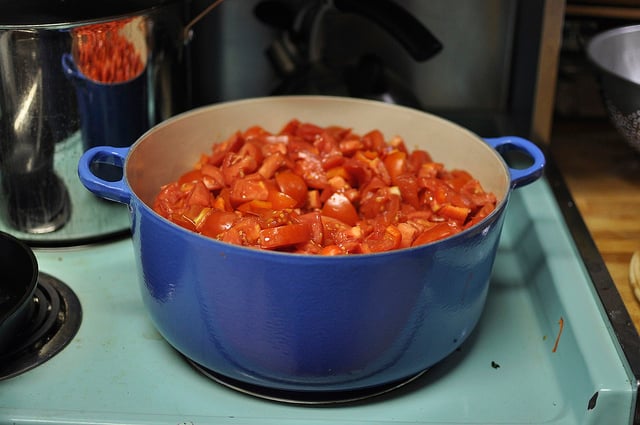
So I tackled a project that had always intrigued me. I made tomato paste. I chopped, simmered, milled, simmered, pureed, reduced and canned 12 quarter pint jars of tomato paste.

I followed the recipe on the National Center for Home Food Preservation website nearly to the letter. The only omission I made was to skip the garlic clove.

I started with approximately 16 pounds of chopped tomatoes at 3 pm on a Saturday afternoon. After an hour of simmering with three cubed red peppers, a bay leaf and a generous pinch of salt, I ran them through my food mill (a brand new purchase, made by Kutchenprofi. The little legs snapped off the minute I started to use it, making it necessary to hold the mill in the air while pressing the tomatoes through. It was frustrating).
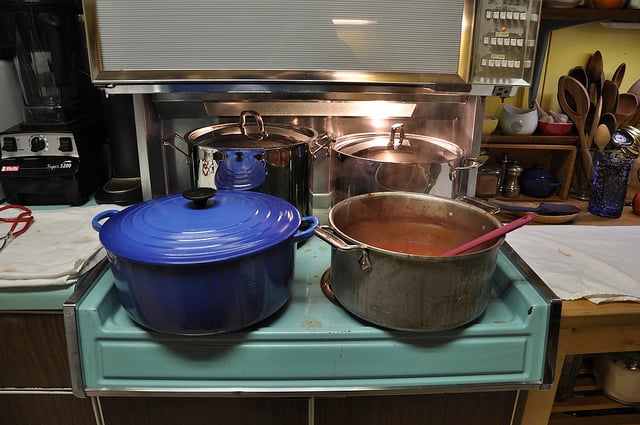
Once the tomatoes were milled, they went back into the pot and spent the next six hours cooking down. It was after midnight by the time they were ready for the jars. If I ever make tomato paste again, I will start much earlier than 3 pm. (As an aside, I don’t think my little apartment stove was designed for this kind of use. With two canning projects going that night, it was utterly overwhelmed.)

Even after six hours of cooking, I think my tomato paste might have been able to reduce further. However, I was out of patience and ready for bed so it went into the jars. The NCHFP recommends using half pints to can tomato paste, but I opted for quarter pints because I rarely use more than a tablespoon or two when cooking. However, as is best practice, I did not reduce the processing time for my smaller jars. They still spent the full 45 minutes in the canner.
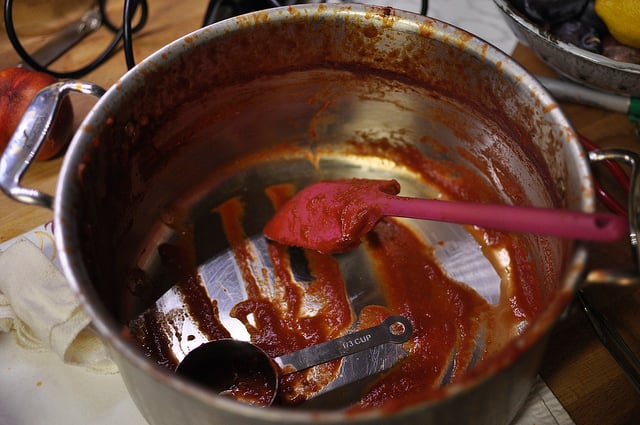
Canning can be a lot of work. I am aware of this and happily do that work when I take on a new project, knowing that nearly all of the time, my end result will be so much better and more satisfying than anything I could buy at the store. However, after tasting my tomato paste, I was disappointed. My paste, which was made from perfectly delightful plum tomatoes, tasted bitter and flat. For the first time in my canning life, I had to confront the truth that the store bought version was better than what I had made.

What’s more, while my tomatoes were fairly inexpensive (I paid $40 for 100 pounds this year), this batch of 3 pints of tomato paste still cost approximately $7 in raw materials and 10 hours of time (that doesn’t include the cost of the jars that the paste is currently occupying). I’m not sure if the investment works out this time around.
I am not suggesting that you guys shouldn’t make tomato paste. I’m sure the fact that my preparations went later than expected and that my food mill started falling to pieces didn’t help me to feel happy and rosy about this recipe. But I think next year, I’ll stick to tomato preservation projects that offer more return on investment (like crushed tomatoes) in less time. This one just didn’t float my boat.

hey I think the recipe for this is no longer on the National Center For Home Preserving .Just thought I would let you know .
I know! I was looking too, I have always read that tomato paste was too thick to home can? I pressure can, but haven’t found a recipe that I was comfortable with. I hate taking up freezer space with paste, but its what we use most.
The recipe in this post is an approved one from National Center for Home Food Preservation.
http://nchfp.uga.edu/how/can_03/tomato_paste2.html
Hi I think th store bought stuff has masses of sugar and salt in it..so we are used to the tom.paste being sweet.
The seeds and skins can cause the pste to be bitter if the toms are cooked at all prior to removing.
I found that freezing hte toms first then milling, a. you can pick the skins off easily whenthe thaw, and they go through the mill really easily. I freeze my toms in 3 kg lots till I hav eenough to use for sauce etc.
I grow my own toms.
I have been put off the paste myself because of the bitter taste, think it was over cooked, prob boiled it instead of slowly letting it reduce.
I’ll try again.
It looks like you initially left the skins on the tomatoes, and you also mention adding some cut up red pepper (sweet bell, I am guessing). Tomato skin will turn bitter, and I have found that peppers can be quite bitter with extended cooking. Salt and a bit of acid might help. I also think it is really difficult to predict outcomes when we are buying produce, no matter how good it is. Different varieties, different times of year, amounts of rainfall, or soil composition can have such an impact on flavor. 10 perfectly wonderful tomatoes may also be very different, and the the same variety you got last year, from the same farmer, might vary enough this year to be distinctly noticeable in a recipe with such concentration of flavor. Still, it’s always good to try and maybe try again!
PS. We had that same stove when I was growing up, minus the powder blue finish. I think Nixon was president.
I’ve been canning tomato paste for years as I have limited space for storage. I love it because I can reduce 6 gallons of washed, chopped tomatoes to 8 half pint jars. I wash, chop and freeze the tomatoes as they ripen in gallon ziplocks. When I’m ready to process, I mill them with my Victorio Strainer. I cook them down to sauce consistency on stove top, then pour the sauce onto two cookie sheets and stick them in the oven at 325 for a couple of hours. You’ll have to pull the paste in from the edges of the cookie sheet from time to time to keep it from scorching, but much easier then constantly stirring on the stove top. To each hot, sterilized jar (20 min. at 225 in the oven to sterlilize then set to keep warm until ready) I add 1 teaspoon of lemon juice, 1/2 tblspon white Karo and 1/4 tsp. canning salt, then spoon the paste into the jars and process in waterbath canner. I’ve never had a jar go bad and its so concentrated that you can add water to it without diminishing the tomato flavor. You cannot taste the Karo or the lemon juice, its a blank tomato product that you can later add herbs etc to for each recipe.
Could you use honey or simple syrup instead of karo? I’m new to this and just curious!
I also heard you’re supposed to use really really ripe tomatoes? Can’t remember where I saw that but does that make a difference?
The tomatoes should be ripe, but you don’t want them to be overly ripe.
WOW – your version sounds much simpler. I am very tempted to try this one.
I have made tomato paste also but froze it in ice cube trays. I blanched and peeled the tomatoes and used the peels for tomato powder after dehydrating them. Then run them through a spice grinder (coffee grinder). And we had that stove too with a brownish color and maybe Eisenhower was president??
We plant Juliet tomatoes, which are sort of like smallish romas – they are super meaty, and grow in grape like clusters. Last year we had so many we just roasted them skin and all, and blended them, again skins and all, in the vitamix. The skins just disappeared into the mix, and I think that between roasting and leaving those skins on, the resulting mix was already super thick. We loved it so much that this year, we planted an extra Juliet so we could make paste, sauce and pizza sauce – and no peeling.
I love your pictures. Your sauce looks delicious. I have a bumper crop of tomatoes this year so I’m going to have to try this.
I just made tomato paste in the crock pot, I am cooling single bagging and adding to one big freezer bag keeping in the freezer till needed then using in soup and sauces. I Blanched, peeled and whirled them in my ninja food prep blender then into the crock pot on low till I filled the pot, I then added Onion Powder, Garlic Powder, Minced Garlic, Seasoning salt to taste, stirred and increased to high with the lid cracked to let moisture out, It took about 24 hours to get the paste I wanted. I will do this again next time. it was easy, I just had to stir it when I walked past.
Thanks for a great post. The first time I read it a few weeks ago, it scared me off. But then last week I tried 5 lbs of peeled & seeded tomatoes and reduced them on a jelly roll pan in the oven. I ended up with only 3/4 cup paste but it was AWESOME!
I bought myself a food mill yesterday and picked another 20 lbs of tomatoes, determined to produce more paste. The food mill made my job a lot easier, and the tomatoes are in the oven but this time I’m using both the base and lid of my turkey roaster to reduce the sauce.
I’m looking forward to having several half-pints of tomato paste!
thank you so much for your honesty about the taste. I have loads of tomatoes and have decided to stick with roasting, or crushing for freezing.
btw, roasting does save a lot of space in the freezer since they are dehydrated.
It tasted flat because you didn’t add the red bell peppers, bay leaves and garlic. Absolutely essential for great homemade paste. Pickyourown.com has a great recipe and I have neve been disappointed with mine. I am canning some now, this is my third year!
If you do try making tomato paste again….or spaghetti sauce …try putting in grated carrots in…an Italian woman told me years ago that they take the bitter out…I can about 100 quarts of sauce a year and it seems to work (because it was bitter before I remembered what she’d told me)….and try a crock pot with a splatter shield on top for cooking down pastes and butters and go to bed…then deal with it in the morning…your jars do look awesome though
Canned tomatoes have the highest BPA…so your efforts and time is not in vein!
In light of the NCHFP recipe being unavailable.. (hopefully not for safety reasons..?), I’ll be using this similar-sounding recipe from Bernardin — http://www.bernardin.ca/pages/recipe_page/51.php?pid=440 — Bernardin is a Canadian company, similar I think to Ball from what I have read on this Blog, and elsewhere.
I probably cook with tomato paste more than any other tomato product (though diced tomatoes is a very close second) – so I’m really hoping the NCHFP recipe hasn’t disappeared for safety reasons!
I’ve done two different batches of tomato paste just recently and they both turned out spectacular. Yes, it is time consuming but I must say that I will never buy store bought tomato again. I made mine a little different. I cooked down onions, garlic, and fresh bell peppers until they were soft. Then I added chopped tomatoes. After everything was heated through, I used an emerson blender to puree everything and I threw a couple of bay leaves in it. I dumped it in a large crockpot and turned it to high for about 6 hours. Then I dumped it in my large dutch over on medium heat and cooked it down for another couple of hours, bubbling the whole time. I like mine pretty thick so I stirred it really well for the last 30 minutes. Turned out great – smooth, slightly sweet, dark red Gold to me. Yumm!!!
Thanks so much for this wonderful and well written post about making T.Paste. I love your pics and your honesty. Keep up the good work!
What did you do with the bi-product (the skins, seeds, etc.) that you milled out?
I am thinking of using the bi-product and running it through the food processor and using THAT for the paste? Hope it works! Great pictures and information.
I discard the bi-product. I don’t think it would be good to use as tomato paste. The skin and seeds can turn quite bitter over time.
I made the easy bake tomato paste from Put ‘Em Up by Sherri Brooks Vinton last year and was very pleased with the results. Her recipe uses ten pounds of tomatoes and yields about 4 cups. It has to be frozen, not canned, but since it doesn’t take up that much room and doesn’t involve as much hand-on time I found it to definitely be worth the time.
next time make ketchup! I think it’s extremely worth it! I am looking for the recipe I made to share with you- it’s the best thing to do with a ton of tomatoes, next to canning them whole.
I made this and its wonderful! But, I tried to follow your links to the National Center for Home Food Preservation and I cannot find a recipe for this. Kinda makes me worry about its safety with no added acid. Can you give me any more info? I know sometimes they pull their recipes if there’s is the tiniest bit of doubt about safety. Thanks!
Just a thought…. Maybe it didn’t “turn out” because of the garlic/recipe…. Try a different recipe (or talk to other canning friends) to see if they have a favorite recipe. Even ask to taste some of their’s 🙂 I have a food mill that I love! It’s an older one that has its own stand with a wooden masher… Sorry I don’t know what type (I found it at our local thrift store) don’t give up on the tomato paste… I haven’t made any, but plan to this year.
I went to the NCHFP website for the tomato paste recipe and it’s gone! I’m getting “404 Not Found” errors. What’s going on? I know they re-did a number of recipe to account for the lower acidity in modern tomatoes, but does this mean they no longer approve of canning tomato paste?!
That’s really weird. I’ve not heard that canning tomato paste isn’t okay anymore, but I’ve sent them an email, in the hopes that they’ll clarify.
I have the OXO Good Grips food mill. It’s a great tool with ver sturdy legs that fold in and out for storage.
Thanks for the post. I have often thought that the amount of tomatoes and the time it took to make so little paste was a waste of time and tomatoes.
In regard to the food mill, I bought an Oxo Good Grips food mill last year, and it was one of the best purchases I ever made. It is a bit pricey, around $50, but it is a work horse. I used it to make home made cranberry sauce last year. The cranberries only cost me $.50/pound and the sauce was very easy to make. The Oxo food mill is truly a work horse and worth every cent I paid.
I will also use it for making jam from berries with tiny seeds that get stuck between your teeth.
What many people don’t realize is the quantity of salt needed when making paste. As you are concentrating the flavor you need to realize that the salt concentration must also be sufficiently higher. I would also recommend next time toss a half a Lemmon in the pot for the first half hour or hour of cooking. Do not squeeze the Lemmon. This will help develop flavor an if you are looking to not use as much salt as is needed in past this will give you that flavor you are looking for! A faster way to do your paste is to bake the tomatoes at 450 in the oven for thirty minutes or until the skins start to darken and caramelize and most of the moisture has evaporated then run through the food mill. This will peel and de seed. Then season well. If still to thin then reduce on the stove top. This will greatly shorten the cooking time!
I am going to try making paste this year, I use my Oster Juicer with the micro screen attachment to process my raw tomatoes. It removes the skin, seeds, and leaves me with a beautiful watery puree. I let it set overnight in the frige to seperate it and remove all excess water. I will cook it down on the stove but the when thick enough transfer it to the oven…much like making apple butter! I think the addition of both salt and sugar will eliminate the bitterness and I will add that to taste after it’s oven time. I’ll let you know the results as I am doing this, this weekend.
Salt should take care of the bitterness.
Mark, no amount of salt could wipe out the bitterness of this tomato paste. Believe me.
Did you add sugar? Most of us have grown up with processed tomato products. There is a lot of sugar in processed products. Some tomato sauces have up to 6 teaspoons of sugar per cup of sauce. I usually add 5 teaspoons of sugar per quart.
Check out the recipe from The Italian Dish, she recommends doing it in the oven. I did this last summer and it is by far better, richer and yummier than any I have ever bought. The post is Make your own Estratto. Or something like that! Do give it a try, if even for just one more batch, I could eat this plain right out of the jar. I wouldn’t take money to do that with canned! (Well, if it is enough money….)….
Okay, I tried my hand at ketchup last year, and I think if I ever try tomato paste, I will do what I did back then: I put my pureed tomato plus stuff into the shallowest dish I could find (I actually used two deep-dish pie plates), and into the dehydrator it went, because I was about sick of dealing with it by bedtime! The next morning, I was pleased as punch to find that it had reduced by half, and only needed a little longer. It did double-duty in that it freed up my stove for the canning of tomatoes (seems like I’m not the only one that had more tomatoes than could be killed off in one batch), and relieved me from having to constantly stir to prevent burning, etc. I highly recommend it.
BTW, I almost decided to can my ketchup as paste–with a little blackstrap molasses, it really peps up the flavor, which I know is cheating, but hey, if it works!
To save lots of cooking time I put the peeled tomatoes through the food mill then put it all in the frige. over night. Most of the liquid omes to the top. I ladel that off then cook what’s left down. This takes about 1 hour, and I don’t have to be in the kitchen watching the pot all day.
I’m sorry to read that your tomato paste didn’t delight you, but you may find that it tastes better in January than it did in September!
I made a dozen quarter-pints of tomato paste last year — using a different recipe than you, an <a href="all-tomato one from Eugenia Bone’s blog Well Preserved, and they tasted a bit bitter at the end of the cooking-down process. But after a little while settling in the wee jars, the paste mellowed some, and I found it both delicious and invaluable over the winter. Just opening the jar and smelling that good tomato aroma, in the middle of winter, made me feel hopeful!
Maybe this is a case where the recipe really makes a difference? In any case, I hope you find your tomato paste useful, even if it’s not the star of your cupboard!
I grew up doing 50 pounds of tomatoes in to paste every three years. It was divine.
I have a friend who is canning this summer and had about 15 pounds more than she wanted to process. So, I took the remaining tomatoes to do paste with. After I had started, she told me I was wasting my time, she had just read a post about how hone made paste never works out. After I was finished with my delicious paste, I asked her for the post and she directed me here. I also had her taste my paste and her jaw hit the floor at the punch you in the mouth velvety rich tomato flavor. At her urging, I share the following:
1) Never give up on doing a failed recipe yourself. Try a new recipe, review your technique, and think about what may have gone wrong.
2) The first time you do a labor intensive project, do it small while doing other things. That way you can skip the heartache of failure and wasted ingredients.
3) Never don’t do something because an expert failed at doing it. Look at what they did wrong and fix their mistake.
The following is the recipe I used. You will notice that it is simple. The only ingredient other than tomatoes is salt. Adding anything else is just asking for trouble and is unnecessary. Your goal here is tomato essence, not ketchup.
Start early, before noon, as this takes a while.
Peel, depip, squeeze tomatoes. Run through a food processor of any type to break it down. For every quart of tomatoes, add 1/4 tsp salt. Put in pot on stove and bring to a simmer. Reduce temp to a slow simmer and be prepared to reduce it more as it thickens. Stir frequently (in a good pan on slow heat, once every 20 minutes seems to work). If you want a more roasted flavor, put it in jelly roll pans in the oven at 200F and turn the paste every 30 minutes. Keep going until you reach your desired thickness. Run through a blender to paste it. Test pH, if it is below 4.6 hot water bath it. Otherwise freeze it, pressure can it, or add acid.
The USDA water bath recommendation is from a cold paste. Your goal is to have the paste reach pasteurization temperature and times. Test your paste’s temperature when done and at least an hour before done. If temp is at a pasteurization temp, then just maintain temperature (you can blend it as much as 4 hours before done). You can then pour it straight in to preheated jars, water bath long enough to heat the headspace (10 min approx), put on heated lids and rings, an call it good – assuming pH under 4.0 (which is the norm with a paste). In the 4.0-4.6 range, I usually go at least 20 minutes to be safe. Any time you can, you need to remember what the advisories are based on (highly contaminated foods, unwashed, from room temperature). Too many people overprocess their canned goods and destroy the bright flavors and textures they would otherwise get. And for the love of peet, take off your rings and wash your jars when they have cooled and sealed. Only jars I have ever had go bad were either bad seals up front, dropped and the seals broke, or gift jars that were unwashed by someone else and molded through ring and seal from the outside.
Common things that make tomato pastes bitter:
Iodized salt (evil, never use when canning)
Burning while reducing it (caramel good, soot bad)
Crap tomatoes (if you would not eat them raw and straight up, forget it)
Leaving in the pips and skins (with this much cooking, every bit of bitter will leach out. At the same time a few pips add character and keep you from going insane trying to remove them all)
Bad cookware that flavors the food (always use good stainless steel)
Finally, as a food blogger, you owe your audience a duty to try again, figure out what you did wrong, tell us how to make it right, and then evaluate if it is worth it to have bpa free tomato gold.
I just wanted to share a link to someone who does a LOT of tomato-based things as her garden produces throughout the summer. It’s a knitting blog primarily, but I think that should you want to try tomato paste again, you could definitely start with the dehydrating bit found here for not a whole lot of additional effort but possibly more concentrated flavor:
http://knitspot.com/?p=450
I love your site and this blog in particular was great! My husband and I have always wondered about how tomato paste is made – its one of those things I marvel at. I really enjoyed all the comments and learning that comes with them as well – interesting that it may have been the ‘type’ of tomato that made it bland. I use tomato paste a lot and my husband tends to buy big boxes of it at Sam’s Club so I may hold off on this for awhile yet. Your kitchen is amazing – reading your blog for the past few months (just discovered it!) I assumed you lived in a gourmet kitchen. Thank you!
Since I spent part of my summers, as a kid, sweltering in the sun and keeping any errant bugs off my grandmother’s “paste boards” in the back yard, I’ve never had the urge to make my own tomato paste. I’m not sure how she did this well into her 70s. This was while she also canned quarts upon quarts of tomatoes and tomato puree.
I still love the smell of tomatoes being cooked/canned, though.
Just seeing your stove brings a whole new level of respect for your craft. I great up with one very similar. Push buttons were on the back of the stove though. Always fun reaching over the boiling pot to turn down the burner. What a great post!!!
I adapted Molly’s Tomato Conserva recipe which I first came across here on your blog for tomato paste. I use just a touch of olive oil, 1/4 cup to what was 28 lbs of tomatoes before prep. When the paste has finished cooking down in the oven I measure it into a pot on the stove top, add the appropriate amount of lemon juice for the amount of paste I have and keep it hot there while I’m ladling it into 4 oz jars. I process it for the recommended 45 minutes. Best. Paste. Ever. http://eatingfloyd.blogspot.com/2011/08/preserving-floyd-more-than-just-tomato.html
I just found your blog… and I’m in love. 🙂
Aww, thanks Laurie!
I’m so with you about somethings canned are not worth it. My failed ones were tomato ketchup, which turned out to be sweet manwich sauce, and tomato soup. Tomato soup was awful. Poured it down the drain.
Thank you for the very honest testimonial. I appreciate it very much. Anyone canning us normally doing it to save money and the extra effort (a lot of effort) weighing with the cost savings is very important. At least you know what ingredients you are consuming. Thank you for the extra effort to record your work. Subscribing.
Oh my gosh – reading this blog and following links from it has FINALLY led me to the kind of acidity chart I’ve been searching for all summer (one for each type of fruit/veg that has amounts in lemon juice and citric acid as well as vinegar). I’m allergic to all citrus fruits, which eliminates a lot of really yummy-looking recipes. The most frustrating part is trying to figure out if the lemon juice is added because the recipe needs the acidity, or if the author simply likes the flavour… having access to charts like the ones on the National Centre for Home Food Preservation is such a relief! Thank you so much for accidentally answering a question that’s been driving me bonkers! 😀
As for the paste, I made my own a while ago and had a similar result. I made paste to save space as it was being frozen… I’ve found that adding a wee bit of sugar and a healthy bit of salt helps a lot. It’s still not that great as a pasta or pizza sauce, sadly.
Made tomato sauce this year after purchasing about 30 lbs of tomatoes from our local farmers market. I went late when they were about to go home and got a great deal cause most of them would rather sell it for less then to take them home. It probably didn’t save me that much money when you consider energy, time and materials…..but it sure felt great knowing that I made them myself! and I knew exactly what went in them!!
I can hardly imagine leaving my oven lit for nearly 24 hours, in the summertime, yet! I think I would recommend doing it the way I make pumpkin and apple butters – Put it in a large slowcooker with the lid on sideways or even off altogether (once it gets up to temp), and letting it simmer for 18-24 hours till it’s thick and flavorful. Works amazingly well for pumpkin butter especially, with no worries about scorching it!
I did Apple Butter in the crockpot this year and will continue to do it this way always. I used metal skewers across the top of my pot and then set the lid on them so my apples would cook down, worked like a charm.
Always thought about doing tomato paste, now probably not. Thanks!
I’m really impressed at the 100 pounds of tomatoes in a tiny apartment! (Is your apartment tiny, I don’t know.) Sorry it didn’t turn out so well.
My apartment is just under 1,100 square feet. So it’s not definitely not huge.
I just love you blog, and I thoroughly enjoyed this post. I have never been able to bring myself to can paste or ketchup due to the sheer amount of time and tomatoes required to come up with enough product to can. I am so sorry that your experience wasn’t a good one. On the plus side, they do sure look pretty in those jars. :o)
Your post has saved so many tomatoes and hours in the kitchen for the rest of us, thank you!
A note on food mills: Last year I purchased the “Food Grinder” attachment for my KitchenAid stand mixer, and I cannot recommend it highly enough. It is the most genius, time-saving, incredible accessory ever, especially when processing huge volumes of food for canning.
A big thank you for sharing a project that was less than successful!! I’ve made a few things this summer that after all of the work and time invested were also disappointing. Glad to know I’m not the only one who experiences difficulties in trying to make delicious, nutritious and frugal foods for my family! I think I too will stick to Contadina! Thanks!!
Bless you for even trying two projects at once on your stove. You’ve got more gumption than I do…..my stove can barely handle one quality project at a time if I decide to do a full recipe of anything….
…sad the paste didn’t turn out and your food mill broke. Two things I’ve been looking into. Guess I’ll scratch off the tomato paste and continue researching the food mill….need one for making applesauce.
Next time you look into a foodmill, try a foley. We’ve had ours for about 27 years and it is a dream.
I used a good-quality food mill for a couple of years, then recently invested in a Norpro Sauce Master Food Strainer (I use it for tomatoes and applesauce), also known as a Squeezo. Now, I want to sell or donate my food mill. The Food Strainer is SO much faster, less hassle once you’re familiar with setting it up, and it makes a great product. It processes a lot of product in a really short amount of time, which for canning, is awesome.
Tomato paste is one of the few things I never had much desire to make, mostly because I always use a couple spoonfuls and the rest molds. Recently I found San Marzano tomato paste sold in a tube (like toothpaste). SO SMART!
I am SO grateful you wrote this post. I was just about to can some tomato paste for myself. Now, I feel that I would rather use my tomatoes as ‘diced in their own juices’ rather than tomato paste. Good call! You saved my tomatoes from blandtown 😉
Thanks for sharing how many pounds of tomatoes you buy and what you get out of it. It really helps me. I pick huge sacks out of my garden, but I never know how many pounds = how many pints or quarts. It’s frustrating not knowing how many jars to clean. I’m getting better with my estimates each season though.
I’m glad you posted this. I’ve debated the merits of making my own, but I always get hung up on the initial amount of tomatoes vs. the end result. I would love to know where you find your tomatoes. I live relatively near you and have yet to find a good source.
Thanks for this post. I’ve wondered about attempting it myself and now I know I won’t bother. I don’t use that much that I don’t think it would be worth my time.