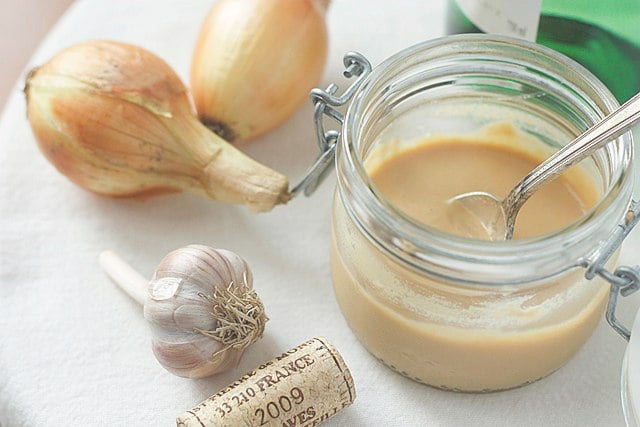
Enjoy this guest post from Kaela Porter in which she shares her expertise on the topic of homemade mustard. She wrote the blog Local Kitchen and during its active period, focused on canning, preserving and eating locally. Kaela also happens to be my mustard mentor and so I’m thrilled to host this tutorial.
Chances are, if you’re here, you can. Maybe you’re a pickle girl, with a love of all things briny; maybe you’re a guy who really kicks out the jams. But I’m here to tell you, if you haven’t tried homemade mustard yet, you are missing out.
Of all the things I make: jams & preserves, chutneys & pickles, salsas and tomatoes galore; mustard is the shining star. The “wow” factor, the double-take, the “you really make mustard?” Friends and family are invariably impressed, even more so when they taste the goods. The paradox is that this most impressive of home-canning treats is by far the easiest one to make.
No slicing or dicing, no blanching or peeling, no running to the store for pectin, no worrying about the set. At its simplest, mustard is simply ground mustard powder + water. That hot mustard you love at the Chinese restaurant near work? Nothing but ‘Oriental’ mustard powder mixed with water: you could make it at home in the blink of an eye.
Homemade Dijon mustard is not much more effort: wine is infused with some onion and garlic for flavor, then whisked with mustard powder and boiled until thick. Pop it in the fridge and in under 30 minutes you’ve got a fancy French mustard, better than most anything you can buy, for only a couple of bucks. No wonder everyone is so impressed by homemade mustard.
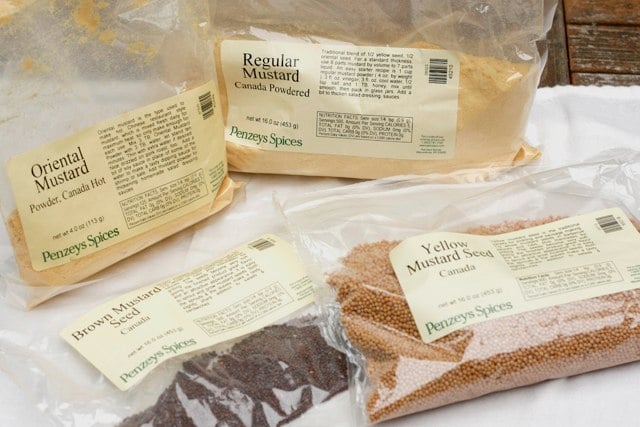
Mustard-making at home is comprised of two basic techniques: 1) combining ground mustard powder with liquid for a smooth, thin mustard, that usually has a more subtle flavor (white wine, fresh herbs, and floral infusions are good here); and 2) soaking whole mustard seed in liquid, then puréeing in a food processor for a hearty, grainy mustard (strong flavors shine here, whether it is acidic fruit, a favorite liquor or spicy chiles).
Mustard, both whole seeds and ground, can be expensive at the grocery store, but is quite economical at Penzeys and other spice merchants. And once you have the mustard on hand, the world is your oyster (or pretzel, or sausage, as the case may be). For mustards destined to go straight to the fridge, flavor options are limited only by your imagination: most mustards contain either vinegar or some form of alcohol and as such are acidic enough, even with added herbs or vegetables, for long-term refrigerator storage.
To can mustards for shelf-stable storage, we must, as in all other canning, take into account canning safety: for processing in a boiling water bath, it is best to rely on trusted recipes, or to make substitutions that you are confident will not adversely affect the pH or density (thickness) of the final product.
The canning itself can be a little tricky, simply because the grainier mustards can be thick and viscous, and it is sometimes challenging to keep the mustard boiling hot while filling the last jars. If you’ve ever made a fruit butter, you’ll know what I mean; just make sure to be diligent in bubbling your jars, leave yourself a generous headspace, and do your best to make sure the mustard is piping hot when it goes into your jars in order to prevent siphoning during processing.
Personally? I hate mustard. Loathe it, actually; so the hardest part of mustard making for me is the “adjust to taste” part (because, well, ew). Luckily, my husband, a certified mustardophile, is happy to step into the role of taste tester. And as my mustards have developed quite a following among friends & family, I make a lot of mustard. After the jump, I offer up two basic recipes: a classic Dijon and a sweet & boozy Bourbon Brown Sugar. If you, or someone you love, is a mustard fan, you owe it to yourself to give this a try: you (like me) may never buy mustard again!

Classic Dijon Mustard
Ingredients
- 1 and ½ cups white wine ideally a white Burgundy, or a crisp Chablis or sauvignon blanc*
- ½ cup white wine vinegar**
- 1 medium white onion chopped
- 2 large cloves garlic chopped
- 4 oz dry mustard powder ground yellow mustard seed, about 1 cup + 2 tsp
- 2 tbsp honey
- 2 tsp salt
- Dash or two of Tabasco or cayenne pepper optional
Instructions
- Prepare canner, jars & lids.
- Combine wine, vinegar, onion and garlic in a medium saucepan. Bring to a boil over high heat, then reduce heat and simmer for 5 minutes. Remove from heat and allow aromatics to steep in the wine for 10 – 15 minutes.
- Strain vegetables from the infused wine, pressing on solids to release all the juice. Return wine to the saucepan and add salt, honey and Tabasco, if using. Over medium heat, whisk in the mustard powder; continue whisking and heating until the mustard comes to a boil. Stirring constantly, boil mustard until it reduces to your desired thickness, remembering that it will thicken further upon cooling (I cooked mine for about 10 minutes). Taste and adjust seasonings.
- Fill hot jars to a generous 1/4-inch headspace (more like 1/2-inch), tamping down the mustard into the jar. Thoroughly bubble by passing the handle of a wooden spoon along the edges and middle of the jar. Wipe rims, affix lids and process in a boiling water bath for 10 minutes. Allow to rest for 5 minutes in the hot water prior to removing from the canner.
Notes
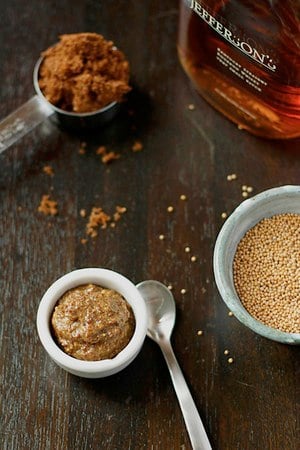

Bourbon Brown Sugar Mustard
Ingredients
- 1 cup bourbon
- 1/2 cup water
- 1 cup brown mustard seeds
- 1/2 cup apple cider vinegar
- 6 tablespoons dry yellow mustard powder
- 1/2 cup brown sugar, lightly packed
- 1 teaspoon salt
Instructions
- Combine bourbon, water and mustard seed in a small bowl. Mix to wet all seeds, and then allow to steep until nearly all of the liquid is absorbed, about 4 hours, or overnight. Alternatively, heat bourbon, water and seeds until mixture just comes to a boil; remove from heat and steep for about 2 hours.
- Prepare a boiling water bath canner and enough jars to hold 3 cups of product.
- Transfer soaked seeds to the bowl of a food processor; process until smooth, or leave grainy, as you prefer (my mini Cuisinart will not get the mustard entirely smooth). Add vinegar, mustard powder, sugar, and salt and process briefly to mix. Transfer to a medium saucepan.
- Over medium heat, stirring constantly, bring mustard to a boil; continue to boil mustard until it reduces to your desired thickness, remembering that it will thicken further upon cooling (I cooked mine for about 3 minutes). Taste and adjust seasonings (add additional water if you need to tinker with the flavor and the mustard is getting too thick).
- Funnel the finished mustard into the prepared jars, leaving a generous ¼-inch headspace (more like ⅓-inch). Remove air bubbles with a bubbling tool or chopstick (wood or plastic only). Wipe the rims, apply the lids and rings, and process in a boiling water bath canner for 10 minutes.
- When the time is up, remove the lid from the pot and turn off the heat. Let the jars rest in the cooling water for five minutes. When that time is up, remove jars and set them on a folded kitchen towel to cool. When the jars have cooled enough that you can comfortably handle them, check the seals. Sealed jars can be stored at room temperature for up to a year. Any unsealed jars should be refrigerated and used promptly.

Yummy!
I made this twice. Second time I QUADRUPLED the recipe. It took 4 hours total from sterilizing jars to completed canning. Yield was 6 half pints after cooking down to desired thickness. Then I let it rest for 1 week. Important step.
Not a big yield but very flavorful.
It sounds like you have really dialed in the process for yourself! Nice work! And yes, letting it rest is so important!
When making this recipe (the bourbon mustard) are we to use 4 oz jars or 8 oz jars??
You can use either. The processing time is the same.
Help! Why was the bourbon mustard part of the post removed? I did write it down, but I’d like to know if it was a safety issue for canning purposes. I want to make it this week.
I don’t know how that happened! I am fixing it now.
I just made this and it’s bitter. Not sure I’m going to can it. I added more sugar but it’s still quite bitter!
Mustard is always bitter when it’s first made. It needs time to mellow.
Why do I keep seeing this same recipe, word for word, by different authors? Methinks plagiarism.
This post is original to this website. So if you’re seeing elsewhere, those folks are the ones doing the lifting.
I made the recipe and my mustard looked thick enough when j put in hard but after processing and even sitting overnight, it is very runny. Can I reprocess it??
There’s really not a whole lot you can do to thicken mustard once it’s been made.