
These days, it takes a lot for a canning book to delight me. After all, I’ve spent the better part of the last decade totally immersed in jamming, pickling, and preserving. I sometimes even begin to think that perhaps I’ve seen every trick and flavor combination there is. And then a book like The Modern Preserver drops out of the sky and into my mailbox, and I am charmed.

Written by Kylee Newton, an artisan jam maker from New Zealand and now based in London, The Modern Preserver offers up a familiar and fresh array of jams, pickles, compotes, jellies, cordials, and more. The design is clean, the photography is gorgeous, and the voice of the book is reliable and welcoming.

It opens with a short introduction that details Kylee’s background, and then offers a bit of information about her ethos as a preserver. From there, she talks about the rules of preserving. Do know that this section is far briefer than it would be in an American book. I’ll dig a little more into that in a moment.
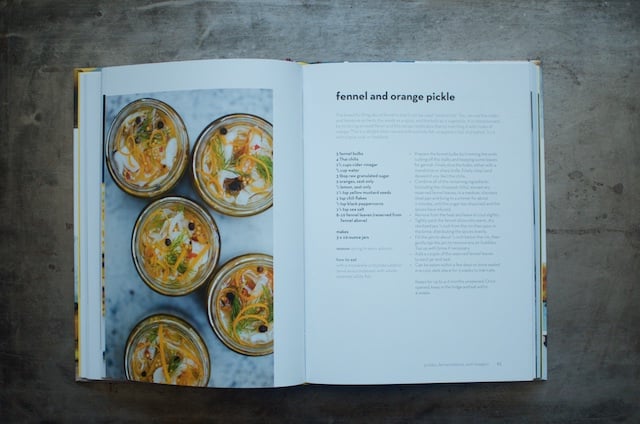
Following the intro, we get into the recipes. The first section contains Relishes, Chutneys, and Sauces. Next up is Pickles, Fermentations, and Vinegars; followed by Jams, Jellies, and Compotes; and Curds, Candies, and Fruit Cheeses. Bringing up the rear of the book are the Syrups, Cordials, and Alcohol.
I have bookmarked a goodly number of recipes in this book, and every time I open it, I find something else that I’d like to make, or at the very least, use as inspiration for a related preserve (Blackberry Relish! How had I never thought to make that?!)

My only quibble with this book is that there’s no acknowledgement that best practices for preserving vary depending on where you are in the world. Here in the US, it’s standard practice that we use jars designed for canning (not recycled jars from store-bought preserves). We use two piece lids and we make sure that the flat lids are new each time we can. And finally, we run everything we make through a boiling water bath. None of this is in the book (I’m a little bit surprised that the US publisher didn’t make them at least add an appendix referencing the different standards).
All that said, I will still be preserving from this book. I’m just going to make sure that I bring along my food science knowledge and general understanding of canning. Everything will be packed into appropriate jars and will get a trip through the canning pot (to determine timing, I’ll reference recipes with similar ingredients and densities).

Disclosure: The Countryman Press sent me the copy you see pictured above for photography and review purposes at no cost to me. All opinions expressed here are entirely my own.

The different standards were exactly my question! I’m a beginner canner though so I’m not sure how to find equivalent water bath/pressure canning timing. Do you know any resources that help make that translation? Thanks for the review!
You can always check the National Center for Home Food Preservation recipes to see if there’s a similar recipe and then use their canning timing.
Thank you so much. I’ll give it a shot. Your guidance and response is much appreciated
Thank you so much. I’ll give it a shot.
Marissa
Thanks so much for your response. I recognize that this is a busy time for you so you taking the time to respond is so much appreciated. I’ll look for similar recipes on your recommended sites and process accordingly.
So there should not be concerns about the actual proportions of the ingredients for food safety – right? It’s just the processing methodology that is different?
Also (last question – I promise ????) I am really really excited to try the two tone jam in the book (just seems like a different presentation) . In that case is it ok to layer and can 2 high acid jams in the same canning jar as presented in the book?
Thanks again for being so gracious with your time. I’ve just caught the canning bug but the excitement to can everything is certainly being tempered with not wanting to make anyone sick.
Whether high or low in sugar, jams are typically processed for ten minute. And as long as it’s a high acid recipe, it should be okay to process. And the two-toned jam should be safe to process, but the colors might bleed in the process.
Hi Marissa,
I recognize that I am referencing an old post but my question is specific to this book. I am stumped at the lack or rather the absence of processing instructions.. its basically fill the jars and seal.Now I am an absolute beginner when it comes to canning (your book, blog and the Ball book are my go tos for now) and am not sure how to proceed. I am wondering if you used some of these recipes and/or could provide some guidance please?
Is there a reference that you can point me toward where I can cross check against for processing times? For e.g. – should all jams and jellies be processed for 10 mins in at sea level (1/2 and 1 pint jars)? what about chutneys ? I understand that this may be a rather vague and open ended question and my apologies for the same but am pretty stuck. I love the idea of the two toned jam, but want to make sure I am preserving them correctly.
thanks so much and congratulations on your beautiful babies.
This a British book and they have different standards when it comes to preserving food. Typically jams and jellies are processed for 10 minutes, and chutneys typically need 15-20 minutes. The best thing to do is go to freshpreserving.com, nchfp.uga.edu, or come here and search for similar recipes from which you can get an understanding of the necessary processing time. I hope that helps!
Recently made strawberry jam from Put ‘Em Up!
I just bought Family Italian by Genaro Contaldo and am loving it.
Pinterest! Thanks for the giveaway!
The new Ball canning book.
My inspiration lately is not a specific recipe. I just moved into a new house, so instead my inspiration is figuring out how to still preserve with an electric stove!!!!
I’ve been using your books “preserving by the pint” and “food in jars”, I’ve checked them out from the library so many times and have now added them to my wedding registry. Thank you for the wonderful books, they are very much appreciated!
I love sitting in the library (or bookstore) and browsing the cookbooks!
You have been my main inspiration…
However, I have been very interested in making jams,jellies and such with less sugar!
So I turned to pomona pectin cook book!
I also have started to pickle! Ferment your vegetables has taken the fear out of pickling!
Vegan Bowls has been giving me plenty of ideas
I have food in jars and preserving by the pint. I also have two ball blue books that I use for recipes and canning times. The fresh preserving web site can also be useful
My raspberry bush! I’ve been trying all things with raspberries.
Tart and Sweet has been a recent source, though I’ve yet o page through your latest, Marisa, so I’m sure I’ll be making something from that soon enough!
Marisa, your pickling adventures lead me to the pickled garlic scapes recipe. I’m waiting the week to try them. We are pretty excited.
For canning projects, I have several recipes marked in each of your 3 books. Our grocery store has stopped carrying the relish he likes, so I have marked a few to try. For general cooking, I’ve also been impressed with the New York Times “Cooking” blog.
Right now I am loving the food documentaries that are airing on Netflix. Mainly “Mind of a Chef” and “Chef’s Table”. I find chef Magnus Nilsson incredibly inspiring in his ultra local attitude towards food. He tries to make each guest to his restaurant experience the place they are in by the food they are eating. This attitude leads him to preserve food and think of unique flavours for the long winter months.
Modern Preserver looks amazing! I feel the same as you – I’ve been preserving food for a while now so when someone comes up with something fresh it is very exciting!
I use Food52 a lot for cooking inspiration.
I’ve just started to use Pomona’s Pectin so I’ve been inspired by their canning cookbook. Would love to try out this book!
I’ve been inspired by the NY Times cooking newsletter. Especially Sam Sifton’s encouragement to make Wednesdays no-recipe nights. I’m a recipe junkie, but I want to get better at cooking with what I have on hand.
Growing up a grandmother and mother who loved to can everything from fruit to vegetables – even meat (my grandma canned a mean hunk o’beef…they were beef farmers) I swore I’d never do any canning…having spent many hours scrubbing cucumbers!! BUT now I’m an avid gardener and with the help of my darling hubby we took the plunge and started doing some canning – starting with strawberry jam…now on to many different types of pepper jams and last year – our apricot trees from our yard (yes, you can grow apricots in Minnesota) – we made some awesome apricot jam and apricot jalapeno jam (my adult sons are always raiding the pantry for it). Can’t wait for retirement to I can do more canning and preserving for my family!!
honestly, your blog is my go to, especially as canning season is starting to ramp up! I’ve got another case of fruit coming from my co-op this weekend!
I like the idea of the “modern preserver” in this day and age! How exciting for new takes and inspirations. I’m currently obsessively preserving from your natural sweeteners book but could definitely make time for some lime/saffron jelly!
I love your Food in Jars books, I have several favorites that I make year after year ever since getting “Food in Jars” as a gift back in 2013! This books sounds amazing, I would be thrilled to win, I am always seek new and unique things to bring the harvest into the colder months! thanks so much for all your work!
abby
I am just loving your Food in Jars blog; I also read “the kitchn” for inspiration, and America’s Test Kitchen is always good for learning why recipes work when they do.
Your wonderful “Preserving by the Pint”, Marisa, and of course the “Food in Jars” blog. That apricot/strawberry jam looks amazing! I must try it!
Appreciate the tip that the canning method is not as thorough as in an American book…good to know. I’ve been finding all sorts of recipe from Aimee Bourque’s Brown Eggs and Jam Jars cookbook. Just fantastic. I’m making strawberry jam this weekend as my first canning project!
I’ve been getting inspiration from Joy The baker!
I used to depend on the Ball canning book but once I purchased “Food in Jars”, my favorite has changed. Thank you
I’ve been looking at both “Food in Jars” and “Canning Granny” websites, in addition to searching the web when I have a lot of some kind of ingredient
I’ve been cooking from the 21 day sugar detox cookbook lately.
Youtube Cooking Channels have given me a lot of inspiration for new recipes and then a favorite cooking show, Farmhouse Rules. Thank you!
Food in Jars Naturally Sweet – really like the recipes!; Ellie Kreiger for healthy cooking; Nancie McDermott for Asian recipes