
One of the things I love about cooking is that despite all the modern advances available to us in the kitchen, so much of it is essentially timeless. Take for example how often you reach for something made of wood in the process of making a meal. I pull out my favorite wooden cutting board at least three times a day and reach for a wooden spoon or spatula all the time.

The only issue with wooden tools is that on occasion, they need a bit of care, particularly in my dry, 20th floor apartment. I used to simply give my wooden utensils and cutting boards a quick wipe with straight mineral oil. About a year ago, I learned a better way from Stephanie at 3191 Miles Apart. Spoon butter (or spoon oil, as she calls it. However, it looks and feels more like butter to me, so that’s what I call it).

It just takes two ingredients to make spoon (or board) butter – mineral oil and natural beeswax*. Take a small saucepan and fill it about a third of the way up with water. Put a quarter pound hunk of beeswax (it smells so lovely) in a wide mouth quart jar and set it in the water-filled pan. Place the pan on the stove over medium heat and gently bring the water to a simmer.
As you heat the water, the wax will begin to melt. As it liquifies, slowly drizzle the contents of a 16 ounce bottle of mineral oil** in with the wax, stirring with a wooden implement until the wax and oil are completely combined. Remove the pan from the heat and carefully set the jar on a folded kitchen towel to cool.
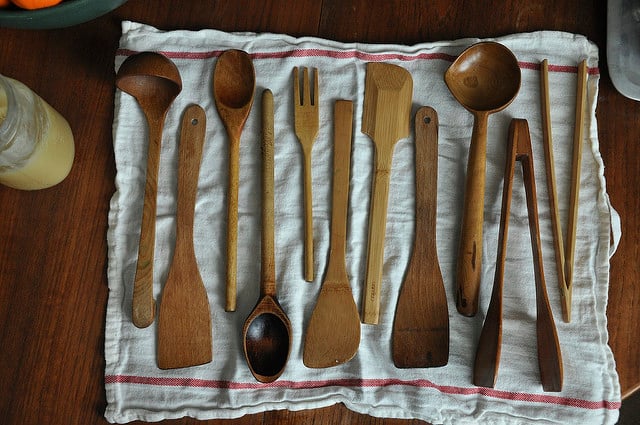
Once the butter is cool to the touch, start smoothing it into your spoons, spatulas, boards and bowls. Let them sit for a couple of hours (or more – sometimes I leave them overnight). When most the butter is absorbed, rub everything down with a clean cloth and return them to normal use.
One of the happy side effects of lubing all your wooden tools with spoon butter is that your hands will feel incredibly soft and well-tended (I think that’s why I like to butter my spoons this time of year, my hands are dry and cracked December through March). I also love how appealingly luminous all the wood looks after it’s been treated.
The spoon butter will keep in a closed jar under the sink or in the pantry for quite some time. It would also make a very nice thing to share. I’ve been imagining a wedding shower gift of a couple sturdy-yet-graceful spoons paired with a small jar of spoon butter and a charming note card with instructions on how to use it. Thoughtful and useful, don’t you think?
*I get my beeswax from Bee Natural in Reading Terminal Market. I don’t remember exactly how much it cost last time I bought it, but I don’t remember it being particularly outrageous.
**If you object to mineral oil, you can also use coconut oil. However, there is a downside to making the swap. Coconut oil is more prone to rancidity than mineral oil and so it will shorten the shelf life of your spoon butter. Consider making a half batch if you plan on using coconut oil, so that you’re able to use it up before it spoils.

First time to make spoon butter. Nine T of beeswax to three T of sunflower oil. Problem is its not creamy, too hard to spread on wood tools. Any advice.
Set the jar in a bowl of warm water for a few minutes to soften it.
Is there a recipe? My friend just introduced me to spoon butter. The link doesn’t work.
The recipe is in the third paragraph of the blog post. It’s just beeswax and mineral oil.
Im not sure exactly where to start with this but I think one can a lot better than mineral oil and beeswax while still being foodsafe.
First of all, mineral oil is simply refined crude oil, nothing more. Sure, it’s been used for years as way to “unclog” ones digestive tract but would you drink 10w30? The second problem with mineral oil is that it NEVER cures or hardens. Pour a little blob on a plate and leave it. Come back in 10 years and it will still be a slimy liquid.
Now, when you are cleaning dishes, pots, utensils in your kitchen, you use soap of some kind, right? Why? Two reasons: to kill bacteria and to remove OIL and grease. What do you think happens to the mineral oil you applied to your spoons, bowls and cutting boards? Yup, you leach it out, wash it away and your kitchen tools dry out, crack and split.
Beeswax is virtually useless as a wood finish. It is incredibly soft and gets worn off (into your food. Mmmm, yummy) and washed away when you clean it. Seriously, to have any effect whatsoever you must use beeswax after EVERY cleaning. Are you willing to do that? Sorry, my time is more valuable than that.
One of the commenters mentioned using sesame oil. I cannot comment of this because I don’t know if it cures and hardens. I make wooden bowls for a living. I make each one by hand and I sign my name to the bottom of each one so quality, food-safety, ease and durability are very important to me, my business and my reputation. Because of that, I use walnut oil, specifically Mike Mahoney’s Utility Finish. Walnut oil soaks into the wood fibers and cures thus, it doesn’t get washed away. It is completely food safe and I have not found a better finish for my work.
If you use wooden bowls, cutting boards or utensils, do yourself a favour and order a bottle of Mike’s finish (over at http://www.bowlmakerinc.com). A small bottle will last AGES unless you bathe in the stuff.
Hope this helps some of you.
Kind regards,
Steve
Marisa, where did you get your kitchen/tea towels? I’ve been on the hunt for some good, lint free ones that will last a while. Are they linen or cotten? If anyone else has suggestions, I would appreciate it!
They look like IKEA dish towels. I love them! They’re lint free and very inexpensive.
Comment 66 is just the comment that I’d been scrolling and waiting for….very authoritative and to the point! THANK YOU!
Here is what is recommended by Edwards Smith, fine woodworker.
http://www.edwardssmithfinewoodworking.com/blog/2010/05/29/making-wooden-spoons/
Sanding and Oiling the Spoons
What remains is to hand sand the spoon. I do not go above 220 grit as these spoons are for cooking and finer finishes are not important. I oil my spoons with sesame oil. I used to use mineral oil but since this is a petroleum based product and not renewable, I feel more comfortable using a vegetable oil.
I choose sesame oil as it has the longest shelf life of all the non-drying oils and does not become rancid easily. This is due to unique antioxidants found in sesame oil and not in other vegetable oils.
I don’t recommend olive oil as it spoils very quickly and you get a tacky residue building up on the utensil. A food safe drying oil such as tung oil can also be used.
Care of the finished product is very easy. Just wash in soapy water and let it air dry. Over the course of time the surface may become whitened due to fragmentation of the fibers with repeated use and washings. Just apply another coat of sesame oil and the finish is restored.
For heavily used spoons a light sanding before reapplication of the oil is all that is needed. A well cared for spoon can last for generations. Below is a picture of spoons ready for oiling.
Would it be alright to lightly sand the cutting board, wooden spoons, etc., before applying the spoon butter?
Just to make sure I understand…the water gets mixed in with the beeswax and oil, or is just used in the saucepan a la a double boiler?
The water is only to be used in the double boiler. Do not mix it into the oil and beeswax.
I’m so glad someone else asked this question since that’s exactly what I thought when I read the instructions.
I have since clarified the instructions in the hopes that they are less confusing.
The major problem with this recipe is Mineral oil really shouldn’t be consumed. It is a by-product of distilling oil for gasoline (honestly, I’m not being hyperbolic here.) It is difficult to find oils that don’t go rancid but that aren’t, well basically, poison.
Would be interesting to know if you could use an edible oil with the beeswax to the same effect.
Thanks!
I’ve not done it, but I hear it’s possible. If you try it, please let us know how it worked!
Sometimes the simplest ideas are the best. Thanks for sharing this wonderful tip!
I love all your wooden utensils. I think maybe I am going to treat my kitchen island wooden top to this treatment. I live in the desert, so it is pretty dry for most of the year.
Nice set of wooden spoons.